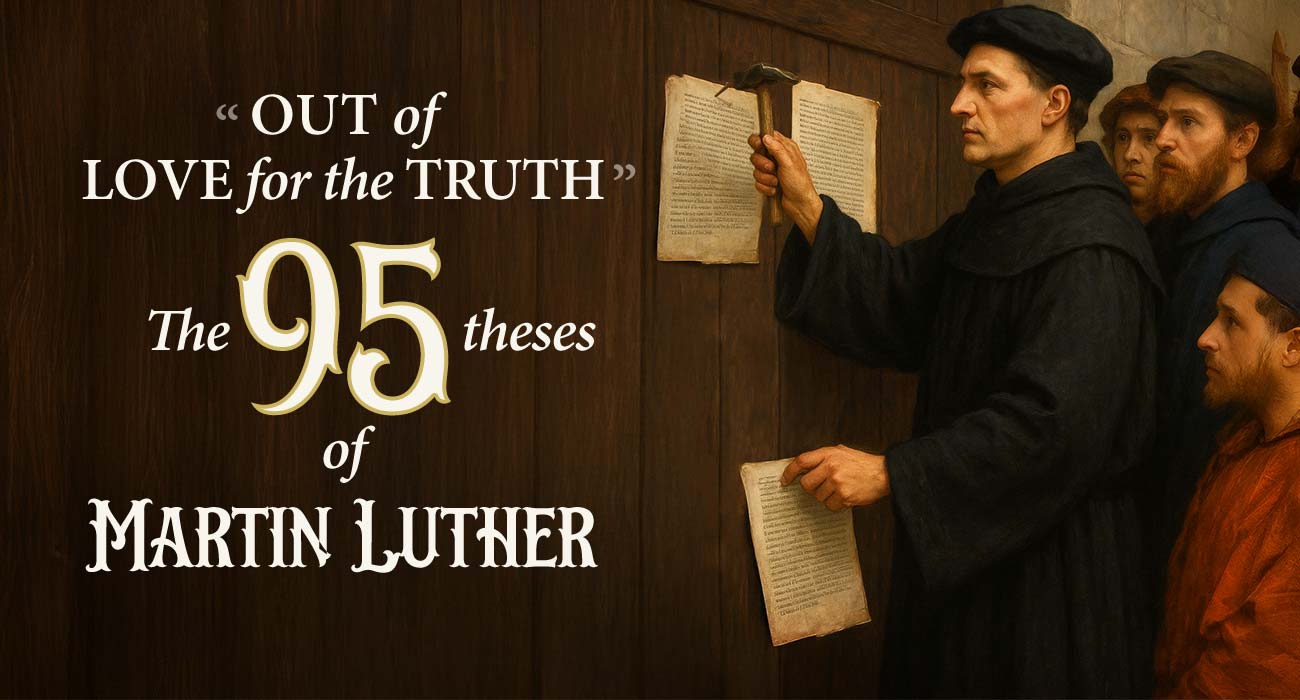
“Out of Love for the Truth”:
The 95 Theses of Martin Luther
 uther’s 95 Theses, nailed to a church door on All Hallow’s Eve, 1517, did far more than spark a theological debate; it unleashed a spiritual and cultural revival that reshaped the Western world. At this early date in Luther’s study and reform, his theology had not fully developed and so he did not yet contend against the existence of purgatory or the supremacy of the pope in church matters. Instead he wished for an open discussion emphasizing those church practices he saw as antithetical to the Bible’s teaching. uther’s 95 Theses, nailed to a church door on All Hallow’s Eve, 1517, did far more than spark a theological debate; it unleashed a spiritual and cultural revival that reshaped the Western world. At this early date in Luther’s study and reform, his theology had not fully developed and so he did not yet contend against the existence of purgatory or the supremacy of the pope in church matters. Instead he wished for an open discussion emphasizing those church practices he saw as antithetical to the Bible’s teaching.
At its heart, the document was a cry for the Gospel in its purest form: salvation by grace alone, through faith alone, in Christ alone. By exposing the sale of indulgences as a grotesque distortion of divine mercy, Luther tore the veil off a system that had turned forgiveness into a transaction. He declared that a repentant heart, trusting in Christ’s finished work, receives full pardon—freely, immediately, without money or mediators. This was not just reform; it was a return to the very soul of Christianity, a rediscovery of the New Testament’s radical message of unearned grace.
Below are a selected few of these theses, highlighting the core of Luther’s grievances against apostasy and showing the Christ-centered theology that he espoused.
Luther’s Introduction
Out of love for the truth and from desire to elucidate it, the Reverend Father Martin Luther, Master of Arts and Sacred Theology, and ordinary lecturer therein at Wittenberg, intends to defend the following statements and to dispute on them in that place. Therefore he asks that those who cannot be present and dispute with him orally shall do so in their absence by letter. In the name of our Lord Jesus Christ, Amen.
- (1) When our Lord and Master Jesus Christ said, “Repent” (Mt 4:17), he willed the entire life of believers to be one of repentance.
- (2) This word cannot be understood as referring to the sacrament of penance, that is, confession and satisfaction, as administered by the clergy.
- (21) Thus those indulgence preachers are in error who say that a man is absolved from every penalty and saved by papal indulgences.
- (27) They preach only human doctrines who say that as soon as the money clinks into the money chest, the soul flies out of purgatory.
- (28) It is certain that when money clinks in the money chest, greed and avarice can be increased; but when the church intercedes, the result is in the hands of God alone.
- (32) Those who believe that they can be certain of their salvation because they have indulgence letters will be eternally damned, together with their teachers.
- (37) Any true Christian, whether living or dead, participates in all the blessings of Christ and the church; and this is granted him by God, even without indulgence letters.
- (45) Christians are to be taught that he who sees a needy man and passes him by, yet gives his money for indulgences, does not buy papal indulgences but God’s wrath.
- (90) To repress these very sharp arguments of the laity [concerns about indulgences] by force alone, and not to resolve them by giving reasons, is to expose the church and the pope to the ridicule of their enemies and to make Christians unhappy.
- (92) Away, then, with all those prophets who say to the people of Christ, “Peace, peace,” and there is no peace! (Jer 6:14)
- (94) Christians should be exhorted to be diligent in following Christ, their Head, through penalties, death and hell.
- (95) And thus be confident of entering into heaven through many tribulations rather than through the false security of peace (Acts 14:22).
|