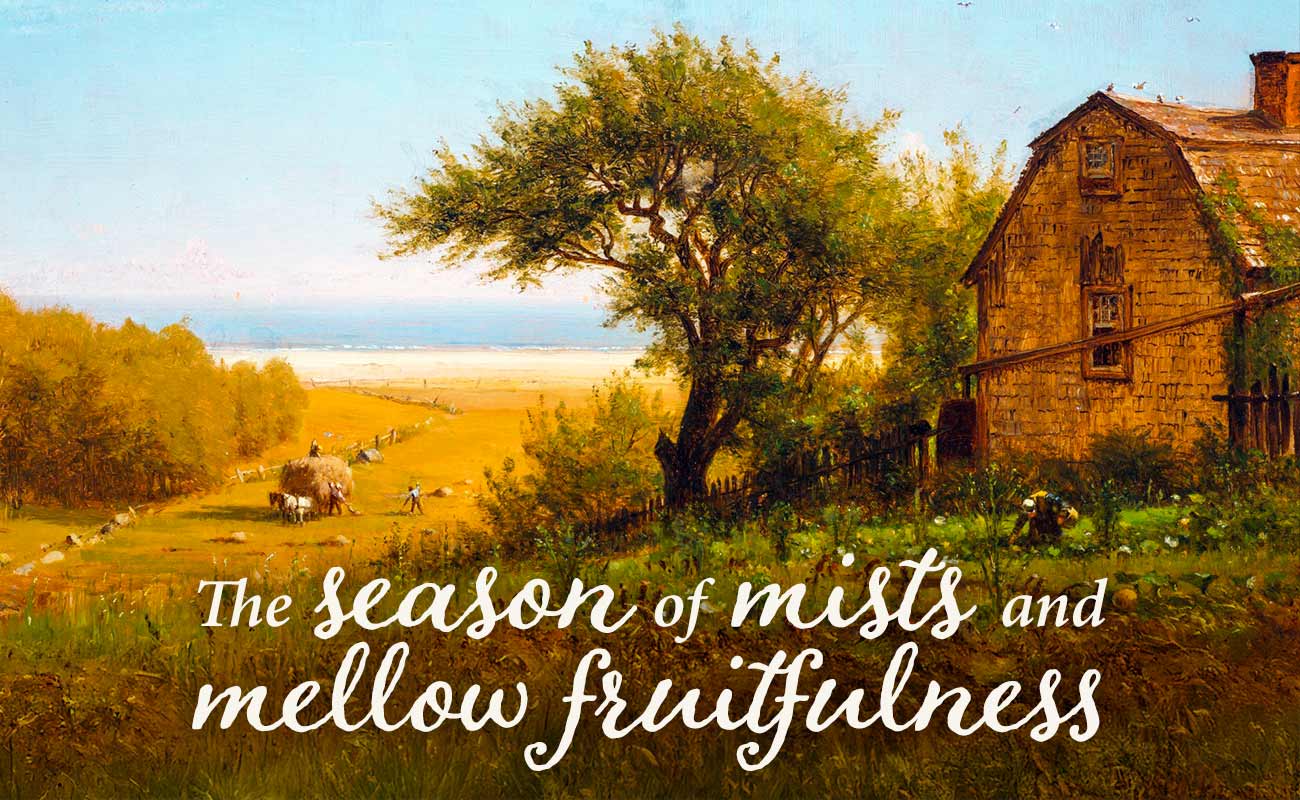
The Season of Mists
and Mellow Fruitfulness
 s we enter the month of November, we at Landmark Events want to wish you a month full of gratitude and delight! s we enter the month of November, we at Landmark Events want to wish you a month full of gratitude and delight!
Autumn is that evocative time of year that should make us pause and ponder the beauty that is to be had in the dying: to self, to others, for the advancement of greater good. Fruitfulness often comes when we are most ready to relinquish ourselves to God’s will, like the harvest that comes not only to feed with its bounty but to humbly make possible the fertile seed. One death this year ensures the perpetuation of a greater yield in the next.
Bless the poets for their capacity to capture in words these grand feelings we experience with this change! All the stirrings up we feel when driving through reddened countrysides or gathering with beloved family in the holiday season or when we catch the tingle of that first giddy chill that marks a changed season truly underway.
This is our Father’s world, and there are many ways to praise Him for it and for the endless lessons planted within. The theologian G.K. Chesterton once wrote that in his opinion he would “—maintain that thanks are the highest form of thought, and that gratitude is happiness doubled by wonder.”
If we were to remain silent on these things, even the stones would cry out. Sometimes they have—even in the form of humanist poets, such as the ever talented John Keats. While he possessed great wonder in the creation, sadly he refused to marvel at its Creator. Yet even Keats could not help but rely on the imagery of the Psalmist in his poems, imagery he learned at his pious mother’s knee. Below is the young Keats’ last completed poem before his death at the age of twenty five after a long fight with tuberculosis. There is no record of a conversion to Christ in those final days, but there is much correspondence where Keats questions and wrestles with the nature of God and everlasting life.
We can be the happy beneficiaries of such a poet’s wonderment, one that was given the eyes of a dying man, to appreciate all that is thrilling about both home and change. We can read his well expressed sentiments—so like our own, despite the passing of centuries—and in turn give God the glory for doing all things well, and for mixing the season of decay with that of harvest, to remind us there is no lasting grief in picking up our cross and following the Man of Sorrows in the way!

“To Autumn,” by John Keats
Season of mists and mellow fruitfulness,
Close bosom-friend of the maturing sun;
Conspiring with him how to load and bless
With fruit the vines that round the thatch-eves run;
To bend with apples the moss’d cottage-trees,
And fill all fruit with ripeness to the core;
To swell the gourd, and plump the hazel shells
With a sweet kernel; to set budding more,
And still more, later flowers for the bees,
Until they think warm days will never cease,
For summer has o’er-brimm’d their clammy cells.
Who hath not seen thee oft amid thy store?
Sometimes whoever seeks abroad may find
Thee sitting careless on a granary floor,
Thy hair soft-lifted by the winnowing wind;
Or on a half-reap’d furrow sound asleep,
Drows’d with the fume of poppies, while thy hook
Spares the next swath and all its twined flowers:
And sometimes like a gleaner thou dost keep
Steady thy laden head across a brook;
Or by a cyder-press, with patient look,
Thou watchest the last oozings hours by hours.
Where are the songs of spring? Ay, Where are they?
Think not of them, thou hast thy music too,—
While barred clouds bloom the soft-dying day,
And touch the stubble-plains with rosy hue;
Then in a wailful choir the small gnats mourn
Among the river sallows, borne aloft
Or sinking as the light wind lives or dies;
And full-grown lambs loud bleat from hilly bourn;
Hedge-crickets sing; and now with treble soft
The red-breast whistles from a garden-croft;
And gathering swallows twitter in the skies.

|