

“For we are God’s handiwork, created in Christ Jesus to do good works, which God prepared in advance for us to do.”—Ephesians 2:10
The Other Side of the Night: RMS Carpathia, April 14-15, 1912
 he tragedy and heroism that marked the sinking of the RMS Titanic amidst the vast ice fields of the North Atlantic has rightly kept our fascination and admiration for over a century. Among the stirring stories often repeated are those of the two telegraph operators, Jack Phillips and Harold Bride. Both bravely stayed at their posts, sending out the chilling distress call, until the electricity gave out and the ship split in two—one perished, the other lived on with health complications.
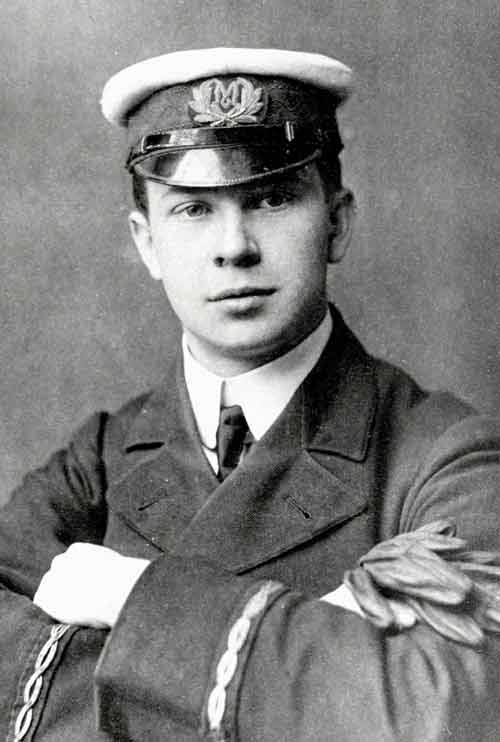
John George “Jack” Phillips (1887-1912)
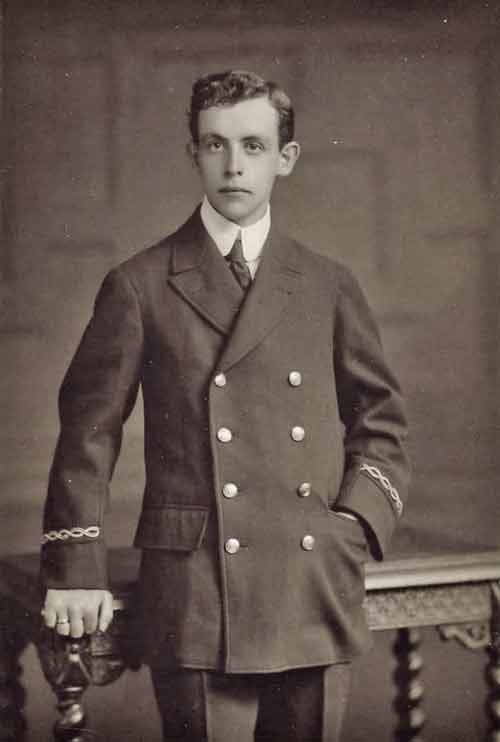
Harold Sydney Bride (1890-1956)
But who were these brave operators trying so desperately to contact? Cape Race on the Nova Scotia coast, for one, but more opportune were any vessels in the nearby vicinity. For the three hours it took the mighty vessel to sink, they sent messages begging for anyone to come alongside and help take on passengers who would be without seats in the too few lifeboats. Did they successfully make contact with anyone in that late hour? They did, and that is the other side of that dreadful night, as D.A. Butler called it in his book, The Other Side of the Night, in which he explores the subject in depth. It highlights a deeply stirring drama of human nature, and of the often gigantic impact that our moral responses hold when calamity strikes.
It turns out there were multiple ships who answered and heard Titanic’s call for help. Among them was Titanic’s sister ship, the RMS Olympic who, after picking up Phillips’ report of a collision, telegraphed back with the placid inquiry, “So are you steering south to meet us?” Phillips tapped back in exasperation, “We are putting the women in the boats,” feeling that should convey the dire situation to anyone listening. Far away the Frankfurt’s operator, who had previously ignored any communication not addressed directly to his ship, broke in with, “Are there any ships around you already?” Then, a few seconds later: “The Frankfurt wishes to know what is the matter? We are ten hours away.”
All this as the water rushed into the lower levels in a torrent and the electricity began to flicker.
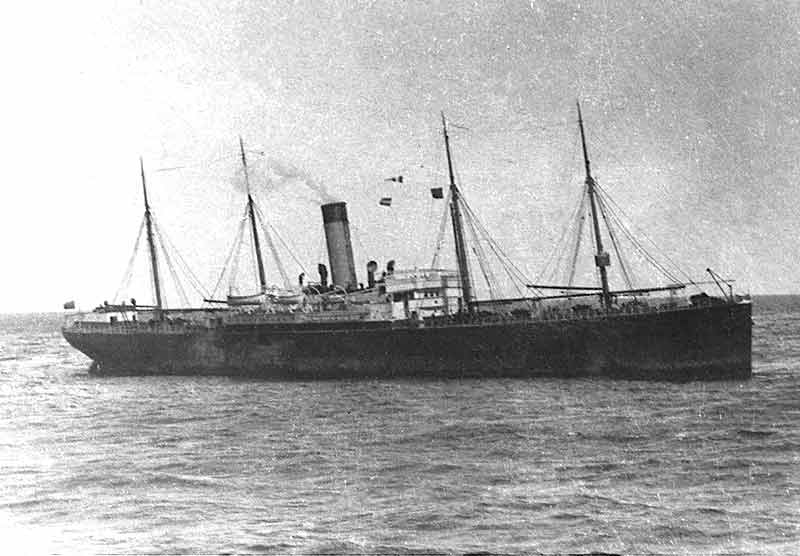
The Californian on the morning after Titanic sank; photo taken from Carpathia
Infamously, the Californian was an estimated mere six miles away, which in the event of a rescue would have enabled them to reach the Titanic with plenty of time to spare before her sinking. Close enough that her senior officers were witness to five successive distress rockets that Titanic sent up, and had time to observe and comment that the distant ships’ lights “looked queer” through their telescopes—Titanic was listing to such a degree by that time that six floors were already submerged on her stern. Close enough that Titanic’s fourth officer Mr. Boxhall, who was sending the rockets up personally amidst the pandemonium of loading the lifeboats, was witnessed to swear directly at the Californian’s distant lights for their fatal inertia.
The Californian’s captain, Stanley Lord, had been asleep already when notified by his officers that a ship appeared to be firing distress rockets in the distance. He encouraged his men to use the method of flashing a morse lamp at the distant ship, but declined to wake up his own telegraph operator to check the comms. Captain Lord then retired back to bed, possibly inebriated, leaving his crew with a great disincentive to wake him for any news.
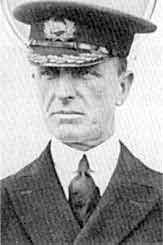
Stanley Phillip Lord (1877-1962), captain of the SS Californian
Meanwhile, some fifty-eight miles away from the site of unfolding disaster, the Cunard liner RMS Carpathia was steaming peacefully toward the Mediterranean under the command of Captain Arthur Rostron. The Cunard Line was a respectable but modest rival of the Titanic’s White Star Line, but like all good passenger steamers of day, she was fitted with the revolutionary wireless technology that enabled ships to pass radio messages between themselves even at great distances. To work this luxury innovation, Carpathia had a single wireless operator, twenty-one-year-old Harold Cottam.
It was a little after midnight on the 15th that Cottam left Carpathia’s bridge and returned to his wireless office, having just handed several routine messages to First Officer Horace Dean. Once there he decided against going to sleep and instead sat down to his telegraph device to relay a number of messages in need of forwarding for the new White Star Liner Titanic. He thought he would remind Jack Phillips, Titanic’s senior operator whom he knew professionally, about those waiting messages. It took a few minutes for his telegraph set to warm up, then he politely tapped out a call to the Titanic, quickly receiving a curt go ahead.
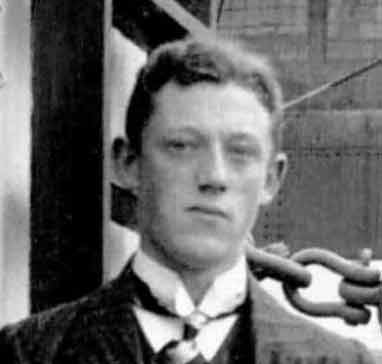
Harold Thomas Cottam (1891-1984)
“Good morning, old man [GM OM].” Cottam typed out cheerily, “Do you know there are messages for you at Cape Race?”
What Cottam heard next made his blood run cold. Instead of the expected jaunty reply came the dreaded “CQD…CQD…SOS…SOS…CQD…MGY. Come at once. We have struck a berg. It’s a CQD (come quick, danger), old man. Position 41.46 N, 50.14 W.”
Cottam later reported being so stunned he did nothing for a moment, then tapped back asking Phillips if he should tell Carpathia’s captain. The reply was immediate: “Yes, quick.”
Cottam then raced to the bridge and breathlessly told First Officer Dean. Dean didn’t hesitate—he bolted down the ladder, through the chart-room and into their captain’s cabin with Cottam hard on his heels. Without the slightest prevarication upon hearing the dire report, Captain Rostron told Dean to order the ship around, and only after doing so grilled Cottam on the details. Being a moderate man, and as informed as any of Titanic’s boasted engineering, he seemed to find the possibility of her sinking as incredible as the rest. He inquired twice if Cottam had not misunderstood. His young telegraph operator insisted he had not, Titanic was sending out every distress call in the books, old and new. Never once did Rostron ask if any other ship was nearer or better suited to answer the call and once convinced of his duty, Captain Rostron swung into action, immediately ordering Cottam to assure Jack Phillips they were coming as fast as they could.
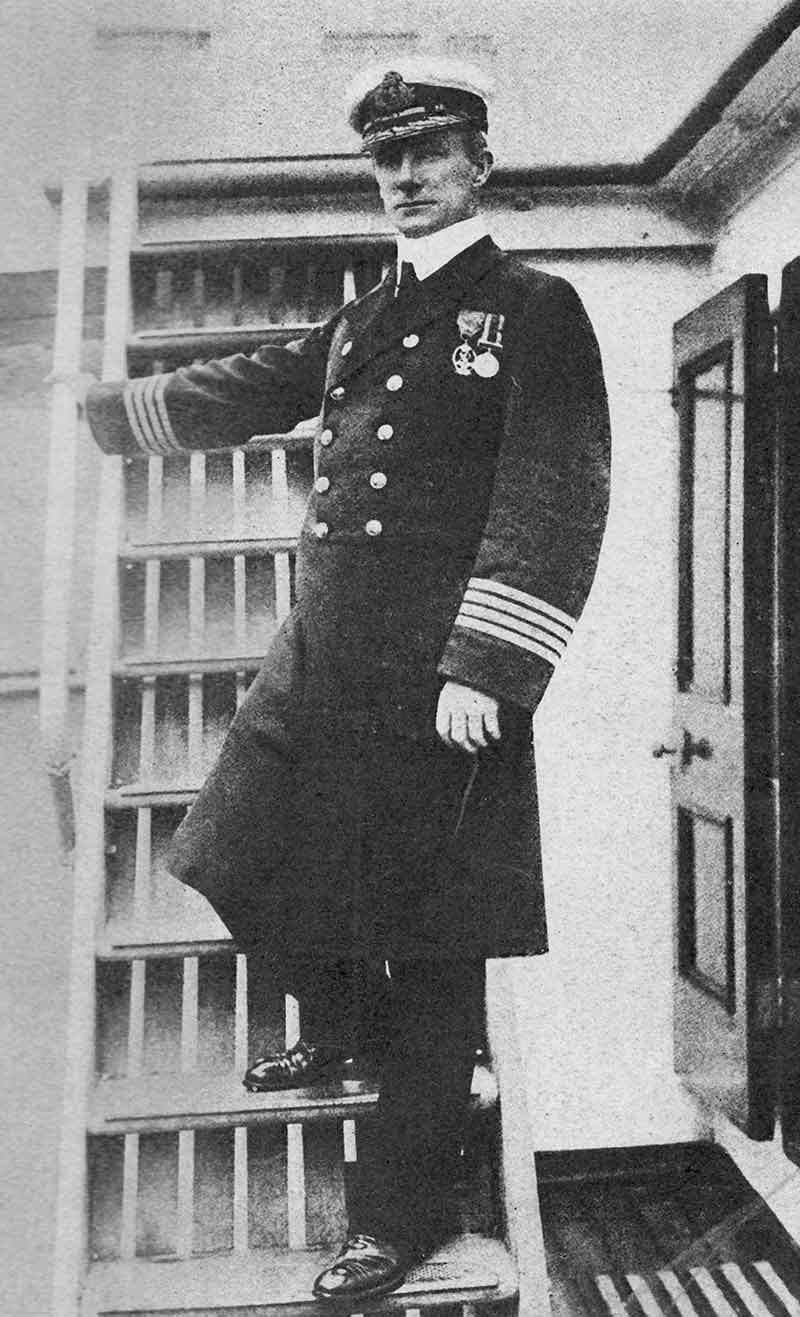
Sir Arthur Henry Rostron (1869-1940), captain of the RMS Carpathia
What followed was one of the most remarkable acts of seamanship and courage in maritime history.
Carpathia was a modest fourteen-knot ship, built for comfortable service rather than speed. Yet to rescue her rival, Rostron demanded every ounce of power her engines could produce. He ordered the off-duty stokers roused and made to shovel coal, the ship’s heating and hot water were cut off from passengers so that every scrap of steam could be diverted to the boilers, and the vessel was thus pushed in every way beyond her normal limits. Titanic carried three thousand souls, and Carpathia was already full, so dining rooms and saloons were noisily rearranged into makeshift berths, with blankets, hot soup, and medical stations organized in the bold expectation of a complete roster of survivors. Above decks, gangway doors were opened, rope ladders and cargo nets rigged, chair slings fashioned to lift the injured and the children from lifeboats.
Carpathia’s Chief Steward, a most unflappable man named Hughes, gathered his stewards and stewardesses together, and knowing they would work harder if told what their mission was, explained to them that the mighty Titanic and her thousands of souls were depending on them and their preparedness alone for rescue. “Every man to his post and let him do his duty like a true Englishman,” he charged them, “As the situation calls for it, let us add another glorious page to British history.”
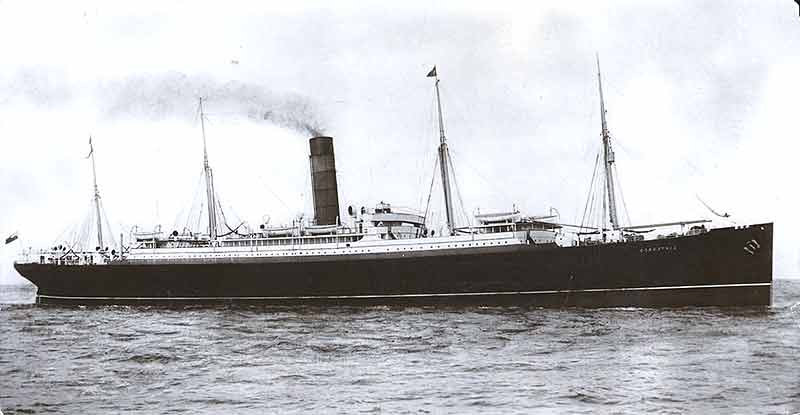
The RMS Carpathia
The middle-of-the-night commotion began to arouse Carpathia’s guests, along with the perturbing symptoms of speed such as their bunks vibrating and the pistons banging underfoot. “We are going north like hell” the Quartermaster informed those who asked, and many upon learning of the rescue attempt they were sudden accessories to, pitched in their efforts and belongings for the relief of the anticipated survivors.
Through fields of ice—the same as had just dealt Titanic her fatal blow—with growlers scraping along the hull, and bergs looming suddenly out of the blackness, the Carpathia raced on for three and a half hours at an unheard-of seventeen knots. Captain Rostron reportedly covered the boiler’s pressure gauge so as not to alarm his crew over minor details like a boiler’s imminent risk of bursting. Despite such haste, he was also determined that the Carpathia would not meet the same fate as the ship she was rushing to aid. Rostron had an extra man posted in the crow’s nest, two lookouts in the bow, extra hands posted on both bridge wings, and Second Officer James Bisset, who had especially keen eyesight, posted on the starboard bridge wing.
Having done all he could do, the devout Rostron attended to one last duty. Second Officer Bisset noticed it first, then so did the others on the bridge—the Captain was standing toward the back of the bridge holding his cap an inch or two off his head, eyes closed, lips moving in silent prayer. Later Rostron would say of Carpathia’s miraculous feat, “I can only conclude another Hand than mine was on the helm that night.”
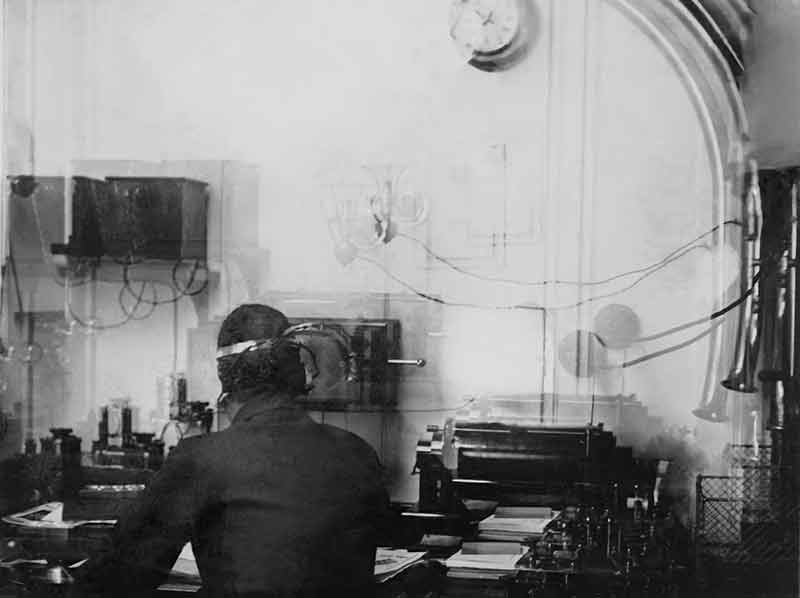
Harold Bride hard at work in the wireless room aboard the RMS Titanic—this is the only known picture of this room, taken by passenger and Catholic priest, Francis Browne
It was a quarter past one aboard Titanic when her captain, Edward Smith, informed operator Phillips that the power was beginning to fade. Maybe ten minutes later he told him the water was reaching the engine rooms. At 1:45 a.m. Phillips, still at his post mechanically tapping out distress calls to any who might hear, called to the Carpathia again, “Come as quickly as possible, old man; engine room filling up to the boilers.”
The way the wireless system worked was such that any ships who were able to pick up these communications between Titanic and Carpathia forwarded them on to the Marconi station at Cape Race, Nova Scotia, and they in turn forwarded them inland to cities like New York and Philadelphia. So it was that this unfolding tragedy and the strenuous exertions of the would-be saviors were read in real time by those awake inland and powerless to do ought but pray for the outcome.
At two o’clock Titanic’s Captain had exhorted Phillips and Bride, “Men, you have done your full duty. You can do no more. Abandon your cabin. Now it’s every man for himself.” According to Harold Bride who survived the night, Phillips had glanced up at him, then went right back to Morsing. The Captain continued: “You look out for yourselves; I release you. That’s the way of it at this kind of time.” Then he turned and left the wireless shack for the last time. Without a word, Phillips continued to tap out his distress call. The lights were starting to take on an orange glow as the power began slowly fading. Phillips kept tinkering with the set, trying to adjust the spark to make it stronger. At 2:10 he tapped out two “Vs” as a test; at 2:17, the distant Virginian heard a faint “CQD…CQ—” that ended abruptly. That proved the last transmission anyone heard from Titanic. Aboard Carpathia, Cottam desperately tried to make contact, but without success. Despite eventually tearing herself apart in her strain to make all speed, the rescue ship would prove two hours late for those who perished in the frigid North Atlantic, the dauntless Jack Phillips included.
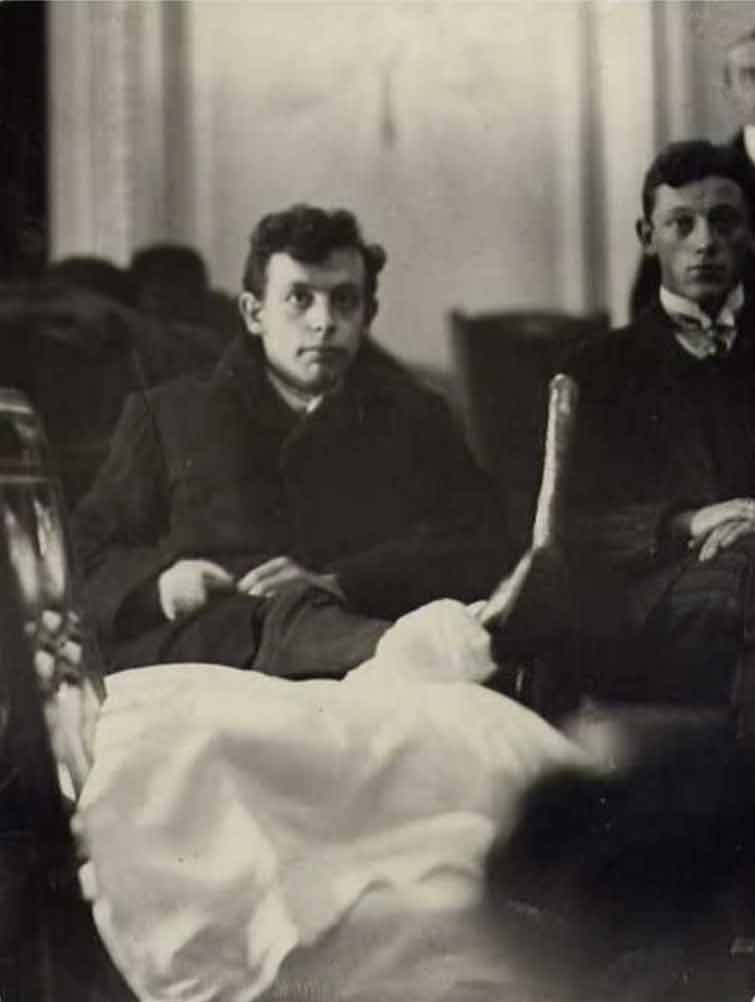
Wireless operators Harold Bride of the Titanic (seated with bandaged feet) and Harold Cottam of the Carpathia during the U.S. Senate inquiry into Titanic’s sinking
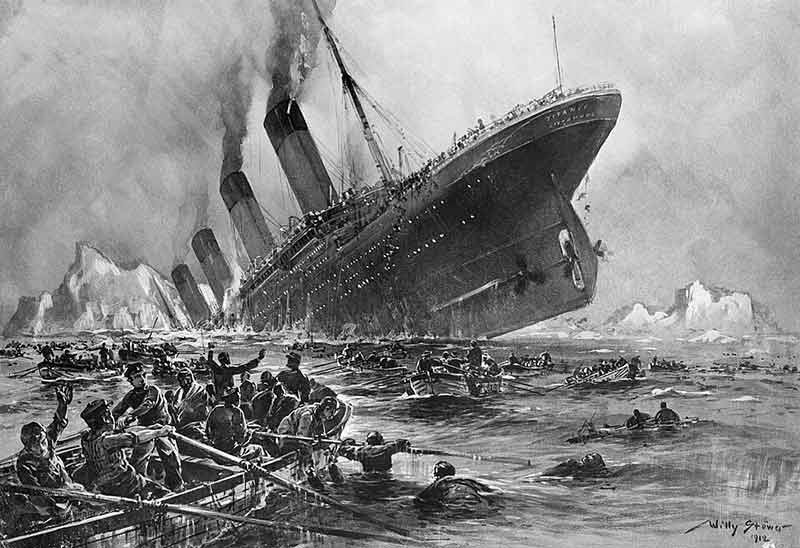
An artist’s rendition of the sinking of the RMS Titanic
As dawn broke over the icy sea, they saw green flares. Knowing the odds were impossible, Rostron still harbored hope that this meant Titanic was yet afloat. It was instead the first of her lifeboats hailing them, relieved beyond expression to be found amidst the huge Atlantic ice floes after hours adrift in the cold, and after spectating one of the greatest—and loudest—human calamities witnessed at sea up to that point. Rostron recorded the moment: “I swung the ship round and so came alongside the first of the Titanic’s boats on the starboard side. Devoutly thankful I was that the long race was over.”
One by one, the boats were emptied—women and children first, the injured and the frozen helped aboard with infinite care. Over the next four hours, Carpathia’s crew and passengers took in 705 survivors, a goodly lot but devastatingly scant when considering the inferred death toll of 1,500. Hot drinks were pressed into numb hands, coats given to the shivering, prayer vigils were held. Rostron offered his own quarters to the most distressed. When the last survivor was safely aboard, the Carpathia turned away from the grave of the great ship, all sick at heart that there were no more to be saved. Captain Rostron would later say with characteristic humility: “I thank God Almighty that I was within wireless hailing distance, and that I got there in time to pick up every one of the 705 survivors of the Titanic wreck.”
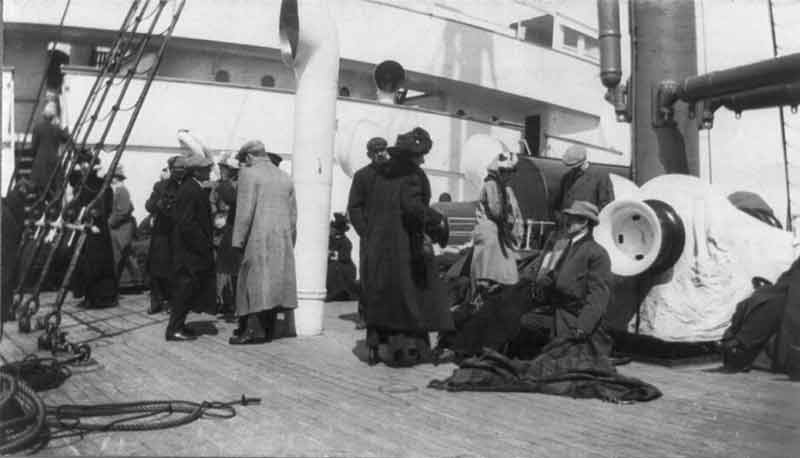
A group of unknown Titanic survivors aboard their rescue ship, the Carpathia
In the weeks to follow there would be other ships sent out—to collect any remains. Multiple official inquiries were held, investigating every aspect of the disaster and critiquing each ships’ response to it. What had been clear to the officers of the Titanic became clear to the public in eagerly sought transcripts of the hearings. Talks of insurance fraud, lifeboat quotas and the like tended to obscure the incredible story that belonged to the Carpathia’s fearless crew, their bravery and urgency, and their real life foil, the dormant Californian.
Captain Rostron’s actions that night are widely praised as a marvel “of systematic preparation and completeness to duty,” and those he rescued would bless him for such efforts until the day they died. These are the stories that, in a Christian’s view of history, quietly shape how we remember even the most wretched of catastrophes, not only for the horror, but for the light of honor that refuses to be extinguished.
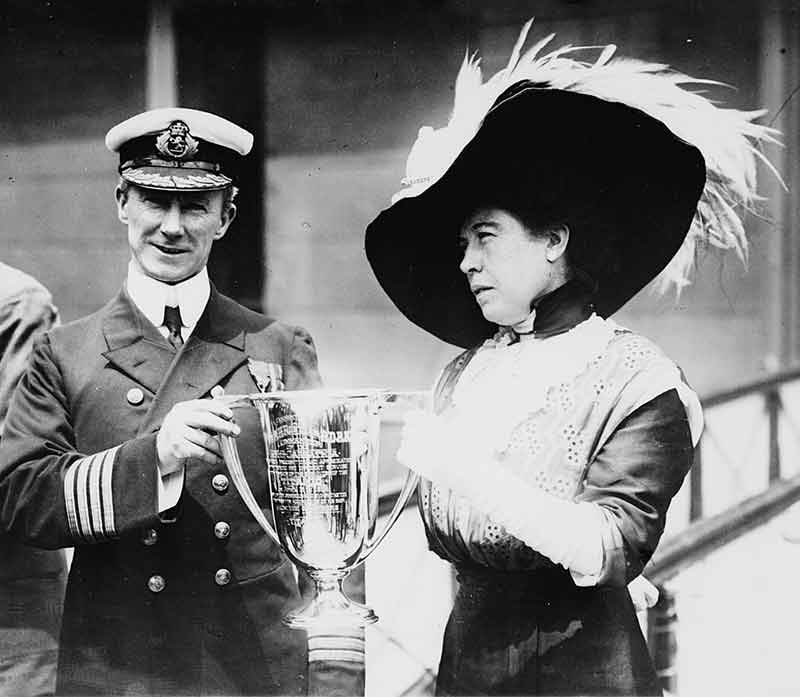
Titanic survivor Molly Brown presenting an award to Captain Arthur Henry Rostron of the Carpathia for his heroism in risking all to save survivors
May we always remember the Titanic, but the Carpathia and the Californian, too! May we always be ready to be used of God for good deeds as Captain Rostron was, for, “who knoweth whether thou art come to the kingdom for such a time as this?”
Image Credits: 1 Jack Phillips (wikipedia.org) 2 Harold Bride (wikipedia.org) 3 Californian (wikipedia.org) 4 Capt. Stanley Lord (wikipedia.org) 5 Capt. Arthur Henry Rostron (wikipedia.org) 6 Harold Cottam (wikipedia.org) 7 Carpathia (wikipedia.org) 8 Titanic’s wireless room (wikipedia.org) 9 Bride & Cottam (wikipedia.org) 10 Titanic sinking (wikipedia.org) 11 Titanic survivors aboard the Carpathia (wikipedia.org) 12 Molly Brown and Capt. Rostron (wikipedia.org)