The Martyrdom of St. Polyeuctus, AD 259

2026-01-07T10:24:14-06:00January 7, 2026|HH 2026|

“Remember the word that I said to you, ‘A slave is not greater than his master.’ If they persecuted Me, they will persecute you as well; if they followed My word, they will follow yours also.” —John 15:20

The Martyrdom of St. Polyeuctus, January 10, AD 259

Throughout the history of the Roman Empire, devout Christians can be found among the ranks of its elite military. They served despite tensions of conscience arising from the army’s integral polytheistic practices, a tradition of pagan sacrifices, and association with unjust violence, all being in conflict with Christian morality.

We recall the Biblical accounts which highlight those positive portrayals of Roman centurions, such as the one in Capernaum whose profound faith prompted Jesus to heal his paralyzed servant, whereupon our Savior marveled that “I have not found anyone in Israel with such great faith”. There was also the centurion at the crucifixion who, witnessing Jesus’ death, confessed, “Truly this Man was the Son of God”. Then again, we have Cornelius, in the book of Acts, who became the first Gentile convert baptized by the Apostle Peter. Each account of these Roman soldiers and their testimony exemplifies the redeeming love of God, and is placed in stark contrast to the rejection that Jewish religious leaders displayed towards the promised Messiah.


Christ and the Centurion, by Sebastiano Ricci

Later instances in history underscore the growing presence and impact of Christian soldiers in the Empire’s legions, all of whom navigated persecution while contributing to the grand dissemination of the faith. By the late second century, evidence like funerary inscriptions confirm that they faced expulsion or martyrdom during “purges” by various emperors. Famously, Saint George (patron saint of England), a high-ranking tribune in the Praetorian Guard under Diocletian, exemplified this: born around AD 280 in Cappadocia, he was brutally tortured and beheaded in AD 303 for defying orders to sacrifice to Roman gods. All of these brave witnesses for Christ eventually paved the way for Emperor Constantine’s conversion in AD 312 and Christianity’s eventual dominance over the Roman Empire, transforming Europe’s religious landscape forever.


Emperor Constantine (AD 272-337)

One such soldier, born in the shadowed annals of the third-century Roman Empire, was named Polyeuctus. Possessed of considerable wealth and stature, he belonged to a Greek family during a time when the Roman Empire stretched far to the east, occupying vast swaths of land in what later became known as Byzantium—now including modern day Turkey and the Balkans.


A map of Europe, the Mediterranean region and beyond, showing the extent of the Roman Empire as of AD 125

Polyeuctus rose to the rank of a distinguished officer and was stationed in the rugged outpost of Melitene, in what is now modern day Armenia, a vital frontier fortress. He was said to command respect among his troops, living a life marked by moral integrity despite adhering to pagan practices. He married young and was blessed with children, enjoying the privileges and education that came with high society. And yet, the hand of God was already upon him when his closest bond became that which he shared with his steadfast comrade Nearchus, a fellow officer and fervent Christian whose adoration of his God pierced the veil of Polyeuctus’ worldly complacency.


Polyeuctus (unknown-AD 259)


Modern-day Malatya, Turkey, near the ancient city of Melitene

Nearchus, already baptized and bold in his faith despite the fierce persecutions surrounding him, grieved deeply over Polyeuctus’ unbelief, fearing that death would eternally separate them. This era was fraught with peril for believers, as an edict came down from Emperor Valerian* around AD 257–260, unleashing a ferocious wave of oppression. This edict carried with it the added atrocity of demanding ritual sacrifices to the pagan gods to shore up the crumbling empire’s loyalty and its supposed need for “divine favor” amid cascading crises: barbarian invasions, plague, economic ruin, and humiliating defeats by the Persians.


Emperor Valerian (c. AD 199-260 or 264)


Roman artifact showing a family burning incense on an altar to one of their pantheon of gods or goddesses

Amidst such hostility and turmoil, the heart of Polyeuctus was nevertheless stirred by his beloved Nearchus’ anguished prayers for him. He became fascinated by the Gospel his friend espoused, its principles of mercy and charity which were in opposition to all that he had known before. Then came a Divine intrusion: a profound dream in which Polyeuctus later said Christ Himself appeared to him and ignited an unquenchable fire of conviction within his soul. In that instant, from the moment he awoke, the Spirit’s regenerating power transformed this pagan soldier into a bold confessor of Christ.


Polyeuctus’ and Nearchus’ legion—The Legio XII Fulminata or “Thunderbolt Twelfth Legion”—in battle against the Quadis

With the unbridled zeal of a new convert, and with passion surpassing prudence, Polyeuctus stormed into the public square, ripped asunder the imperial edict that condemned Christians, and proceeded to tear down the lifeless idols surrounding him that mocked the living God. We can imagine what a disruption such a scene made, with him being so distinguished a figure in his district, and committing these acts of defiance while in the uniform of a soldier of the Empire.

Almost immediately he was seized by the authorities and tortured, while his weeping wife, children, and father-in-law implored him to recant his new religion for the sake of an earthly reprieve. Yet, fortified by the indwelling Spirit of God, this brave man was immovable, his faith anchored in Christ alone, declaring the fleeting glories of this world as mere dross compared to the eternal riches of knowing the one true Savior.


The martyrdom of Polyeuctus

As Polyeuctus was led to execution, he spotted his beloved Nearchus in the crowd. Polyeuctus cried out to him joyfully: “Save yourself, my dear friend! Remember the vow of love confirmed between us!”—which was a sacred pledge of brotherhood, to remain faithful unto death for Christ’s sake.

Beheaded on January 10, AD 259, Polyeuctus’ martyrdom reminds us that God’s dear ones are preserved through fiery trials by His unassailable providence.

Nearchus, the faithful instrument of grace in Polyeuctus’ conversion, soon followed his beloved comrade into glory through a separate yet equally glorious crown. Having gathered Polyeuctus’s blood in a cloth as a precious relic and chronicled the acts of his martyrdom for the encouragement of the church, Nearchus himself was arrested amid ongoing persecution and condemned to be burned alive—a torment distinct from his friend’s swift beheading. His fiery death sealed their shared vow, reuniting them eternally before the throne of the Lamb.


The martyrdom of Nearchus

The legacy of their joint witness endures far beyond the obsolete frontiers of the Roman Empire, a fortifying reminder that through Christ we are unified and strengthened, though some of us may be bereft of family or security, in Him we have all that we need, and in each other we should find that community and encouragement for which we have been made a body of believers.


*NOTE: As is often the case with the lives of early saints, the established narrative of their testimony has been cobbled together —in many cases centuries after their deaths—and from sources now lost to us. Such biographies of the lives of these saints are called hagiographies, and were written in part to justify their saintly canonization by the Catholic or Orthodox Churches. Their factual veracity is thus under some weight of scrutiny, and in the case of Polyeuctus, the earliest narratives of his life disagree on dates and whether the edict of persecution came down from Emperor Valerian or Emperor Decius, yet the discrepancy is only a matter of a decade.

Lincoln Orders the Largest Mass Execution in American History, 1862

2026-01-07T09:38:22-06:00January 6, 2026|HH 2025|

“You shall not fall in with the many to do evil, nor shall you bear witness in a lawsuit, siding with the many, so as to pervert justice.” —Exodus 23:2

Lincoln Orders the Largest Mass Execution in American History, December 26, 1862

The Civil War is largely lauded for its impact in regards to ensuring an “indivisible union”, the emancipation of slaves, and laying the foundation for America’s emergence as a world power in the 20th century. There was, however, a tremendous price paid for this, and few instances display that so grimly as the treatment of America’s Native Tribes out west.


A Sioux Village in Wyoming, 1859

The following story is to highlight only one such event: the mass hanging of 38 Dakota men in Mankato, Minnesota, on December 26, 1862. These men were sentenced without due process or recourse, and were hand-picked by President Lincoln himself to make an example of them. Though the story itself is brief, the reflection it casts on the emergence of an arbitrary central power is boundless and chilling.

Many historians have put forth that Abraham Lincoln’s declaration of war against the South marked a paradigm shift toward centralized government power, dismantling the checks and balances that had previously served to restrain federal overreach and protect the rights of states and individuals. This consolidation of power not only transformed the conduct of war between western nations—allowing for the wholesale targeting of non-combatants and bypassing Congressional authority for declarations of hostilities—but also set a grievous precedent for penalizing dissenting people groups.


Sioux women cooking and caring for children in their encampment

The most grievous victims of this emerging American behemoth were its civilians. These included Northern detractors of the Civil War, Southerners subjected to previously unimagined atrocities, and Native Americans such as the Dakota people.


An 1851 Treaty between the Sioux people and the government of Minnesota

The bare facts of this story are thus: in 1851, ten years before the start of the Civil War, certain tribes belonging to the Sioux Nation* in Minnesota sold twenty-four million acres of land to the federal government for $1,410,000. Ten years later, thousands of settlers were pouring onto both these lands and also those which the Natives retained. There was such corruption in the federal government—preoccupied with the Civil War as it was—that almost none of the promised money was ever paid to the Sioux. To make matters worse, in 1862 a crop failure meant that the Sioux were starving, yet lacked their previous broad territory or the promised pecuniary assets to alleviate this. Considering the treaty thus broken, the Sioux revolted.


After the treaty was broken, the Sioux revolted, attacking local farmers and settlers

A short “war” ensued. To ensure a quick end to this revolt, Lincoln put General John Pope in charge of an expedition sent west for that purpose. Pope had distinguished himself earlier in 1862 by dealing harshly with the defenseless citizenry of the Shenandoah Valley, and he was encouraged to use the same tactics out west. Pope wrote a subordinate upon embarking for this new post,

“It is my purpose to utterly exterminate the Sioux…They are to be treated as maniacs or wild beasts, and by no means as people with whom treaties or compromises can be made.”


General John Pope (1822-1892), photographed 1860-65

Nevermind that it was his own government, and his Commander-in-Chief, President Lincoln, whose faithlessness had broken the treaty in the first place. Pope and his modernized army predictably overwhelmed the natives by October, 1862. The revolt thus put down, General Pope now held hundreds of “prisoners of war,” many of whom were native women and children who had been labeled as combatants for defending their homes.


President Abraham Lincoln (1809-1865), photographed in 1862

These unfortunate souls were herded into military forts and there, over the course of a few months, military “trials” were held. Each trial lasted from five to fifteen minutes, conducted without an interpreter, without legal representation, and by a tribunal of officers who had in previous days been desecrating the homes of the accused. The lack of hard evidence, however, was manifest; many men were condemned just because they were present during a battle happening on their home turf.

In total, three hundred and three natives belonging to the Dakota tribe were sentenced to death for rising up against federal soldiers.


Sioux internment camp, Pike Island, winter 1862

When the transcripts of these proceedings reached Lincoln, he expressed fear that such a heavy-handed display of military justice might incite censure. He wrote,

“I ordered a careful examination of the records of the trials to be made, in view of first ordering the execution of such as had been proved guilty of violating females.”

Only two men were found guilty of this, although how that was determined with the language barrier and lack of witnesses was not clear. The execution of two men was far too mild a response to satisfy the Minnesota government, on whose good graces Lincoln was heavily reliant for men and food to continue his war. As a result, Lincoln expanded this list of condemned men to thirty-nine, chosen for their supposed crimes against civilians. To sweeten this executive choice, Lincoln promised Minnesota’s politicians that in due course the Federal army would remove every last Indian from Minnesota—treaty or no. He kept that promise.


Fort Snelling, at the convergence of the Mississippi and Minnesota Rivers, where nearly 2,000 Sioux were kept, awaiting “trial”

So it was that on December 26, 1862 President Lincoln’s hand-picked selection of thirty-eight men were executed by hanging, all at once, on a special scaffold made for the purpose. One had been pardoned last minute. An estimated 4,000 spectators crammed the streets of Mankato and the surrounding area to watch.

It remains the largest mass execution in American history—and yet the guilt of the executed was far from being determined beyond reasonable doubt.


The mass execution of 38 Sioux men in Mankato, Minnesota, December 26, 1862

According to historian Thomas DiLorenzo’s conclusions in his richly-cited book, The Real Lincoln:

“Lincoln would look bad if he allowed the execution of three hundred Indians, so he would execute only thirty-nine of them. But in return he would promise to have the Federal army murder or chase out of the state all the other Indians, in addition to sending the Minnesota treasury $2 million.”

Thus, the original violators of the treaty—the Minnesota government—would be payed with the money first promised to the Sioux Tribes in the broken treaty.


A memorial once stood to mark where the executions took place—it was removed in 1971

This tragic event remains a cautionary horror regarding the overreach of government, and how it is a cold and impersonal entity, bent by nature towards perpetuating injustices through any newfound might. Very often these powers are relinquished or bestowed by a fearful populace, eager for the promised benefits, blind to the impending tyranny. Oliver Cromwell once warned us,

“Necessity hath no law. Feigned necessities, imagined necessities… are the greatest [trickery]** that men can put upon the Providence of God, and make pretenses to break known rules by.”


*The “Sioux” Nation is a confederation of related tribes comprised of the Dakota, Nakota, and Lakota peoples, each speaking dialects of the Siouan language, with the Dakota being the easternmost group.

**original word used was “cozenage”, meaning trickery or deception

The Legacy of Martyred Sir John Oldcastle, the Original Falstaff, 1417

2025-12-16T12:27:40-06:00December 16, 2025|HH 2025|

“When He opened the fifth seal, I saw under the altar the souls of those who had been slain for the word of God and for the testimony which they held. And they cried with a loud voice, saying, “How long, O Lord, holy and true, until You judge and avenge our blood on those who dwell on the earth?” Then a white robe was given to each of them; and it was said to them that they should rest a little while longer, until both the number of their fellow servants and their brethren, who would be killed as they were, was completed.” —Revelation 6:9-11

The Legacy of Martyred Sir John Oldcastle, the Original Falstaff, December 15, 1417

Historical fiction has, over the centuries, maintained both its popularity and also its extreme influence on how actual historical events are remembered in the public consciousness. Whether it be Homer’s dramatization of ancient conflicts, or Virgil’s weaving of a founding myth for Roman civilization, or Harriet Beecher Stowe’s divisive powder keg of a novel, Uncle Tom’s Cabin, to more recent works like the Left Behind series that fundamentally changed an entire generation’s interpretation of the end times: the power of fiction based on fact is enduring.


William Shakespeare (1564-1616)

In their own time, Shakespearean plays pioneered a form of wholesale historical dramatization—and at times revision—of past events that remains the accepted version for many of us to this day. Whether William Shakespeare was indeed a real man, or simply the alias of a more formidably-educated and politically-motivated nobleman, is a theory to be explored another day. What is an undisputed fact is that the man behind these plays was a genius and throughly intentional in his use of entertainment to reveal political truths and sway public opinion.

But cleverer still than all that, I think, are the ways in which Shakespeare wove in side characters, figures who mirrored real life supporting characters of great events. He often changed their names or tweaked their motivations, but his incorporation of these more minor personages displays his acceptance of their impact on events, as well as his deep knowledge of his subject.


A parade of Shakespeare’s characters, many based on real people

One such supporting character he named Falstaff. This knight appears in what is often referred to as Shakespeare’s “Henriad”—a series of plays detailing the reigns of Henrys the IV, the V and the VI of England, with an errant Richard II thrown into the middle. Falstaff appears therein as an uncouth, cowardly and entirely disreputable companion of a young King Henry V, in the eponymous play Henry V—best remembered for its rousing speech in which Shakespeare coined the phrase, “we few, we happy few, we band of brothers!”.


The Thanksgiving Service on the Field of Agincourt by Edmund Blair Leighton portrays King Henry V and his men giving thanks at Agincourt—it was the precursor to this same battle that Shakespeare memorialized via King Henry’s rousing “we few, we happy few, we band of brothers!” speech

The “real” man on whom Falstaff was based was actually a Sir John Oldcastle of Cowling Castle. In fact, in his original drafts of the play, Shakespeare used Oldcastle’s name, but such was the outrage of Oldcastle’s surviving relations regarding his plans to portray their ancestor as a corrupting sidekick, that the playwright was forced to come up with the alias “Falstaff” instead.


Shakespeare’s Falstaff character in a tavern with a young future King Henry V

The real Sir John was indeed a royal favorite of Henry V, but also a follower of John Wycliffe, both members of a religious sect called Lollards by their opponents. Sir John Oldcastle’s ardor in the cause of equipping the common Englishman with a Bible in his native tongue, and the price he later paid for it, led to him being considered the first martyr for Christ among England’s nobility.


The remaining entrance gate of Cowling (or Cooling) Castle

Sir John rises to prominence in historical accounts at the time of his marriage into nobility in 1409, after having distinguished himself in various Tudor wars fought in Wales and Scotland. It was during these campaigns that he grew close with a young Prince Hal, who would later become the legendary Henry V. Once a member of the nobility, Sir John took his seat in the House of Lords, and there exercised his patronage of those followers of Wycliffe who sought to reform the church. No such ecclesiastical reform has ever been undertaken by the people of God without a political consequence resulting, and so Wycliffe’s Lollards were considered a great threat by the establishment.


John Wycliffe (1328-1384)

In Sir John’s time, the persecution of the Lollards had grown so commonplace that the first law passed in England allowing for the burning of a criminal was in the case of burning these “heretics” for their religious sentiments. Despite such adverse conditions, Sir John Oldcastle had many copies of Wycliffe’s writings copied and circulated throughout Canterbury, Rochester, London and Hertford. If any Lollard preacher was forbidden to preach or was arrested, Oldcastle would advocate and protect him—and King Henry V in turn protected his old friend. Sir John also reached out to fellow believers in Europe, and thus created an international community espousing the doctrines of Christ Alone put forth by Wycliffe and Hus.


Housed on the grounds of the University of Geneva in Geneva, Switzerland, the International Monument to the Reformation—more commonly called Reformation Wall—depicts William Farel, John Calvin, Theodore Beza, and John Knox, among other key historical characters

In response to his fearless convictions, the established clergy set about to convince King Henry that his old friend was the motivating drive behind an international conspiracy targeting the Church and the King—the wicked have no new tactics, the playbook remains familiar. King Henry then sent for Sir John and pleaded with him personally to explain himself and recant his heretical stances regarding the corruption of the clergy and the authority of the pope. Sir John told his liege that he had been willing and desirous to obey him in all things, but this he could not do. Being thus rebuffed, the king banished Sir John back to his abode at Cowling Castle.

The clergy were undeterred and soon summoned Sir John to trial, going so far as to forge a decree from the king for him to be examined and punished as they saw fit. Thus, in 1413, under false pretenses, Sir John Oldcastle was put on trial by the ecclesiastical court where he refused to recognize papal authority over the Scriptures. When the court demanded a confession from him, he instead confessed aloud to God in their midst, saying “I confess to Thee, O God! and acknowledge that in my frail youth I seriously offended Thee by my pride, anger, intemperance, and impurity: for these offenses I implore thy mercy!” Then to the court he said, “I ask not your absolution: it is God’s only that I need.” When the sentence of death was read out, Sir John said, “It is well, though you condemn my body, you can do no harm to my soul by the grace of my eternal God.”


The entirety of the Tower of London complex as it stands today within London

For this he was summarily excommunicated and condemned to death as a heretic, but the king granted him a stay of execution for forty days, hoping he would recant. During that time Sir John was imprisoned in the Tower of London, but in a mysterious providence, he managed to escape before his execution and took refuge in Wales, sheltered by his fellow Lollards in the land he had once helped King Henry to subdue. There he is believed to have led an armed revolt, although the corrupted history of the time—as is made apparent by the previous false accusations made against him—casts doubt on the likelihood of this being true. Nevertheless, it is now referred to as Oldcastle’s Revolt and the version of it told to King Henry estranged the two friends forever.


The White Tower—the oldest standing portion of the Tower of London—dates from 1078 and was built by William the Conqueror


King Henry V (1386-1422)

The freedom he enjoyed in Wales did not last. Sir John Oldcastle was recaptured after a span of four years on the run, and taken back to London to serve his previous sentence. This time King Henry, being absent due to continuing his conquest of France, did not intervene. Before his execution Sir John proclaimed to the gathered mob:

“. . . I suppose this fully, that every man in this earth is a pilgrim toward bliss, or toward pain; he that knoweth the holy commandments of God, and keepeth them to his end, he shall be saved, though he never in his life go on pilgrimage, as men now do, to Canterbury, or to Rome, or to any other place.”

Sir John Oldcastle was then brought to London’s St. Giles in the Field, and there on December 15, 1417, was suspended by chains over a slow fire and cruelly burned to death. Of his legacy in the faith renowned church chronicler, John Foxe, wrote:

“Thus resteth this valiant Christian knight, Sir John Oldcastle, under the altar of God, which is Jesus Christ, among that godly company, who, in the kingdom of patience, suffered great tribulation with the death of their bodies, for His faithful word and testimony.”


The martyrdom of John Oldcastle

John Finn and the Attack on Pearl Harbor, 1941

2025-12-09T16:50:11-06:00December 9, 2025|HH 2025|

“So we can confidently say, ‘The Lord is my helper; I will not fear; what can man do to me?’” —Hebrews 13:6

John Finn and the Attack on Pearl Harbor, December 7, 1941

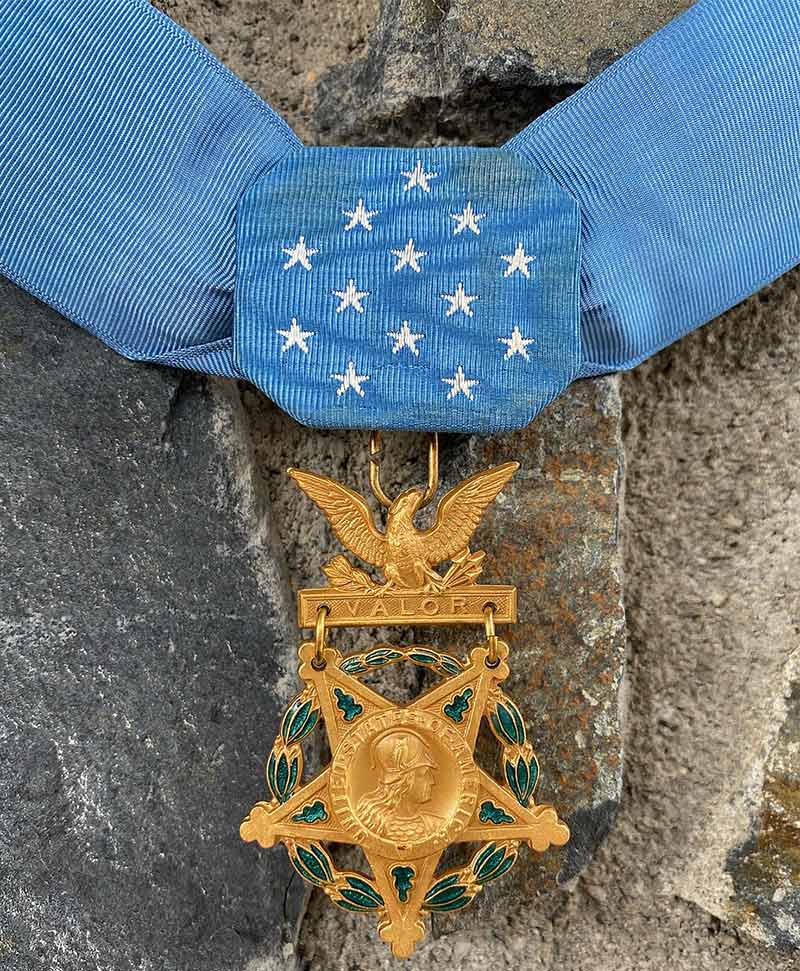
In commendation for their actions during the infamous Japanese attack on American bases at Pearl Harbor, fifteen U.S. servicemen were awarded our nation’s highest military award: the Medal of Honor. For fourteen of them, the honor was given posthumously, their valor having cost them their lives. The fifteenth recipient, aviation ordinance chief of the U.S Navy, John Finn, survived that dark day against all odds because, in his own words, “the Lord wasn’t ready for me yet.”


John William Finn (1909-2010) wearing his Medal of Honor

John Finn joined the Navy back in 1926, just days shy of his sixteenth birthday, when the world seemed permanently at peace and joining up presented a wonderful way for a curious young man to travel the globe. Travel he did, serving on a variety of ships that took him through the Panama Canal and six hundred miles up the Yangtze River. He not only traveled during this time but he also married a lovely lady named Alice. He earned one promotion after another for his diligent attitude, rising through the ranks to become chief petty officer in charge of a twenty-man ordnance crew whose primary duty was maintaining the weapons of a squadron of naval patrol planes.


Kanoehe Bay, Hawaii

December, 1941 found him stationed at the Naval Air Station in idyllic Kanoehe Bay, Hawaii. It was a perfect, serene and respectable place to have one’s family on base, and John Finn, sleeping in with his wife on a Sunday morning, was awoken by a popping noise. His initial reaction was aggravation, assuming some young buck had decided to start gunnery practice early.

Then he heard the sound of planes passing overhead and shouting in the street, followed by a loud knock on his door. It was the wife of one of his men. When he asked her what was wrong, she just pointed up in the air and told him he was wanted at the squadron right away.


Kaneohe Bay Marine Air Station in 1962

Still not aware of what was causing all the confusion, Finn then jumped in his car, clad only in his pajamas, and headed for the hangars where they kept the planes. His wife, Alice Kitt, sensing a more dire situation than he, yelled after him to come back alive.

He was still observing the base’s strictly-enforced speed limit of twenty miles an hour when a fighter plane came roaring down out of the sky above him. He watched it with curiosity for a moment until he saw the “red meatball” of the Japanese insignia, then rammed the car into second gear and stomped on the accelerator.


Sailors trying to save flying boat at Kaneohe Bay, December 7, 1941

He got to his squadron base where the amphibious patrol planes were towed back and forth between the water and their hangars, and found total chaos. All but three of the thirty-nine planes under his charge were already on fire. Some of his men were inside those burning planes, tenaciously trying to utilize their still-functioning machine guns to fire back at the enemy. Others had the bright idea of removing the guns out of the damaged planes, but there were no stationary gun mounts on the ramp to hold them. The sailors then took to improvising, using pipe from the machine shop and other materials. Finn found the squadron’s painter valiantly trying to figure out how to work a .50-caliber machine gun; Finn suggested he take it instead.

Finn found a mobile tripod on which guns were sometimes mounted to teach gunnery. He moved the stand into the nearby parking area where he would have clear visibility and mounted the .50-cal machine gun on it. Clear visibility goes both ways, and this entire time Finn and his men were being relentlessly strafed by the Japanese. Now Finn began to shoot back.


A map of the area on December 7, 1941, demonstrating what was hit and what was spared: Attacked targets: 1: USS California. 2: USS Maryland. 3: USS Oklahoma. 4: USS Tennessee. 5: USS West Virginia. 6: USS Arizona. 7: USS Nevada. 8: USS Pennsylvania. 9: Ford Island NAS. 10: Hickam field. | Ignored infrastructure targets: A: Oil storage tanks. B: CINCPAC headquarters building. C: Submarine base. D: Navy Yard.

John Finn would hold his position at the .50-cal in the middle of the parking lot for the next two hours. The Japanese fighters went by too quickly to track with the gun but he did hit some of the slower-moving bombers, although they quickly disappeared over the tree line so he never knew if any eventually crashed. He kept it up and didn’t stop firing until all the enemy planes had gone and it was quiet again.


Burned out cars at Kaneohe Bay, December 7, 1941

Extraordinarily gutsy and resourceful as this action was, due to the completely unprepared status of the men on the ground during the attack, it was commonplace amongst our servicemen that day. Battlefield heroics showcase a particularly carnal and immediate kind of courage, where impossible tasks are undertaken in murderous conditions due to split second instincts.


Kaneohe Bay in ashes after the attack, December 7, 1941

Lt. John Finn displayed all these things, but what set him apart was that he stuck to his post for two hours despite having been struck by shrapnel a total of twenty-one times. Several of these wounds proved to be severe. When silence descended in the aftermath of the attack, when no buzz of an approaching enemy plane threatened, Finn took stock. His appraisal noted that his left arm was numb and a bullet had passed through one foot.

Only when ordered to leave the gun and seek medical attention did he get some gauze slapped on these obvious abnormalities, but then returned despite his physical pain and set about supervising the rearming of the remaining planes.

For these actions he was awarded the first Medal of Honor of the Second World War. He was formally presented with the decoration on September 14, 1942, by Admiral Chester Nimitz, for courage and valor beyond the call of duty. The ceremony took place in Pearl Harbor on board the USS Enterprise and Finn would later cheekily remark he was relieved not to have received it from FDR as he “wasn’t a fan” of his. He also gave his wife and dedicated nurse, Alice, full credit for nursing him to health and ensuring he lived long enough to wear it. When asked by children how he won the medal, he was fond of telling them he didn’t win it, he just did his job.


Alice Finn admires her husband John’s Medal of Honor


U.S. Navy Admiral Chester W. Nimitz presents awards on the flight deck of the aircraft carrier USS Enterprise at Pearl Harbor. The USS West Virginia is visible in the background with salvage work going on. The bottom of USS Oklahoma is visible in front of West Virginia, the main mast of USS Arizona is beyond her.

After the war Finn resided on a 90-acre ranch in California, where he and Alice became foster parents to five Native American children belonging to a nearby tribe. In his retirement he made multiple appearances at various events honoring veterans, and was dogmatic about remembering the other fourteen Medal of Honor winners from that day who perished.


Seamen at Kaneohe Naval Air Station decorate the graves of their fellow sailors killed at Pearl Harbor, 1941

He lived to be 100 years old and gave credit to his Maker for each:

“Twenty-one wounds and not one of them fatal. The doctors told me later a couple of those bullets missed my heart by inches. I told ’em, ‘Boys, it wasn’t inches—it was the hand of God.’ He had His hand on me that day, no question.”

Whatever the politics of the moment, the withheld warnings or the responsibilities of those in high command, a total of 2,403 common servicemen died from a Japanese preemptive attack on December 7, 1941. Some died aboard their ships, some in their barracks, some in the strafed hospitals, others while defending their bases and airfields. Let us never forget.


John Finn—in 2005 at the age of 96—speaking at a dedication ceremony


John Finn in 2008 (seated, center) with six other Medal of Honor recipients of WWII

Hudson Taylor’s Holy Ambition, 1857

2025-11-18T15:59:36-06:00November 18, 2025|HH 2025|

“l have been young, and now am old, yet l have not seen the righteous forsaken or His children begging for bread. He is ever lending generously, and His children become a blessing.”
—Psalm 73: 25-26

Hudson Taylor’s Holy Ambition, November 18, 1857

The great British missionary, Hudson Taylor, established his China Inland Mission in 1865, on the premise that it would never solicit funds but simply trust God to supply its needs. While this stringent policy may not be appropriate for every ministry, it provided Hudson Taylor with thousands of examples of God’s faithfulness: examples he was faithful to record for posterity—that includes us—so that we might marvel and take heart that we serve a most generous Lord.


Hudson Taylor (1832-1905), photographed in 1893

This policy was not enacted by some naïve, overzealous babe in Christ—no indeed, by the time of his establishment of the Inland Mission in 1865, Hudson Taylor had been faithfully ministering in China for over ten years. During this time his health had been broken, he was forced to navigate various rebellions and wars, and was at times condemned by fellow missionaries for assimilating into Chinese culture through clothing and tradition. None of this deterred him in the slightest from his ultimate aim—to spread the Gospel of Jesus Christ in China, far beyond her frequented port cities and into her interior.


Barnsley, Yorkshire, England, hometown of Hudson Taylor

Taylor himself had been born in Barnsley, England, to devout Methodist parents who prayed from his infancy that he would serve as a missionary. A sickly child who trained as a medical assistant to prepare for the field, Taylor initially doubted his parents’ faith, but then underwent a profound conversion at the age of seventeen and fearlessly dedicated his life to the service of his Creator.

Just as his parents had once prayed, a divine call to evangelize the vast, benighted regions of pagan China seized Taylor and in 1853, at the intrepid age of twenty-one, he sailed for Shanghai. He was sponsored by the English-based Chinese Evangelization Society, and arrived amid the chaos of the Taiping Rebellion. As is the case with so many of our evangelizing forbearers, Taylor’s first act of business in the port city of Ningbo was to open a hospital, thus giving back to the community he sought to ingratiate himself into. Over the next seven years, Taylor preached, distributed tracts, married Maria Dyer and faithfully ran the hospital—mostly without the promised funds from England.


Hudson Taylor at the age of 21


Hudson Taylor and his first wife, Maria photographed in 1865

In 1860 he was forced to return to England for a furlough, after almost succumbing to a life-threatening liver infection after repeated attacks of hepatitis. In London, Taylor struggled with guilt over leaving the mission field despite this health emergency. He also reflected on his ties to the various missionary societies, including that with the Chinese Evangelization Society, with whom he had broken partnership earlier, and who had not supplied his full sponsorship in China. During this furlough, Hudson Taylor said he had a “heavenly vision” on Brighton Beach, where he surrendered all his doubts and committed to a new vision for inland evangelization that would be supported by God’s provision alone.

In his own words, Taylor’s “holy ambition” was to penetrate China’s eighteen inland provinces, long neglected by coastal-focused missions. For this cause in 1865, he founded the China Inland Mission with no fixed salaries, relying solely on prayer for support, and governed from China rather than a distant board.


The “Lammermuir Party”, photographed in 1866—Hudson Taylor is seated, center, with his wife Maria to the right of him, each holding one of their children. The four children pictured are all theirs. After Maria’s death in 1870, Taylor would then marry Jennie Faulding, who is seen here seated to the left of Taylor.

Recruiting twenty-four missionaries, he led the “Lammermuir Party” back to China in 1866, establishing mission stations amid famine, riots, and threats by those natives who resented Christian and imperial influence. Taylor insisted all his workers dress and live as locals to foster trust and enable evangelism. Despite suffering severe personal losses—four of his children died young, as did his beloved first wife—he recruited over 800 missionaries to share in the task, emphasizing, “let us in everything not sinful, become like the Chinese, that by all means we may save some.”

In all this, his Lord provided. By the time of Taylor’s death in 1905, the Inland Mission project had become the world’s largest Protestant mission agency, with 125 schools, 18,000 converts, and churches in even the remotest of regions. To this day, Taylor’s legacy endures in China’s underground church boom, a testament that no culture is too far gone for redemption, and a defense of Taylor’s unyielding belief that “the Great Commission is not an optional suggestion but a command.”


Maria Dyer, Hudson’s first wife (1837-1870)


Jennie Faulding, Hudson’s second wife (1843-1904)

On November 18, 1857, at the start of his ministry, a young Hudson Taylor penned a letter which would immortalize the trust he put in his God to provide. The holy ambition displayed in it would continue to animate him until the very end of his life when he would be buried beside his first wife in the land he had sought to claim for Christ.

Many seem to think I am very poor. This is true enough in one sense, but I thank God it is “as poor, yet making many rich.” My God shall supply all my needs; to him be the glory. I would not, if I could, be otherwise than I am—entirely dependent myself upon the Lord, and used as a channel of help to others.

On Saturday we supplied, as usual, breakfast to the destitute poor, who came to the number of 70. Sometimes they do not reach 40, at other times exceeding 80. They come to us every day, Lord’s Day excepted, for then we cannot manage to attend to them and get through all our other duties, too.

Well, on that Saturday morning we paid all expenses, and provided ourselves for the morrow, after which we had not a single dollar left between us. How the Lord was going to provide for Monday we knew not; but over our mantelpiece hung two scrolls in the Chinese character—Ebenezer, “Hitherto hath the Lord helped us”; and Jehovah-Jireh, “The Lord will provide”—and He kept us from doubting for a moment. That very day the mail came in, a week sooner than was expected, and Mr. Jones received $214. We thanked God and took courage. On Monday the poor had their breakfast as usual, for we had not told them not to come, being assured that it was the Lord’s work, and that the Lord would provide. We could not help our eyes filling with tears of gratitude when we saw not only our own needs supplied, but the widow and the orphan, the blind and the lame, the friendless and the destitute, together provided for by the bounty of Him who feeds the ravens.

—Hudson Taylor, November 18, 1857 in a letter to his sister, Amelia Hudson Taylor


The China Inland Mission headquarters in Shanghai, China in the late 1800s

Go to Top