
“It is God who arms me with strength and keeps my way secure.”—Psalm 18:32
Caesar Rodney | Profiles of 1776
 erilous times produce heroes of all types, and it was God’s particular grace on America during her founding era to possess men whose courage matched their vast intellect. Each delegate who met at the Second Continental Congress in the spring of 1776 faced severe repercussions even for attending. By summer, each had been made aware by King George’s proclamation that the cost of their convening could be their lives.
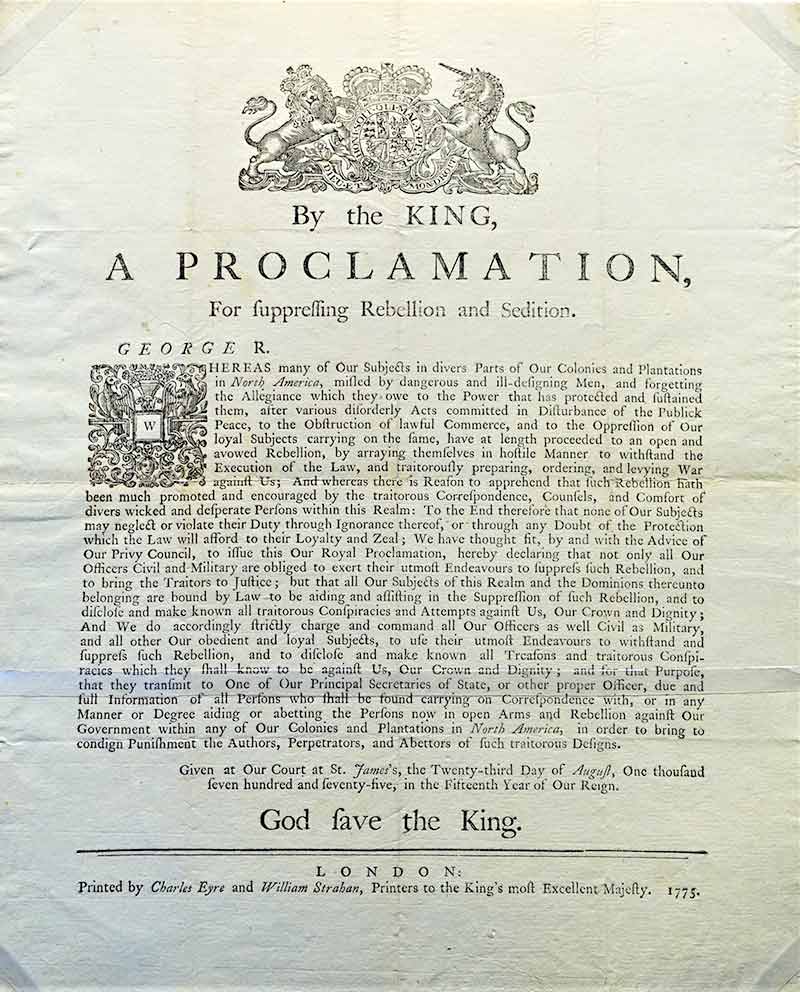
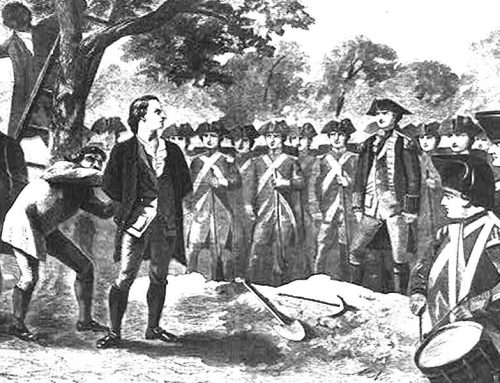
King George’s ‘A Proclamation for Suppressing Rebellion and Sedition’ issued on August 23, 1775, declared elements of the American colonies in a state of “open and avowed rebellion” and ordered officials of the empire “to use their utmost endeavours to withstand and suppress such rebellion”, as well as encouraging loyal Royalists—both in America and Britain—to report anyone carrying on “traitorous correspondence” with the rebels so that they could be punished.
A brave contingent of the members refused to abandon what they considered their duty. They determined among themselves to resist the impending doom of their liberties—and the results of this stubbornness they surrendered to God. They continued their meetings and, most importantly, contended over the Lee Resolution: a motion proposing a vote for an immediate proclamation of independence from the mother country.
All was not harmonious in these discussions. The firebrands of Congress were greatly outnumbered by many who were violently opposed to such a motion on principle, while others thought it rash considering the full might of the British navy was even then sailing with full canvas to conquer New York. Yet it became increasingly clear that if such an irrevocable action were to be undertaken, it must be done with absolute unity or the entire endeavor would fall apart. Each colony must depend upon the other for support and cooperation in the upcoming struggle. In most cases, their respective legislatures back home had already voted on the matter throughout the spring and sent their delegates back to Congress with clear instructions.
When, on July 1, 1776, an unofficial vote was held on the Lee Resolution, it became apparent that Delaware would be one of the colonies presenting serious obstacles to unanimity. The colony had sent three delegates to Philadelphia that year, but Caesar Rodney—a soldier-statesman—had dashed home to deal with Loyalist uprisings. His two colleagues who remained, Thomas McKean and George Read, were of opposing convictions and became hopelessly deadlocked.
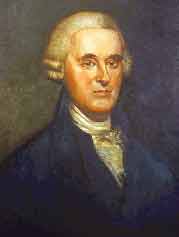
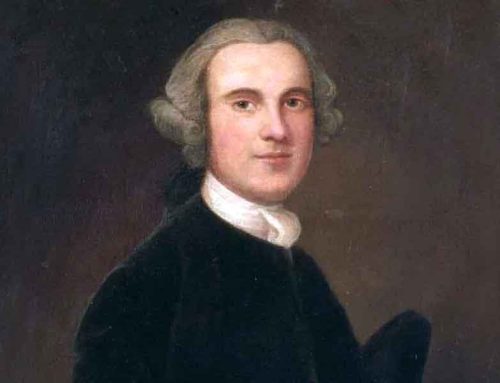
Thomas McKean (1734-1817)
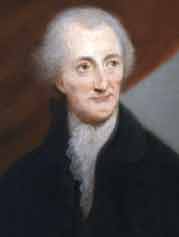
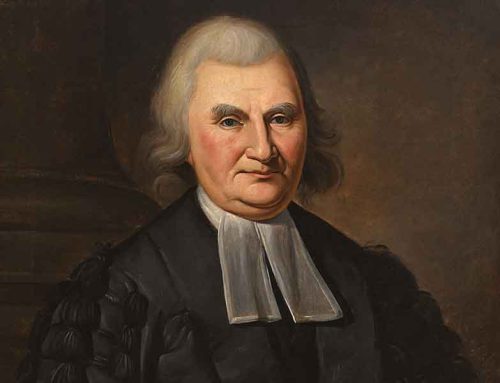
George Read (1733-1798)
McKean, an outspoken rebel, wanted independence, while the cautious Read did not think the time was right to break with England. After the unofficial vote, John Adams was stunned to find that what had been a reliable colony could suddenly no longer be counted on. He urgently advised McKean to dispatch a message to Rodney, begging him to make all haste and appear for the official vote the very next day.
Up to that point in his life, Caesar Rodney had undertaken a veritable catalogue of roles in service to his colony: high sheriff of Kent County, member (and later Speaker) of the Delaware colonial legislature, delegate to the Stamp Act Congress, chairman of Delaware’s first patriotic convention, delegate to the Continental Congress, and—most recently, since the commencement of hostilities—a brigadier general in command of Delaware’s militia.
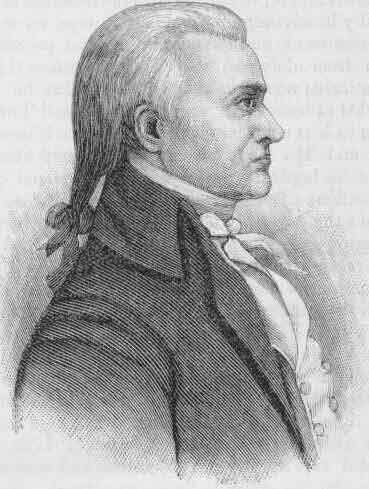
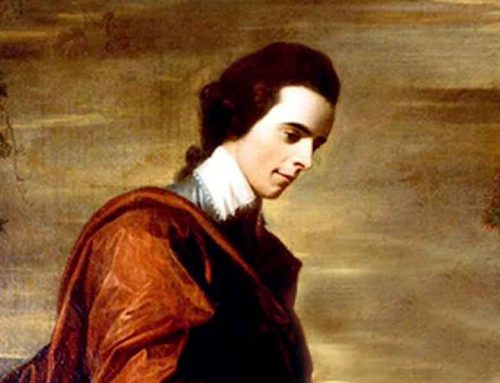
Caesar Rodney (1728-1784)
Such vigorous public service might suggest a man of means, but Caesar Rodney had faced a difficult path since his father’s death in childhood. He had been educated almost entirely by his mother, whom he supported throughout his life, and his pursuit of law and public office was regularly beleaguered by accumulating health issues. He was severely asthmatic throughout his youth, and the onset of gout soon compounded his mobility problems.
Just as relations between Britain and America began to heat up in the late 1760s—and Rodney’s role in them became more taxing—he was afflicted by a growing facial cancer. This malady would eventually spread across the entirety of one cheek. An operation to remove one of the tumors left him with a deep gash, which he hid in public by ingeniously wrapping a cloth across his face. Rodney’s surgeon had recommended that he go to London to seek a specialist’s help before the cancer claimed his life. Yet with the course the Continental Congress was taking, it seemed more likely Rodney would go to London in chains than for treatment.
Upon meeting this frail but deeply committed man, John Adams was so struck by him that he wrote in his diary with typical candor:
“Caesar Rodney is the oddest-looking man in the world; he is tall, thin, and slender as a reed, pale; his face is not bigger than a large apple, yet there is sense and fire, spirit, wit and humor in his countenance.”
His “fire and spirit” were proven beyond doubt when Rodney received the urgent appeal from McKean. Despite the night being far advanced and the weather teeming with storms, he had his horse saddled for the long dash back to Philadelphia—an eighty-mile journey.
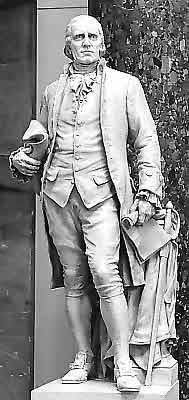
Statue of Caesar Rodney in the US Capitol Building
In Philadelphia the next morning, the air was humid after the previous night’s tumultuous rains, and heavy clouds threatened another deluge. Delaware’s rebel delegate, Thomas McKean, paced the hall, peering anxiously out from the tall windows. To him, it seemed that the fate of the resolution rested on one sick man—his friend and colleague, Caesar Rodney.
John Hancock, as President of Congress, called the session to order. Proceedings on the vote were imminent. Then, suddenly, with all the drama of Paul Revere’s own midnight ride, the pounding of horse’s hooves sounded on the cobblestone streets. Along came Caesar Rodney in his three-cornered hat up Chestnut Street—mud-splattered and bedraggled, a veritable picture of fatigue and suffering.
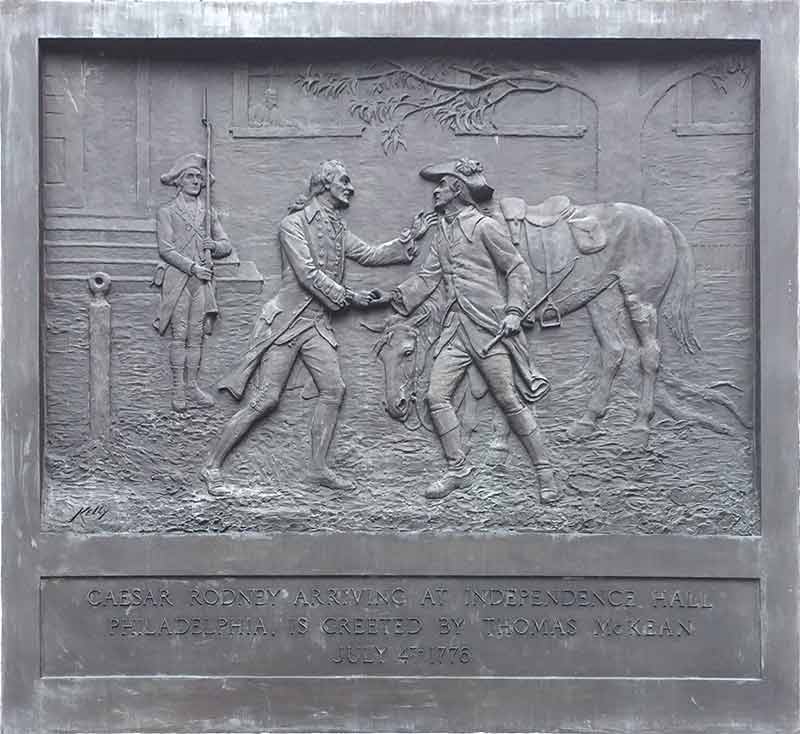
A panel from the pedestal of the Caesar Rodney memorial in Rodney Square, Wilmington, Delaware depicting McKean greeting Rodney upon his arrival
McKean greeted him with grateful fervor and learned that Rodney had ridden for eighteen hours, not even stopping to change clothing, and had switched horses only twice. What the demurring Mr. Read felt upon seeing his vote thus overruled by Rodney’s sheer force of zeal is not recorded.
When President Hancock called for Delaware’s vote, Caesar Rodney pulled himself to his feet. He made bold to speak for his colony, saying:
“As I believe the voice of my constituents and of all sensible and honest men is in favor of Independence, and my own judgment concurs, I vote for Independence!”
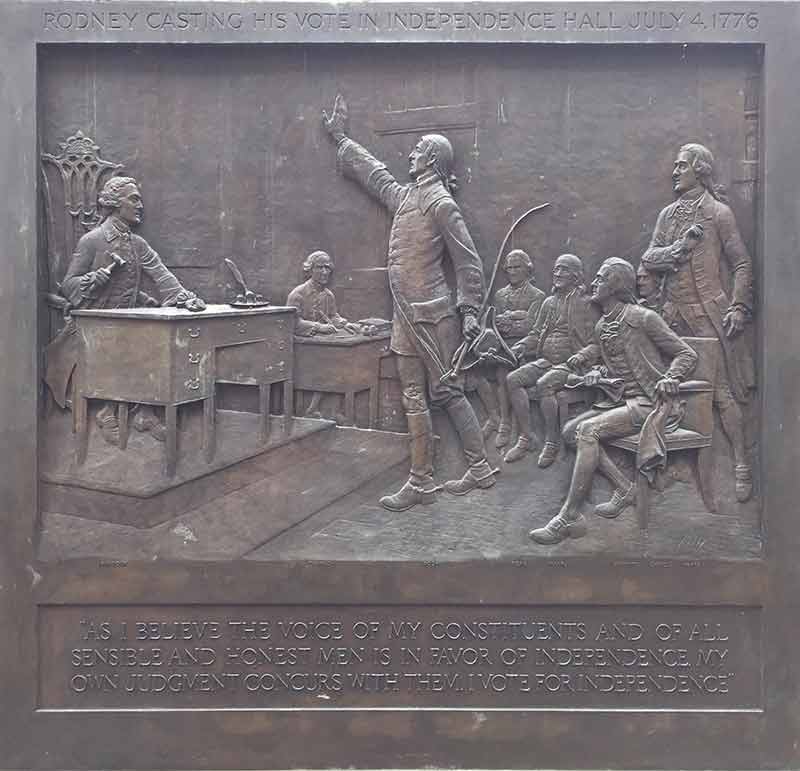
A panel from the pedestal of the Caesar Rodney memorial in Rodney Square, Wilmington, Delaware depicting Rodney’s vote for Independence on behalf of his Delaware constituents, and according to his own conscience
Having done his duty, this great man then sank exhausted into his seat. All three Delaware delegates would eventually affix their names to the Declaration of Independence later that month. Rodney would lose his local position due to political opposition, yet despite increasingly poor health and crippling pain, he continued to serve as a general in the coming war. He was elected President of Delaware in 1778 for a three-year term, expended himself in that role, and was later re-elected to Congress and the Delaware Assembly, though he never served again. He had reached the end of his strength and had nearly bankrupted himself in service to his state.
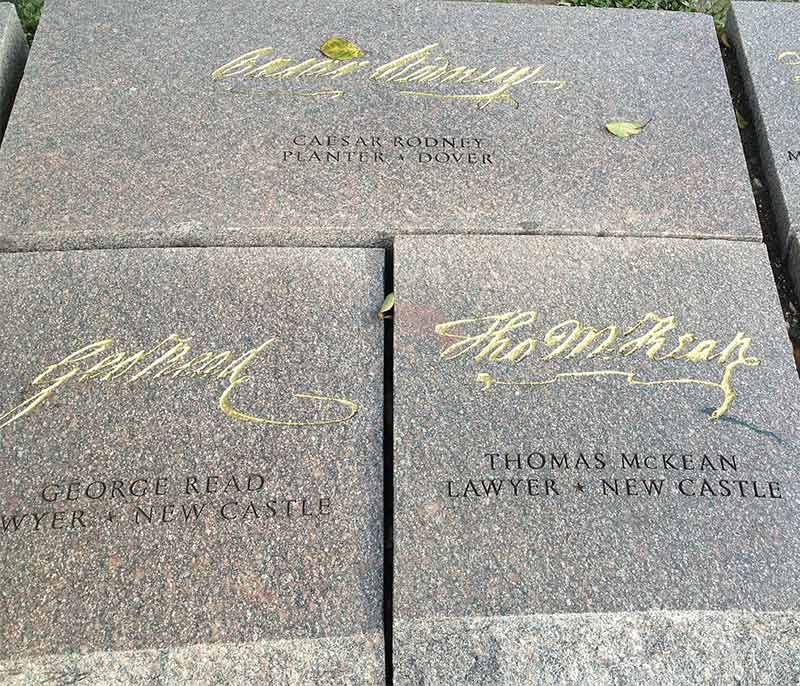
Memorial to the 56 Signers of the Declaration of Independence in Constitution Gardens, National Mall, Washington, D.C.—These three blocks commemorate the Delaware delegates: Caesar Rodney (top), George Read (bottom left) and Thomas McKean (bottom right)
Caesar Rodney died at age fifty-six, childless but far from friendless, at his home near Dover on June 26, 1784. He left what remained of his estate to his nephew, Caesar Augustus Rodney, and in his will provided for the gradual emancipation of his slaves.
A modest man of great fortitude, Rodney did not expect adulation for his role in the vote for Independence, and during his lifetime it remained simply a matter of family pride. But today his home state rightfully honors him in many ways: a giant equestrian statue stands in Rodney Square in Wilmington, schools and dormitories bear his name, and a handsome statue represents Delaware in the Capitol’s Statuary Hall in Washington, D.C. The Delaware state quarter fittingly shows Rodney galloping on his quest to break the tie.
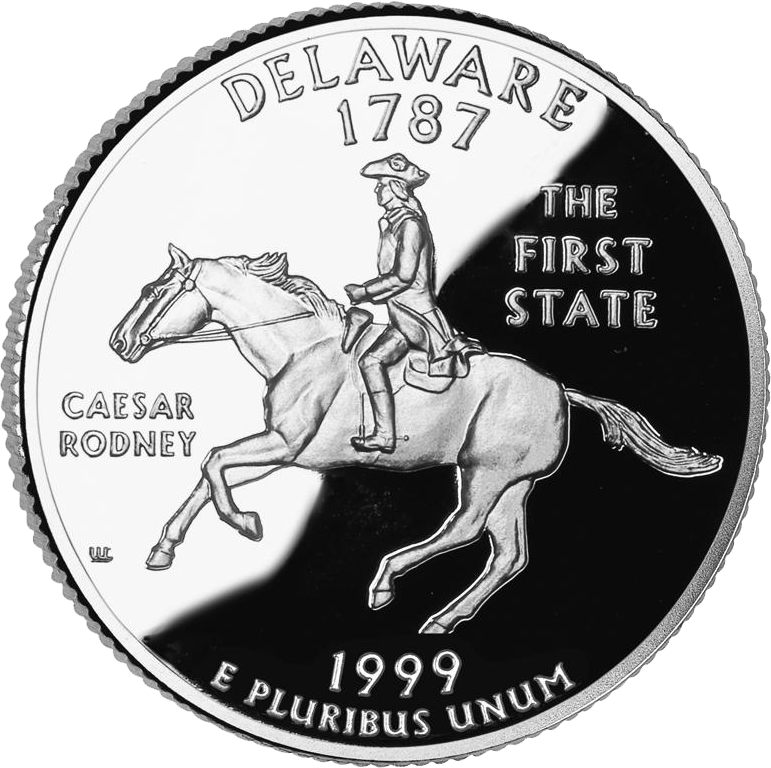
Delaware State Quarter commemorating Caesar Rodney’s magnificent ride for Independence
Next time you read our nation’s founding document and its famous opening boast—“the unanimous Declaration of the thirteen United States of America”—I hope you will remember what a wondrously formidable yet frail man our God used to bring about such a miracle.
Image Credits: 1 Proclamation of Rebellion (wikipedia.org) 2 Thomas McKean (wikipedia.org) 3 George Read (wikipedia.org) 4 Caesar Rodney (wikipedia.org) 5 Rodney in the Capitol (wikipedia.org) 6 Rodney’s arrival (wikipedia.org) 7 Rodney’s vote (wikipedia.org) 8 Delaware delegates (wikipedia.org) 9 Delaware quarter (wikipedia.org)