
“…I have filled him with the Spirit of God, with wisdom, with understanding, with knowledge and with all kinds of skills.”—Exodus 31:3
John Glover & His Marblehead Sailors | Profiles of 1776
 n the good old colony days, all along New England’s great north shore, a certain breed of American had sprung up. They were rugged maritime pioneers—Indian converts, religious fugitives, and intrepid sailors. All toiled along its rocky coast in an odd yet industrious fusion that created a culture which prized its whale oil almost as much as its non-conformist preaching.
Resourceful and independent, there was nothing more quintessential of the type than those who belonged to the “codfish aristocracy”: personages recognized as the arbiters of coastal trade. One, Mr. John Glover was a staple of that tight-knit community.
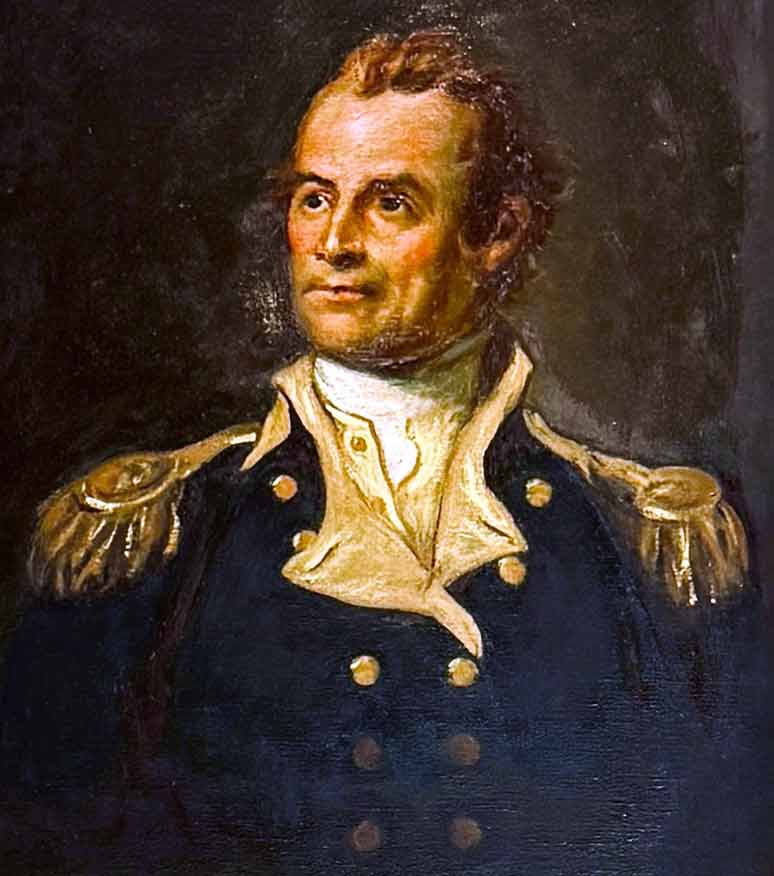
John Glover (1732-1797)
John Glover had embraced responsibility early in his life. He had become his widowed mother’s sole provider before his teenage years. To supply this provision, the Glovers had established themselves in the bustling town of Marblehead, Massachusetts, and there young John embraced the rigorous life of a sailor. Through hard work and honesty he rose to prominence, became the proud owner of his own fishing schooner while still a young man, then owned a whole fleet of schooners, and soon was considered among the most influential men in Marblehead.

Bay of Marblehead, Massachussetts
Glover was not a radical by nature, but as a merchant sailor he suffered repeated insults and meddling from a thieving mercantile system. Merchants like Glover—and his more famous counterpart, the inimitable John Hancock—were among the first to feel the sting of British tyranny in writs of assistance, corrupt customs officers, and illegal impressments of their crews into His Majesty’s Navy. As early as 1760 he was making his grievances known, and later joined Sam Adams’ illicit Committee of Correspondence to participate in their potential solution.
By the time shots were fired at Lexington, Glover was a colonel in command of the Marblehead Militia that he had helped to raise, comprising about 500 men in total. They marched to the relief of Boston in 1775, and in the general pandemonium of the early Continental Army—with its almost continuous comings and goings of armed men without distinctive uniforms or flags—the arrival of the Marblehead men caused a stir. In fact, Glover’s unit was one of the few to earn the privately expressed approbation of the newly appointed Commander in Chief, George Washington.
It is recorded that his tough Massachusetts fishermen wore the blue jackets of sailors, with white shirts, white breeches, and caps, while their short, stocky, red-haired commander distinguished himself with silver lace trim on his blue broadcloth coat and by carrying an enviable brace of silver pistols.
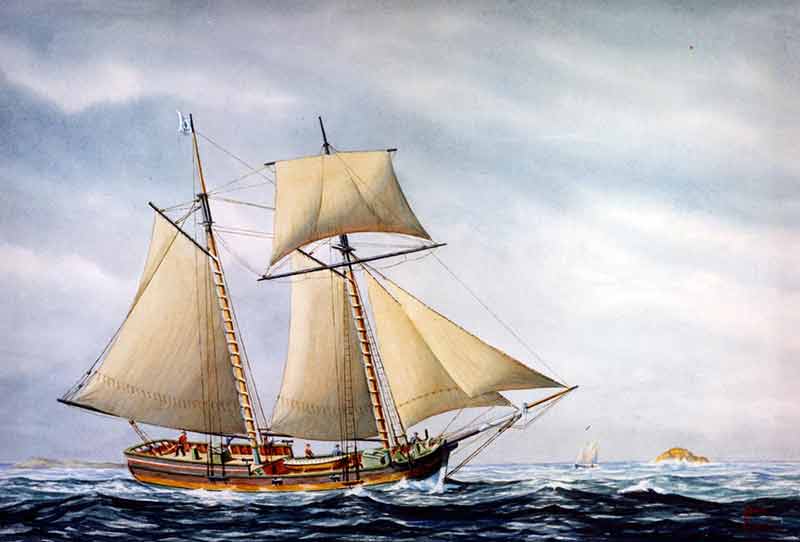
The schooner Hannah—one of John Glover’s ships and named for his wife
Their arrival brought a degree of hope and discipline that was greatly needed among the general ranks. They also brought with them their unique coastal culture. Glover’s militia unit was integrated to an almost unprecedented degree. As was the case with the average American merchant crew, his militia reflected the ethnic composition of New England maritime towns. It was noted in the muster rolls of the time that roughly one-third of his men were “dark complexioned”: these included men from the melting pot of the West Indies, Hispanics from the Caribbean, Native Americans, and upwards of fifty free Blacks.
Despite being sailors, Glover and his men turned themselves to engineering and built fortifications better than most of their compatriots, the farmers, and in doing so proved themselves in possession of the marked virtue that would come to define the success of the American War for Independence—adaptability.
When Washington decided to create a navy, he charged Glover with acquiring ships and converting them for war. The decision soon produced its first results. Glover’s men captured the British HMS Nancy with its desperately needed cargo of guns, flints, and ammunition. In doing so, Glover gave Washington almost as many supplies in one single stroke as Congress had provided all year. The mutual endearment that sprang up between the two men in their shared cause was lasting, and Colonel Glover would enjoy General Washington’s trust and friendship ever after.
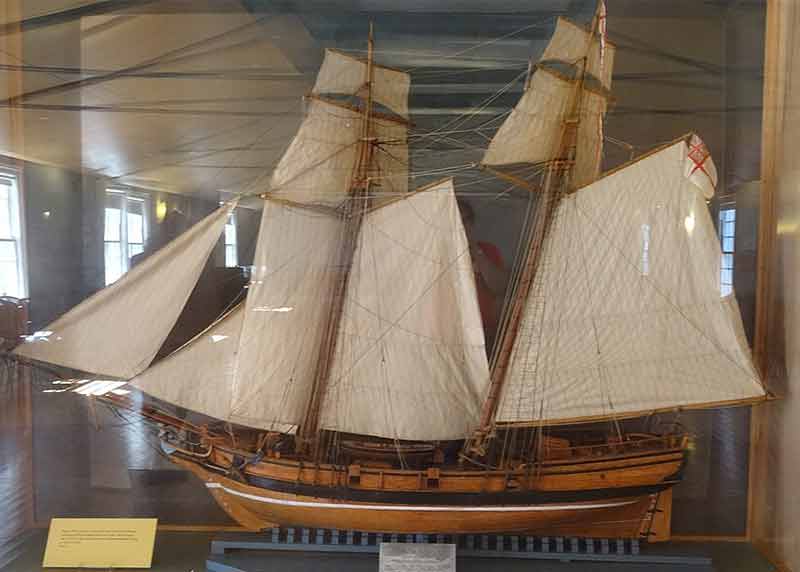
A model of the HMS Nancy
With these successes also came reprisals. Around this time, Admiral Samuel Graves, commander in chief of the Royal Navy in America, adopted a policy of total attrition against coastal towns. This campaign of terror was begun under Captain Henry Mowat, who received orders to “lay waste, burn and destroy.” These orders he obeyed to the letter by bombarding the town of Falmouth, Maine, for nine hours, with marines setting fire to any remaining structures and driving the defenseless populace of about one thousand women, children, and the elderly into the winter wilderness.
It was made clear that all of New England could expect the same treatment. If any stiffening of spine had been needed in Glover’s already ferocious men, such barbaric tactics employed against their wives and children certainly had a galvanizing effect.
After their victory at Boston, Washington moved his army to New York City in expectation that the British would strike there next. His prediction proved right. In June of 1776 a total of 130 British ships anchored in New York Harbor. By July 12 an additional 150 joined them, and British forces numbered over 30,000 men. One American militiaman, hailing from the inland farms of Pennsylvania, recorded feeling as if the entirety of Britain were afloat to attack them. Washington faced this gigantic force with a poorly trained, poorly fed, and almost encircled army. To make matters worse, in a scenario that appeared to be forming all the key characteristics of a naval battle, the much-needed American navy was still practically nonexistent.
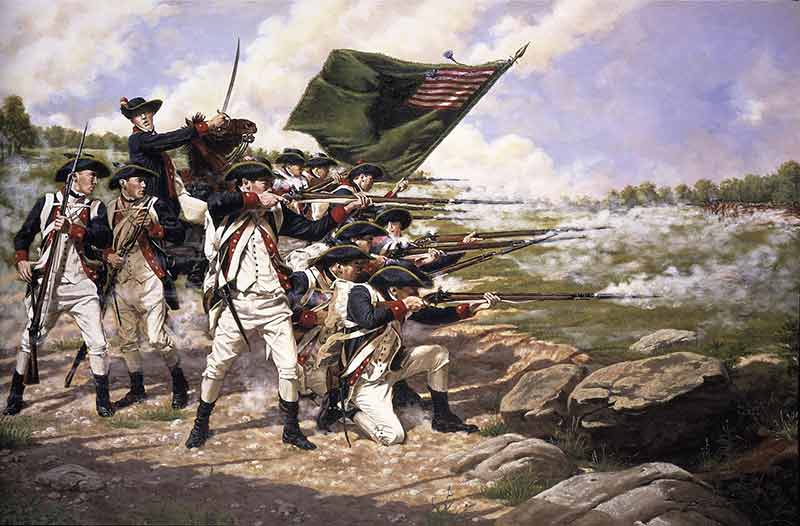
Battle of Long Island
By August of 1776, the situation faced by Washington and the army was critical. Having been outsmarted and outfought on Long Island, they were now hemmed in at Brooklyn in an area about three miles around, their backs to the East River, which could serve as an escape route only as long as the wind cooperated. With a change in the wind, it would take only a few British warships to make escape impossible. Poor strategy and limited ammunition made it a certainty that the men would be overrun and the entire American army destroyed.
It was then that General Mifflin, one of Washington’s young commanders and an erstwhile delegate to the Continental Congress, suggested a preemptive retreat. Lest anyone call him a coward, Mifflin insisted he would provide the rear guard himself. This motion was accepted by the council of war, and the tremendous task of secretly evacuating 9,000 men, their supplies and ammunition, horses, and artillery was undertaken.
And who other than Colonel John Glover could be entrusted to organize this great feat? By sheer ingenuity and resilience, his sailors purloined any vessel that could float and, in an orderly but urgent manner, conducted a significant portion of the evacuation in a single night. According to historian David McCullough:
“In a feat of extraordinary seamanship, at the helm and manning oars hour after hour, Glover’s men negotiated the river’s swift, contrary currents in boats so loaded with troops and supplies, horses and cannon, that the water was often but inches below the gunnels—and all in pitch dark, with no running lights. Few men ever had so much riding on their skill, or were under such pressure, or performed so superbly.”
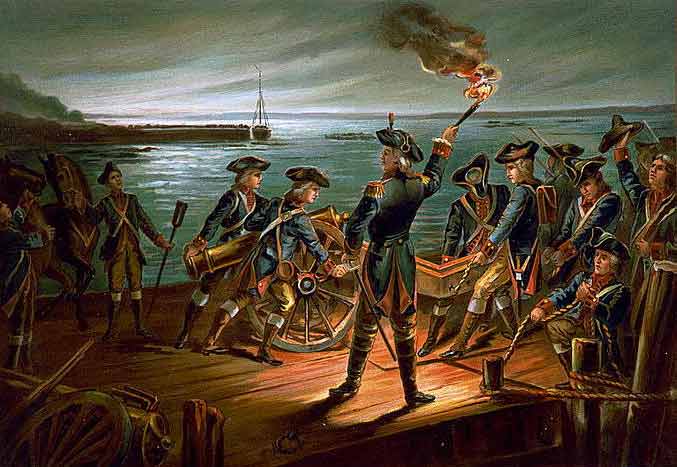
Retreat from Long Island
So it was that when morning broke and the providential fog of the night before lifted, the British Army realized they had been duped. Of course, they moved quickly to cut off any further escape, but yet again Glover’s men saved the day. Having gotten their precious cargo to the mainland, they took it upon themselves to act as both sailors and marksmen, placing themselves between the opposing armies and slowing the British advance by their harassment. The British losses inflicted by the Marblehead men that day proved greater than those at the Battle of Long Island itself, and the delay allowed Washington to move his army intact from Manhattan to White Plains.
Wars are not won by retreats, however glorious their execution; further defeats, desertion, smallpox, and a host of woes continued to afflict the army’s morale, supplies were exhausted, and volunteers were nearing the end of their enlistment, and soon the American Army was in absolute crisis. It was at this point that General Washington made his bold move to attack the British encampment at Trenton, requiring a crossing of the mighty Delaware—a frozen river, in the pitch dark of a stormy night, on Christmas Day.

An icy Delaware River at the crossing point in January 2025, showing conditions likely similar to the ones Washington faced on the night of the crossing
It was the evacuation of New York all over again but even more perilous. And again, Washington called on Glover, and again Glover and his Marblehead sailors responded with tenacious fortitude. The crossing of Washington’s force was largely made in big flat-bottomed, high-sided Durham boats, as they were known—normally used to transport iron on the Delaware from the Durham Iron Works to Philadelphia. Painted black and pointed at both ends, they were an unwieldy forty to sixty feet long. The biggest of them could carry as many as forty men standing up, and fully loaded they drew only about two feet and so could be brought close to shore. The oars—or sweeps, as they were called—used to propel the boats were a hefty eighteen feet long.
One of the militiamen they carried was hardly a man by today’s standards. John Greenwood, a sixteen-year-old fifer under strict orders to make not a single noise, had picked up a musket instead. He later recalled that brutal night:
“Over the river we then went in a flat-bottomed scow. After a while it rained, then hailed, snowed, and froze, and at the same time blew a perfect hurricane.”
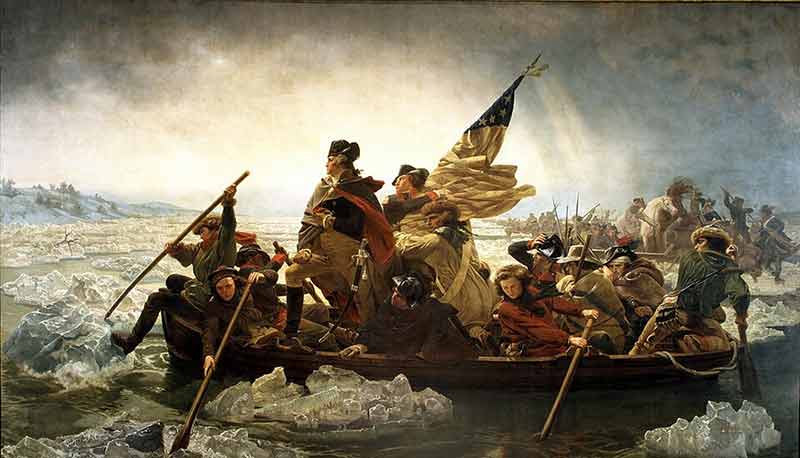
The now iconic painting ‘Washington Crossing the Delaware’, by artist Emanuel Leutze—Metropolitan Museum of Art, New York City
The conditions couldn’t have been more miserable, but the sailors, accustomed as they were by their trade to brave such brutal weather, were by all accounts indomitable in the face of it. As for those art critics who have enjoyed picking apart the now-famous renditions of this iconic moment, one such being ‘Washington Crossing the Delaware’, a common complaint has been the portrayal of men precariously standing up in small boats. But while those boats are indeed rarely portrayed as the flat-bottomed barges they were, historian David Hackett Fisher points out that sitting in the bottom of the real scows would have been a death sentence with the amount of ice water the men recorded sloshing around on the journey over. At the end of the day, critics might not be satisfied with composition and lighting, but their greater ambition—particularly in academia—has been to cast doubt on whether such a moment actually occurred, and in turn whether such valor ever existed, and thus whether it should be honored by us, the recipients of their fortitude.
Glover’s indomitable sailors, with their uniquely American blend of origins brought under the banner of justice into a cohesive unity of purpose, were beautifully portrayed in Emanuel Leutze’s famous painting, which depicts Glover’s sailors as the motley band of heroes that they were. They were the stuff of American legend, the soul and sacrifice of which must never be forgotten! In this brief retelling of one man’s role with his militiamen in preserving the American cause through her first year, I hope you have had your admiration confirmed anew and your gratitude rekindled as a result.
The scale of the now-famous crossing and the resultant battle are small in comparison to many amphibious operations now taught in history. But it was the sheer daring, the utter ingenuity required to use the poor equipment on hand, and the almost jubilant spirit of determination animating the men that desperate night which has placed it as a magnificent proof of American heroism and Divine sanction in our nation’s preservation.
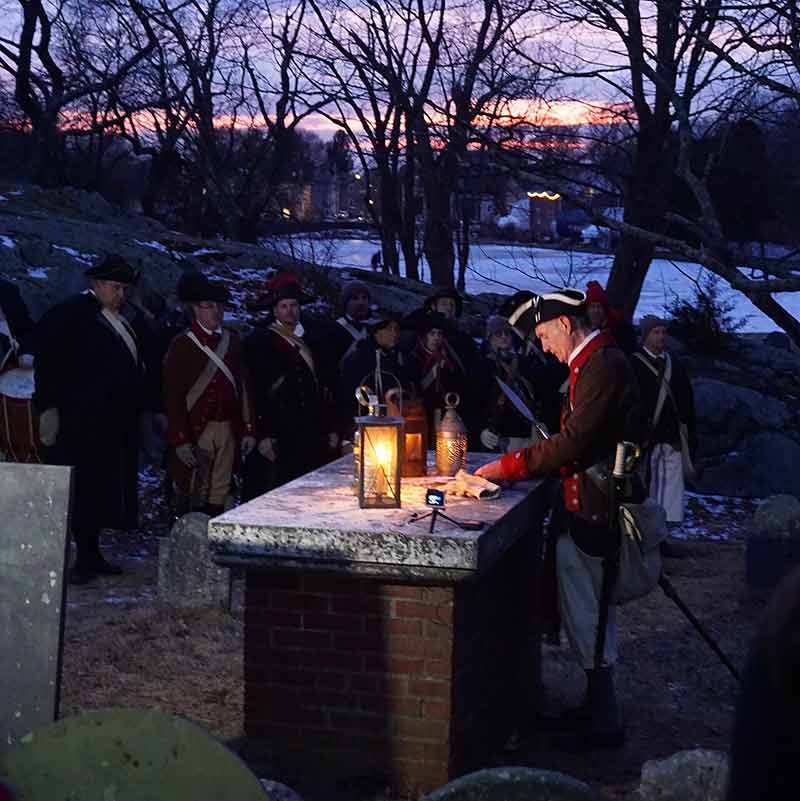
An annual memorial service held at General Glover’s grave, commemorating his many and significant contributions to the cause of freedom for our nation
Image Credits: 1 John Glover (wikipedia.org) 2 Marblehead, MA (wikipedia.org) 3 Hannah (wikipedia.org) 4 HMS Nancy (wikipedia.org) 5 Battle of Long Island (wikipedia.org) 6 Retreat from Long Island (wikipedia.org) 7 The Delaware River, frozen (wikipedia.org) 8 ‘Washington Crossing the Delaware’ (wikipedia.org) 9 General Glover’s grave (wikipedia.org)