
“This day I call the heavens and the earth as witnesses against you that I have set before you life and death, blessings and curses. Now choose life, so that you and your children may live.”—Deuteronomy 30:19
John Winthrop’s Model of Christian Charity: A Vision for America, April 25, 1630
 he spring of 1630 found England restless under a king seemingly bent on stamping out the pure, gospel-based worship so many devout souls practiced and desired to maintain. King Charles I and his archbishop, William Laud, had tightened the screws on the Puritan Reformers by banning their meetings, silencing their preachers, and enforcing ceremonies that became increasingly popish in practice and trappings. King Charles had also suspended Parliament indefinitely, causing grave concern for the security of the rule of common law.
For parishioners who believed the Church of England had not gone far enough in its Reformation, that both churches and courts should be brought under the law of God, the only honorable path left was to consider departure.
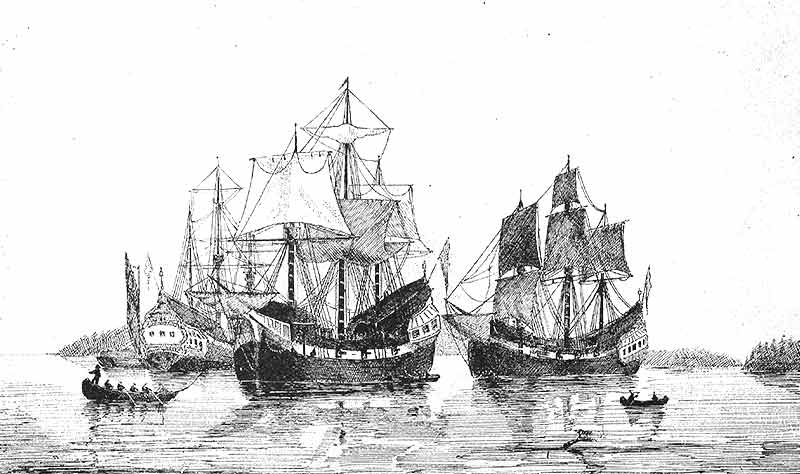
Arbella in the Winthrop fleet
And so a fleet of eleven ships carrying nearly a thousand souls set sail for the untamed shores of Massachusetts Bay, determined to build a commonwealth ordered entirely by Scripture. At the head of that company stood John Winthrop. Quiet, scholarly, and profoundly devout, he was a forty-two-year-old lawyer and gentleman of Groton, Suffolk, and had been elected governor by the shareholders of the Massachusetts Bay Company before the ships ever left English waters.
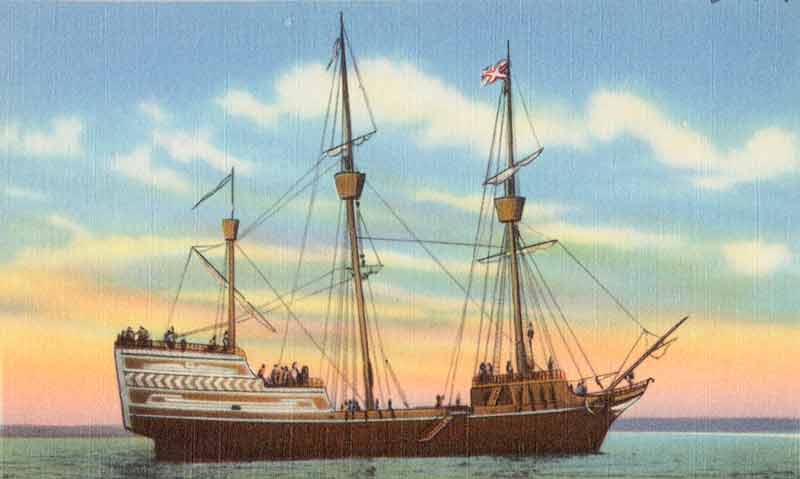
Arbella, flagship of the fleet—Winthrop’s sermon was preached on board
It is important to keep this context in mind—that Winthrop was an elected public official sent to establish the rule of law in the new country while it disintegrated in the old—when he delivered his now famous lay-sermon aboard the flagship Arbella. He titled it “A Model of Christian Charity.”
His subject was not a call to obey civil magistrates, a warning against laziness or even an encouragement to bravely face the trials ahead, but rather it was a solemn charge to model for all the world the chief attribute of the Christian Religion: charity.
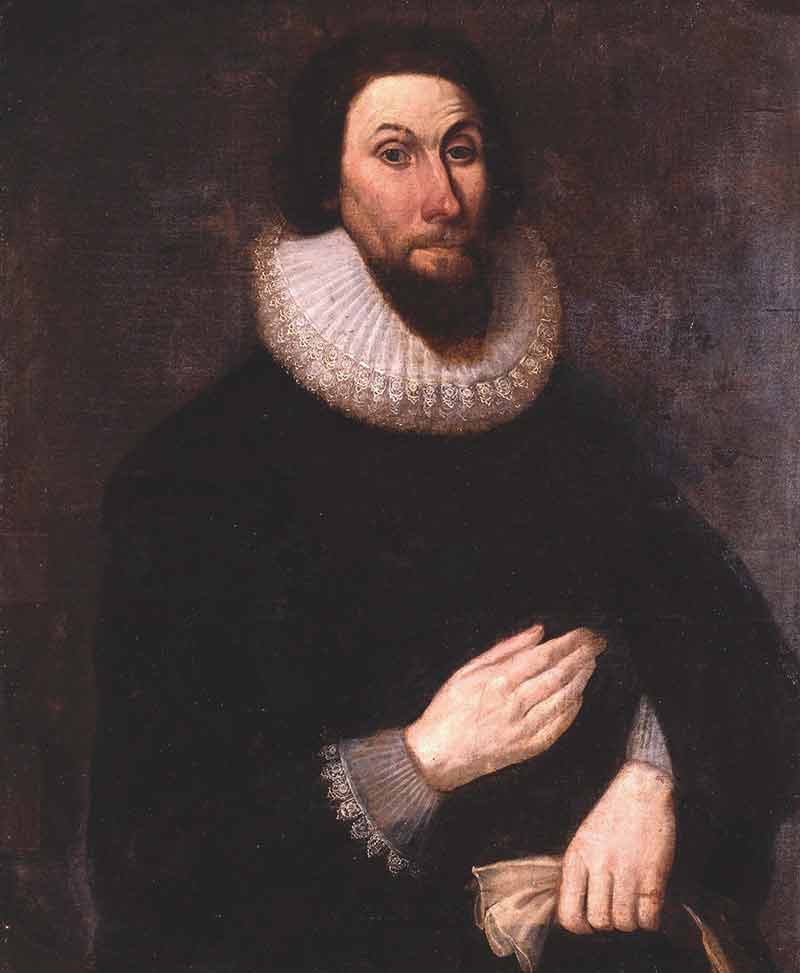
John Winthrop (1588-1649)
Winthrop began, as the sermon itself opens, with the plain fact of Providence:
“God Almighty in His most holy and wise providence hath so disposed of the condition of mankind, as in all times some must be rich, some poor, some high and eminent in power and dignity, others mean and in submission.”
Why this inequality? Not, he insisted, for the sake of the individuals themselves, but for the glory of the Creator and the common good of the creature, and so their experiment was first and foremost to be a model society rooted in graciousness.
The reasons were, he said, threefold:
“First, to hold conformity with the rest of His works, being delighted to show forth the glory of His wisdom in the variety and difference of the Creatures and the glory of His power, in ordering all these differences for the preservation and good of the whole, and the glory of His greatness, that as it is the glory of princes to have many officers, so this great King will have many stewards counting Himself more honored in dispensing His gifts to man by man, than if He did it by His own immediate hand.”
Second, he said,
“That He might have the more occasion to manifest the work of His Spirit: first, upon the wicked in moderating and restraining them: so that the rich and mighty should not eat up the poor, and amongst the regenerate in exercising His graces in them.”
Third, he asserted,
“That every man might have need of the other, and from hence they might be all knit more nearly together in the bond of brotherly affection; from hence it appears plainly that no man is made more honorable than another or more wealthy but for the glory of his Creator and the common good of the creature, man.”
The heart of his appeal was contained in the closing paragraphs where Winthrop warned his listeners that they had entered into a special covenant with God, that the eyes of the world were upon their endeavor, but greater still the eyes of Heaven. If they dealt truly with one another, loved their brethren as themselves, and labored together for the common good, then in the beauty of God Almighty’s economy they would become “a praise and glory” in the earth. But if they failed—if selfishness, greed, or coldness crept in—they would become an infamous “by-word throughout the world.”
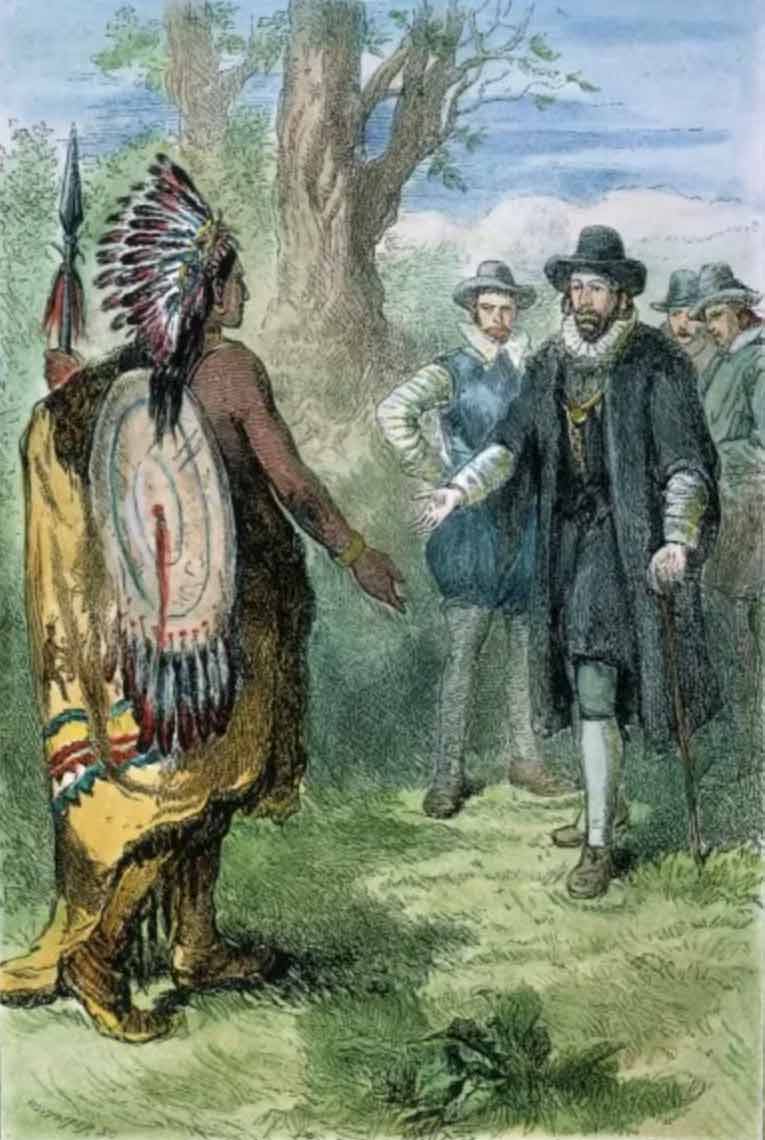
Winthrop meets with a Narragansett warrior, c. 1631–1639
Theirs was the holy “duty of mercy” which was to be the hallmark of the new American colonies. Winslow gave them a profound charge:
“Beloved, there is now set before us life, and good, death and evil in that we are commanded this day to love the Lord our God, and to love one another and walk in His ways and to keep His Commandments and His ordinance, and His laws, and the articles of our Covenant with Him that we may live and be multiplied, and that the Lord our God may bless us in the land wether we go to possess it. But If our hearts shall turn away so that we will not obey, but shall be seduced and worship other gods, our pleasures and profits, and serve them; it is propounded unto us this day, we shall surely perish out of the good land wither we pass over this vast sea to possess it. Therefore let us choose life that we, and our seed may live, by obeying His voice, and cleaving to Him, for He is our life and our prosperity.”
Then came the immortal, vision-casting line that has echoed down four centuries: “We shall be as a city set upon a hill. The eyes of all people are upon us.”
What followed that April address was the slow, arduous work of turning this vision into the renowned, devout, industrious colony that would, in future generations, become the Massachusetts of Harvard, Lexington Green, and Bunker Hill fame. By the influence of this ideal, Massachusetts was the first state to establish a board for American Foreign Missions, and America entire would produce more missionaries in her short 250 years than all the rest of the Christian world.
Winthrop himself would serve as governor for twelve non-consecutive terms in the colony’s first nineteen years, guiding the settlers through famine, disease, and the constant temptation to scatter or compromise. The Massachusetts Bay Colony never became the perfect society he desired—human frailty saw to that, his own included—but its founding ideal endured.
Though the sermon itself lay unpublished until 1838 and was little known for two hundred years, its essence shaped New England’s churches, schools, and laws. Later generations would reach back to that “city upon a hill” imagery and apply it, sometimes loosely, to the whole American experiment. Presidents from John F. Kennedy to Ronald Reagan would quote Winthrop’s words when recalling the nation’s divine purpose.
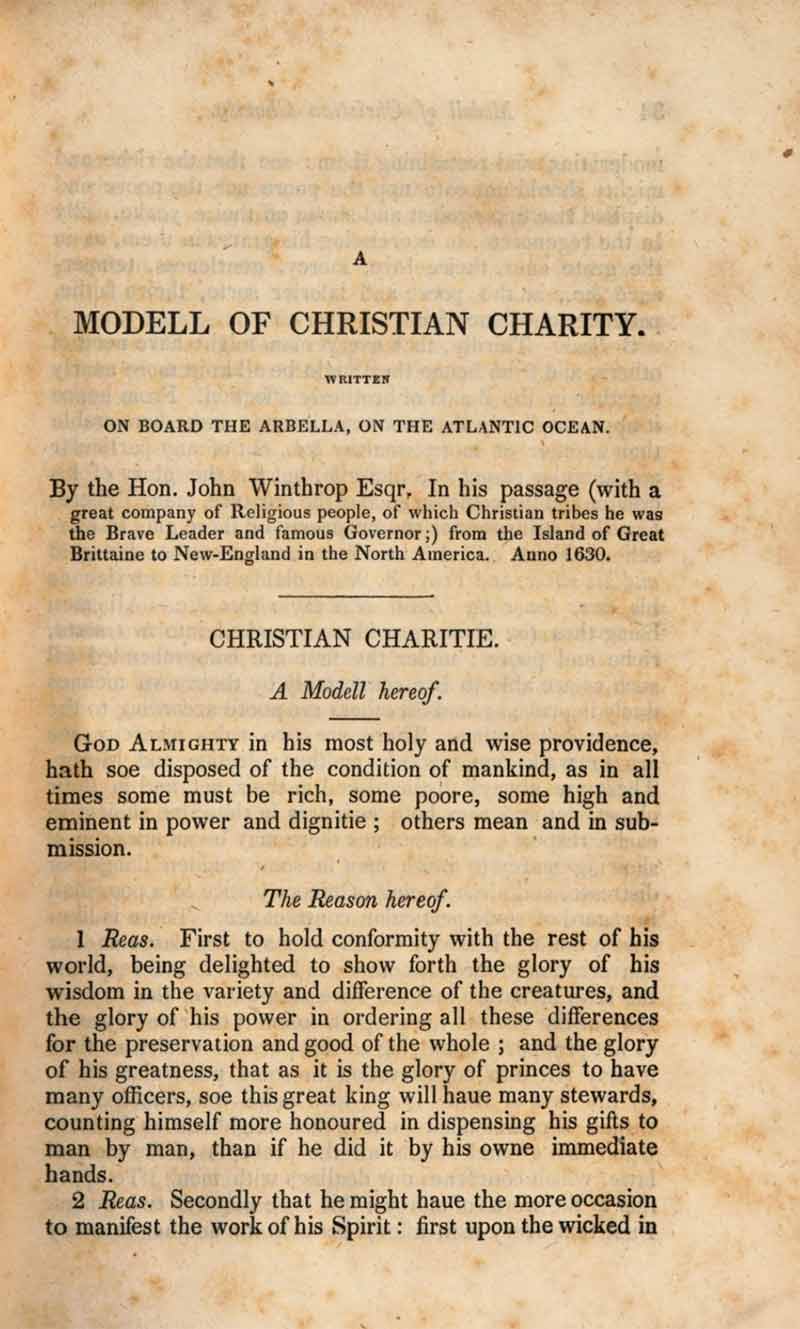
John Winthrop’s “Modell of Christian Charity” sermon, as published in 1838
Winthrop himself would write in his journal, years later, that the colony’s survival had been “a wonder of wonders,” and he gave glory to the Most High for this mercy. Winthrop’s charge is as applicable today as it was in 1630, that to be a city set upon a hill we must reclaim our Christian duty to charity, for we are commanded to “not neglect to do good and to share what you have, for such sacrifices are pleasing to God.”