
“For God gave us a spirit not of fear but of power and love and self-control.”—2 Timothy 1:8
Profiles of 1776 | Elizabeth Annesley Lewis
 n the course of Providence, when Elizabeth Lewis’ husband, Francis, put his name to the Declaration of Independence, he signed away not only his own life but—most tangibly—hers as well. He was the oldest delegate from New York—pulled from a comfortable retirement at the time—and he approved of Independence all while knowing that his home was directly in line for the next British invasion.
Little is known of this couple before the war. Francis grew up an orphan in Wales before becoming a self made man by dealing in trade. He enjoyed prosperity in America and found himself seated at John Hancock’s lavish table by 1776. Elizabeth was the youngest sister of Francis’s partner in the mercantile trade. They were blessed with seven children, three of whom survived infancy. Francis Lewis was intrepid in his business, traveling as far as Russia to promote his trade, and Elizabeth ran the business at home in concert with her brother. In the words of her granddaughter:
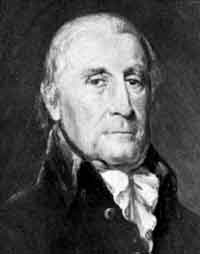
Francis Lewis (1713-1802)
“To Francis Lewis she was Heaven’s best gift. When his adventurous spirit led him to embark on long and perilous voyages, he knew that he left his children to the care of an able as well as tender mother, who could train their characters as well as protect their interests.”
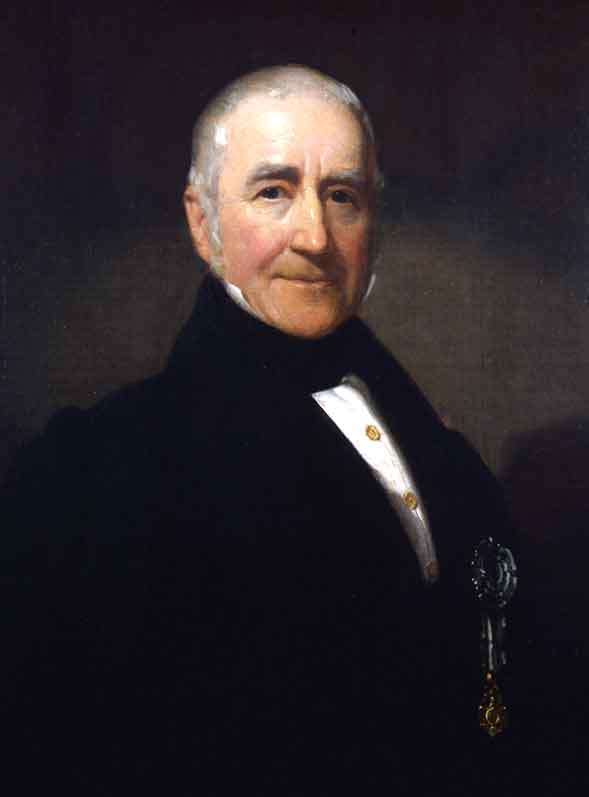
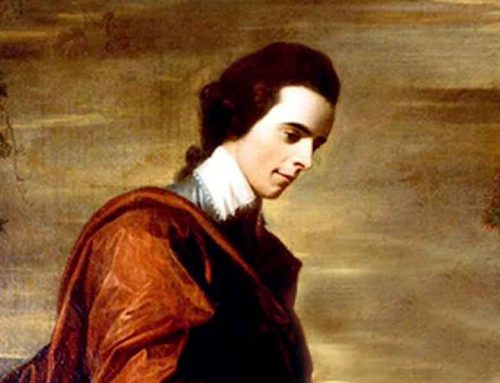
Morgan Lewis (1754-1844), son of Francis & Elizabeth Lewis, continued the legacy of his parents by serving his country in many ways, including in both the War for Independence and the War of 1812, the New York State Assembly (1789, 1792), the New York State Senate (1811–1814), as New York State Attorney General (1791–1801), and the third governor of New York (1804–1807).
About 1765, Lewis moved his family to Whitestone, Long Island, where he acquired a handsome estate. Francis retired from business in 1771 except for the purpose of establishing his son, Francis Lewis, Jr., in the trade. Mrs. Lewis resided permanently on Long Island, even as her husband and sons were away more and more as tensions escalated. Francis Lewis devoted his attention entirely to public affairs after his election to the First Continental Congress.
Like his fellow New York signers—Floyd, Livingston, and Robert Morris—Francis Lewis was declared an outlaw by the British authorities and a price set upon his head. The enemy did not stop there. General Washington and the patriot army were soon driven from New York in the summer of 1776, and the king’s troops took possession of Long Island. They were singularly rapacious, having endured a harsh winter in Nova Scotia and been dealt a bitter defeat by the rebels in Boston the previous year. They took out this aggression on the citizenry of the idyllic little community, with violence, pillaging, and rape becoming commonplace. “The troops hold the rebels very cheap,” wrote Ambrose Serle, secretary to General Lord Howe, “and long for an opportunity of revenging the cause of their countrymen who fell at Bunker Hill.”

Memorial to the 56 Signers of the Declaration of Independence,
National Mall, Washington, DC
So empowered, a certain Colonel Birteh promptly led a troop of light horse to go give the aged New York signer “the hanging he deserved.” Finding Mr. Lewis not at home, Birteh changed course “to seize the lady and destroy the property.” As the soldiers advanced on one side of the Lewis home, a ship of war from the other fired upon the house. A shot from the vessel struck a board on which Elizabeth stood.
When one of her servants urged her to run, Mrs. Lewis pluckily replied: “Another shot is not likely to strike the same spot,” and did not change her place. The soldiers entered the house and began their work of plunder and devastation. One of them threw himself at her very feet and tore the glittering buckles from her shoes, only to be disappointed that they were dupes. “Not all that glitters is gold,” Elizabeth reportedly tutted.
The soldiers destroyed books, papers, pictures, and ruthlessly broke up the furniture with hatchets, making the lady of the estate watch her domain being systematically laid to waste. And then, after this pillage, they seized Mrs. Lewis herself and took her off with them on horseback. She was carried to New York and there thrown into prison. She was not allowed a bed or a change of clothing and was only given the coarse and scanty food that was doled out each day to the other prisoners; she was also not permitted to communicate with anyone outside.
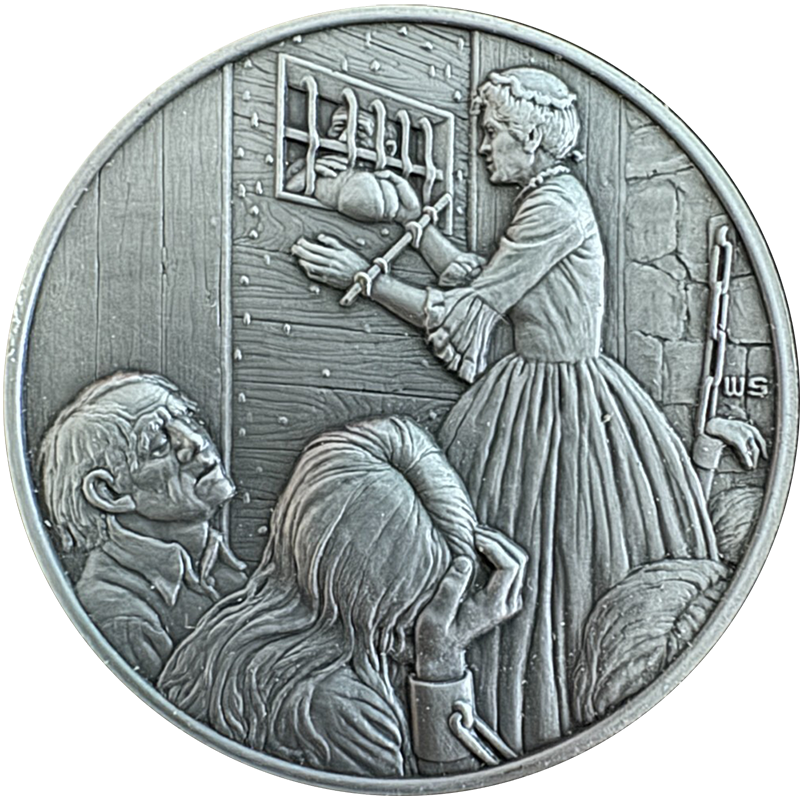
Originally commissioned in 1974 by the Daughters of the American Revolution and issued by the Franklin Mint, a series of pewter medallions—Famous Women of the American Revolution—was produced. Elizabeth Annesley Lewis is commemorated here.
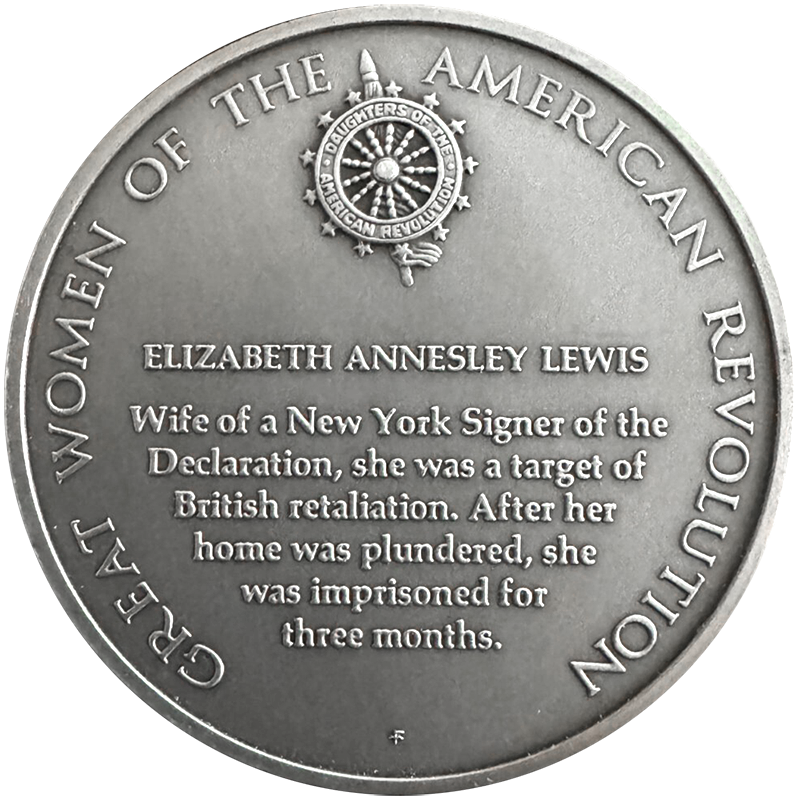
Elizabeth Annesley Lewis medallion, back
This went on for months. It became obvious the British were bent on making an example of her by imprisonment and by denying her the bare necessities of life. Elizabeth Lewis was sixty years old.
In retaliation for this outrage of war being waged on the weaker sex, General Washington put the wives of two prominent Philadelphia Tories under a far more benign house arrest. At last a prisoner exchange was arranged—these two ladies for Elizabeth’s freedom. She was released in broken health and initially disallowed from leaving New York to join her rebel husband. Her faithful servant who had followed her was gravely ill himself, and despite her own dire circumstances she cared for him until he passed away from the illness.
Elizabeth eventually reunited with her husband, lived to see a daughter elope with a British sea captain and a son marry the daughter of another signer, Robert Livingston. When Francis was reelected to Congress in 1779, he asked a leave of absence so he might attend to his invalid wife, whose broken health had only worsened in the past two years. She died that year, having never recovered from the deprivations inflicted on her.
Elizabeth Lewis’s tale is one of many such stories, showcasing the grave sacrifices that the citizenry endured in the cause of liberty, and the animosity they faced from those who invaded their homes and destroyed their lives in retribution for daring to break away from the motherland. Hers is a story quintessential of the spirit of 1776, and quintessential of that sturdy virtue which animated the women of the Revolution.
In the words of eminent historian David McCullough:
“The year 1776, celebrated as the birth year of the nation and for the signing of the Declaration of Independence, was for those who carried the fight for independence forward a year of all-too-few victories, of sustained suffering, disease, hunger, desertion, cowardice, disillusionment, defeat, terrible discouragement, and fear, as they would never forget, but also of phenomenal courage and bedrock devotion to country. The war was a longer, far more arduous, and more painful struggle than later generations would understand or sufficiently appreciate. By the time it ended, it had taken the lives of an estimated 25,000 Americans, or roughly 1 percent of the population. In percentage of lives lost, it was the most costly war in American history, except for the Civil War.”
Elizabeth Lewis was one such life; may we never forget.