
“The people of Israel shall camp each by his own standard, with the banners of their fathers’ houses.”
—Numbers 2:2
Profiles of 1776 | Susannah Elliot
 n the twenty-eighth of June, 1776, Susannah Elliot watched from shore with crowds of fellow onlookers as an enormous British fleet tried to force their way into Charleston Harbor, pummeling the patriot’s crudely constructed first line of defense with shot and shell. Made of palmetto logs and sand thrown up hastily on Sullivan’s Island, Fort Sullivan’s ferocious patriot garrison defied all suggestions to leave their post or submit to their terrible odds. Susannah’s new husband of five months was Major Barnard Elliott, commanding a regiment of artillerymen in that garrison. Her suspense and prayers thus were twofold.
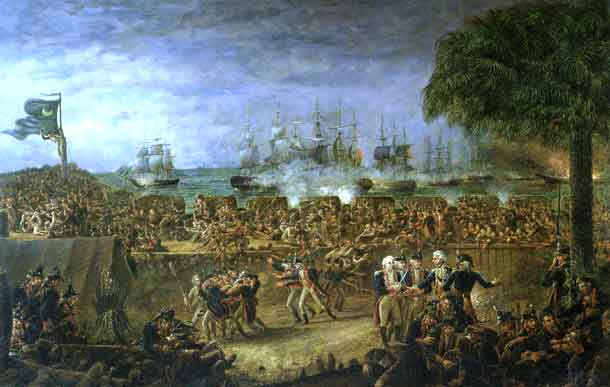
Battle of Fort Sullivan (now Fort Moultrie), 1776
For ten hours Susannah watched as the South Carolinians withstood the onslaught of the greatest navy in the world, and when once their flag had been struck down by a barrage, a Sergeant William Jasper hurled himself over the parapet, exposing himself to almost guaranteed death in order to retrieve it and plant it once again atop the defiant little fortress. There would be no mistaking it for a false surrender. By nightfall the British fleet sailed away, heavily battered, and Charleston was saved from British occupation for the time being.
The morning after the battle, Susannah received word from her husband, still living by God’s grace and exulting in the incredible triumph, “Now, my dear wife,” he wrote to her after commending the bravery of his men, “let us not forget to whom we are indebted for this success against our enemy. Let us return [to] God thanks for it. It is He that does all for us—He inspires our officers and men with courage, and shields their heads in the day of battle—He is the wonderful God of victory.”
Three days later the valiant 2nd Carolina Regiment was drawn up to receive honors from Governor Rutledge and a grateful populace. On this occasion, Mrs. Elliott stepped forward with a costly new pair of silk flags, (colors) embroidered by her own hands and presented to Colonel Moultrie and his Lt. Colonel; whereupon she charged them:
“Your gallant behavior in defense of liberty and your country, entitles you to the highest honors; accept these two standards as a reward justly due to your regiment; and I make not the least doubt, under Heaven’s protection, you will stand by them as long as they can wave in the air of liberty.”
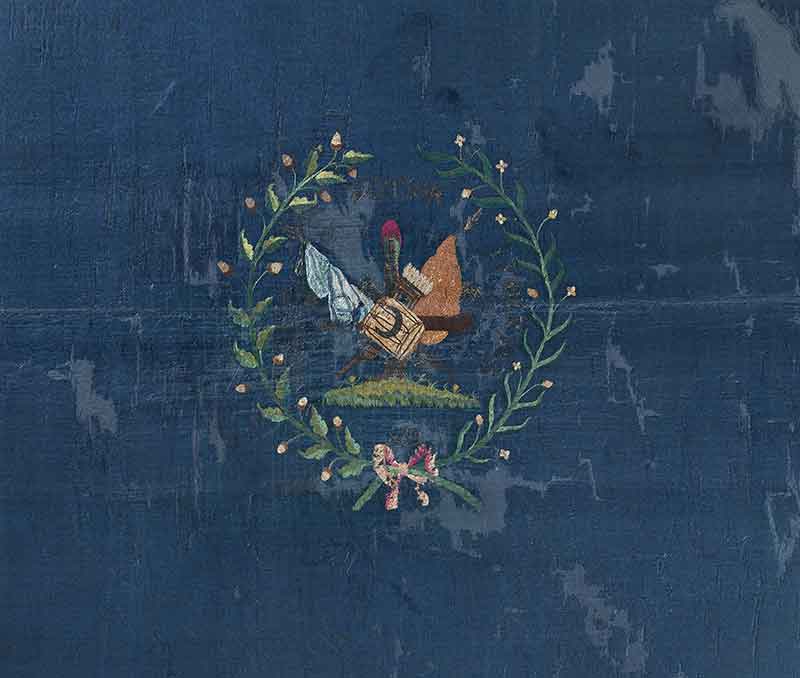
Susannah Elliot’s Blue Flag, currently on loan from the Smithsonian and on display at the South Carolina State Museum for their America’s 250th birthday exhibit
Flags have never been just pretty emblems of identification or a device to communicate across a battlefield. From the Roman signifer whose duty it was to bear the Roman Eagle into conquest, to the brave Marines who raised the Stars and Stripes on Iwo Jima, one’s flag was everything. In the smoke and roar of battle such standards were the only sure rallying point. Men dressed on them, advanced by them, and, when all else failed, gathered again to die beneath them. In American history they were almost always meticulously crafted by the mothers, wives and daughters of the men who fought beneath them, and the flag a man carried was therefore not only the emblem of his country or his cause; it was the visible token of the home he had left and the people for whom he fought.
For her colors, Mrs. Elliot chose one to be blue and one to be red. The blue silk that survives is marked “II REGT”, which means second regiment. At the center, within a wreath of acorns and small flowers, a drum rests on a patch of green. On the drum is a crescent that would later be adopted as the state’s emblem. Beside it are a liberty cap on a pole and draped fabrics of pale blue and tan. Across the emblem, now faded, runs the Latin Vita potior libertas—Liberty rather than life.
This motto would be exacted of Susannah herself in a personal cost when two years later, in October of 1778, her beloved husband Lieutenant Colonel Barnard Elliott was struck down, died and was buried at St. Philips in Charleston with full military honors. Men of the Second Regiment walked in the cortege carrying the silk colors his wife made for them.
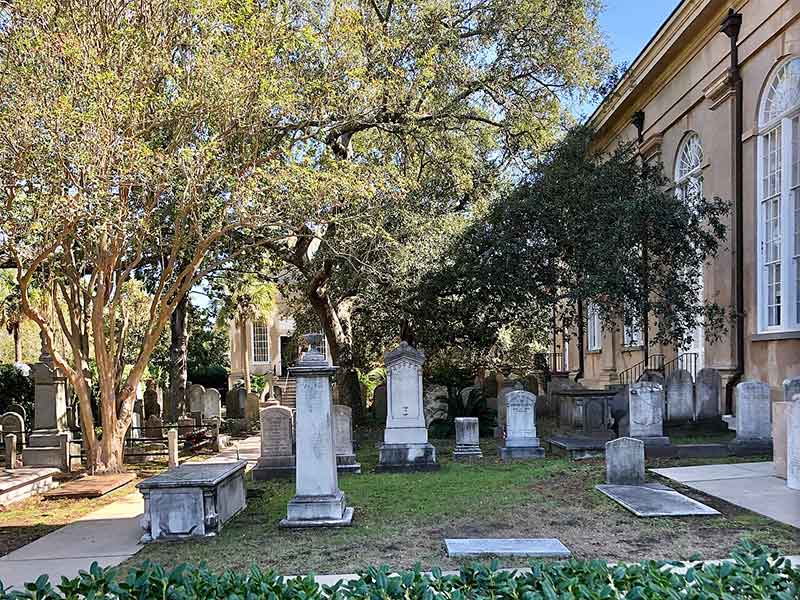
St. Phillip’s Episcopal Church and Graveyard, Charleston, South Carolina—final resting place of Lieutenant Colonel Barnard Elliott
Despite this terrible loss, the faith and patriotic fervor of this woman were remarked upon by all who came in contact with her, including General Nathanael Greene who offered her an escort through the lines so that she might better fulfill her self-appointed duties to the militiamen. Mrs. Daniel Hall, a close neighbor, said Susannah was “one of the most busy among the Revolutionary women, and always active among the soldiers.”
Meanwhile at home on her plantation called the Hut, Susannah Elliot proved to be the savior of two Continental officers who were staying at her home when the British came by in a raid. She quickly hid two of them in a closet behind the hearth, known only to herself, while the third trusted his horse to make his escape. He was killed within sight of the house.
The British raiding party ransacked her home and demanded her silver, to which she could honestly reply she had none in the home since she had hid it in the Carolina swamp months before. Two large mounds in her back yard were likewise questioned and she informed them they were the graves of two British soldiers who had died in her home. After much digging, it was proven she was being truthful on this score, as well. The raiding party then left, leaving behind much damage, including the defacement of a portrait of Mrs. Elliot herself. Still owned by her descendants, it shows her to be beautiful and mild in expression, but marred by a tear in the canvas from where a sword had been run through one eye.
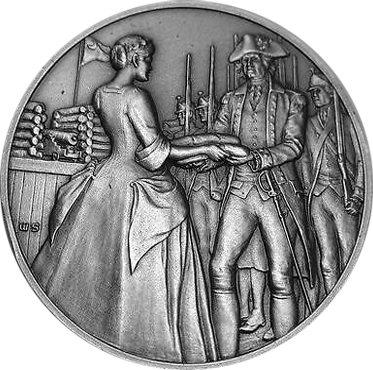
A commemorative Medallion issued by the Franklin Mint shows Susannah Elliot presenting her finished flags to the regiment
In October, 1779 during the battle to take Savannah, the patriots under Francis Marion carried Mrs. Elliots colors into the thickest of the fray. It is recorded that at the Spring Hill redoubt, Lieutenant Bush planted one standard on the British earthworks and was shot down. Then a Lieutenant Hume, going to plant the other, fell in the same way. Lieutenant Gray, supporting them, received his mortal wound. “Liberty rather than life”, their motto, had once again been exacted from their bearers.
Then it was that Sergeant Jasper—who in 1776 had received acclaim for rescuing the flag during the bombardment of Fort Sullivan—seized the colors and succeeded, for a moment, in planting them at the very top of the British redoubt. Then a retreat was called, and Sergeant Jasper succeeded in regaining the American camp with the colors in hand. It became apparent then that he too had received his death wound in bearing them up. It was recorded later that in his last moments Sergeant Jasper charged his commanding officer, Major Horry: “Tell Mrs. Elliott I lost my life supporting the colors she presented to our regiment.”
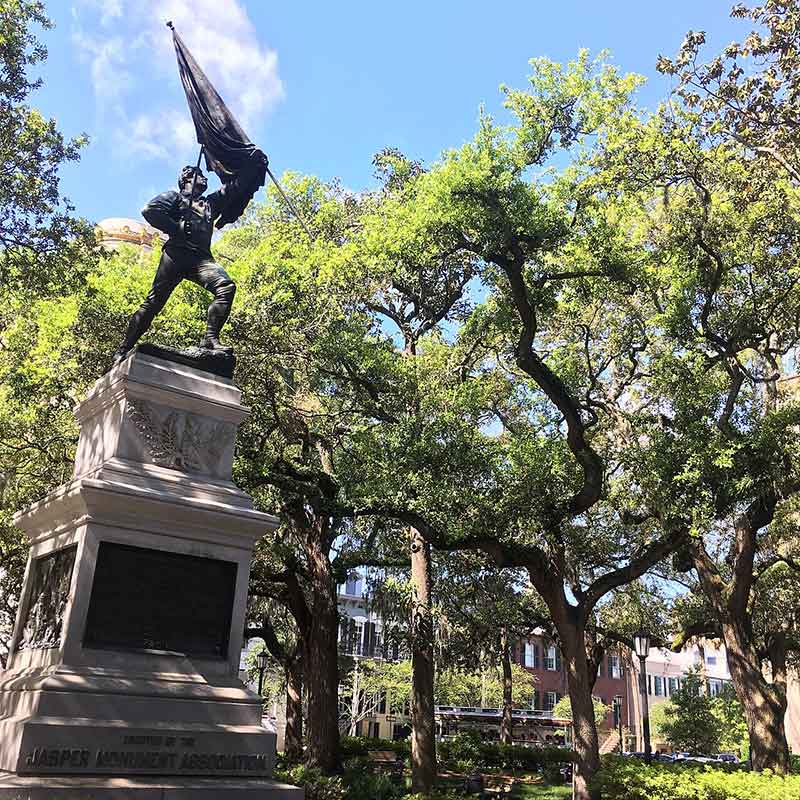
Memorial statue to Sergeant William Jasper in Savannah, Georgia
At the fall of Charlestown in 1780, the 2nd Regiment was captured by the British army, and their standards with them. The blue silk was taken off by Colonel Augustine Prévost and carried to England, where his family kept it as a trophy for more than two hundred years.* In 1989 the South Carolina State Museum and the Smithsonian Institution purchased it jointly. It is now displayed in Columbia, South Carolina. The red standard was never recovered. Of their fame in the war, and of the brave men who died under them rather than disprove their implacable motto, Colonel Moultrie would write to Mrs. Elliot, “There were never colors more honorably supported and never were colors better disposed of.”
*Author’s Note: As with many domestic stories of the Revolution, quotations, letters, and even some dates in this account rest on later recollection—some secondhand, and often preserved by descendants rather than by wartime contemporaries. Historians also disagree on when the surviving blue standard was taken. Nineteenth-century narratives regularly place its capture at the fall of Charleston in 1780; modern research and museum curators hold to it being a trophy of Savannah in 1779.