
Profiles of 1776 | Thomas Paine
 consummate “atrocity propagandist,” no single individual influenced American perceptions to a greater degree in the year 1776 than English-born essayist Thomas Paine. In January of that revolutionary year he put forth his polarizing pamphlet Common Sense, and he closed out December with the succinct The American Crisis—both of which would go down in history as integral expressions of the spirit of resistance.
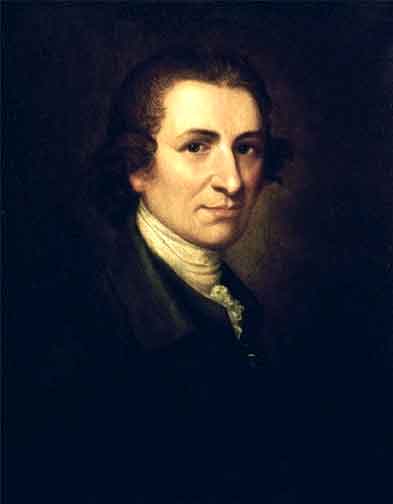
Thomas Paine, c. 1785-95
Common Sense was forty pages long and sold 100,000 copies in three months to the roughly two million residents of the thirteen colonies. By July 1776 it was in nearly everyone’s pocket, and even General Washington had given it his stamp of approval. Titled so as to appeal to those whose sentiments it aligned with—and terribly galling to those who found it unpersuasive—many would later say it catalyzed the public calls for independence that reached their fruition six months later in the Declaration.
It began thus:
“Some writers have so confounded society with government, as to leave little or no distinction between them; whereas they are not only different, but have different origins. Society is produced by our wants, and government by our wickedness; the former promotes our happiness positively by uniting our affections, the latter negatively by restraining our vices. The one encourages intercourse, the other creates distinctions. The first is a patron, the last a punisher.”
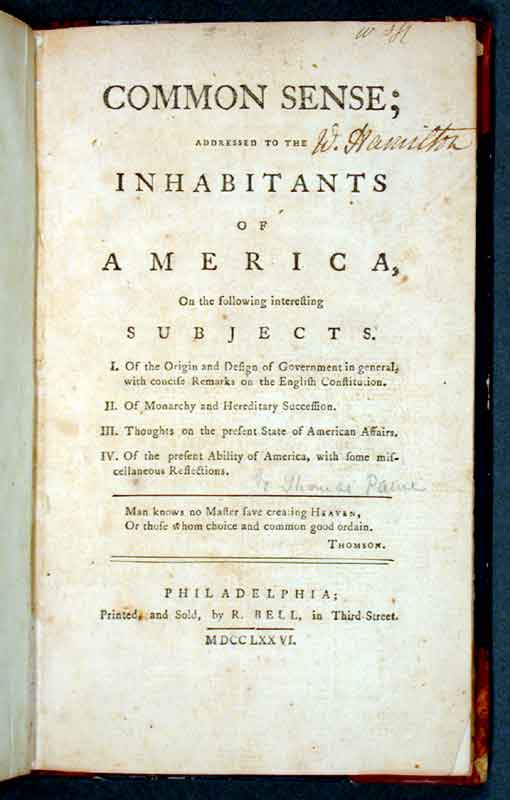
The title page of a 1776 copy of Paine’s Common Sense
Thomas Paine himself came from a most unexpected quarter. He had immigrated to the colonies from the mother country just two years before the Revolution at the behest of Benjamin Franklin. He had failed at multiple trades in England, been repeatedly dismissed for neglecting his post as a tax collector, and nearly gone to debtors’ prison. In such a low state he came to America and there found his talents better suited as the editor of the Pennsylvania Magazine.
Before Paine’s arrival in America, sixteen magazines had been founded in the colonies and all of them had failed, each depending upon content and reprints from England. But in late 1774, Philadelphia printer Robert Aitken announced his plan to create what he called an “American Magazine” with content derived solely from the colonies. For its inaugural edition in January 1775, Paine jumped at the chance to contribute two articles. Aitken was so impressed that he hired him as editor right away.
Although Aitken had initially conceived of the magazine as apolitical, Paine’s ability to produce compelling and well-received content without relying on England convinced him to give his new editor free rein. Paine, ever attuned to popular sentiment, had tasted the brewing resistance right away and was soon rejoicing quite verbosely that “every heart and hand seem to be engaged in the interesting struggle for American Liberty.”
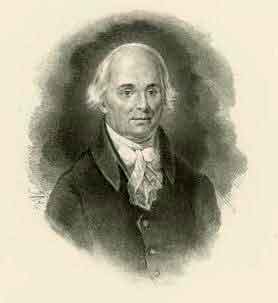
Robert Aitken (1734–1802)
Paine used this platform to rail not only against British overreach but also against slavery, workers’ rights, and early issues of what would now be called social justice. He wrote of his hopes that the Pennsylvania Magazine would, under his guidance, become a “nursery of genius.” It certainly gained him many new friends prominent in the liberty movement, including future signer of the Declaration Dr. Benjamin Rush, who helped him come up with the title of his most influential work, Common Sense.
About the impact of Common Sense, historian Paul Johnson observed:
“The first year of hostilities in America had furnished many actual instances, and many more myths, of brutal conduct by British or mercenary soldiers. Entire towns, like Falmouth (now Portland, Maine) and Norfolk, had been burned by the British. Women, even children, had been killed in the inevitable bloody chaos of conflict. Paine preyed on these incidents: his argument was that any true-blooded American who was not revolted by them, and prepared to fight in consequence, had ‘the heart of a coward and the spirit of a sycophant.’ Crude though this approach was, it went home. Paine cut right through the half-and-half arguments in favor of negotiations and a settlement under British sovereignty. He wanted complete independence as the only possible outcome. Nor did he try to make a distinction, as Congress still did, between a wicked parliament and a benign sovereign. He called George III ‘the royal brute.’”
Not all Americans were so inspired by this piece, and not all would eulogize it as the founding document it is now remembered as. For his part, founding father John Adams initially described it as “a crapulous mass” and took exception to the type of radical democracy it promoted, but then begrudgingly admitted, “Without the pen of the author of ‘Common Sense,’ the sword of Washington would have been raised in vain.” Meanwhile, George Washington himself praised it, writing that “I find Common Sense is working a powerful change in the minds of many men” in favor of independence.
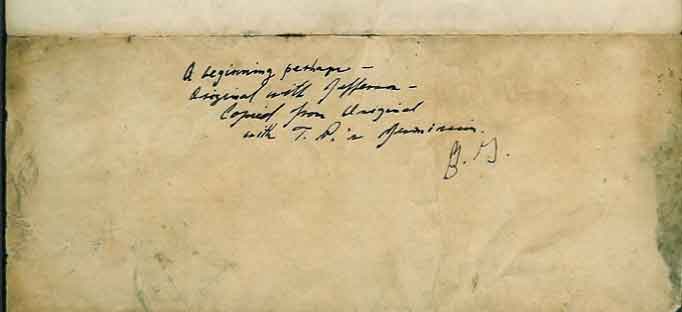
An inscription on the reverse of a Sherman Copy of a Declaration of Independence draft reads: “A beginning perhaps—original with Jefferson—Copied from original with T.P.’s permission”
A powerful change that none relied upon so heavily as General Washington himself, whose militia army was entirely composed of volunteers with expiring terms of enlistment. For its effect alone in stirring the placid businessmen of Pennsylvania and the far-removed planters of Virginia to exert themselves in the struggle—to enlist, to persevere, to find commonality—Common Sense and its controversial author were unquestionably used by Providence in a very specific way and at a crucial time.
Paine was not merely content to remain a commentator on such events, however. In November of 1776 he joined in the sufferings of the army he had helped to raise by volunteering his services as a civilian aide on General Greene’s staff. Enduring with them in the harrowing retreat through New Jersey, Paine gained an intimate perspective on the human cost of the American cause. Sick at heart over the suffering he witnessed in the demoralized Continental Army, he began to craft an essay of a very different nature from his first incendiary piece.
He began what he would title The American Crisis with these immortal lines:
“These are the times that try men’s souls. The summer soldier and the sunshine patriot will, in this crisis, shrink from the service of their country; but he that stands by it now, deserves the love and thanks of man and woman. Tyranny, like hell, is not easily conquered; yet we have this consolation with us, that the harder the conflict, the more glorious the triumph. What we obtain too cheap, we esteem too lightly: it is dearness only that gives every thing its value. Heaven knows how to put a proper price upon its goods; and it would be strange indeed if so celestial an article as FREEDOM should not be highly rated.”
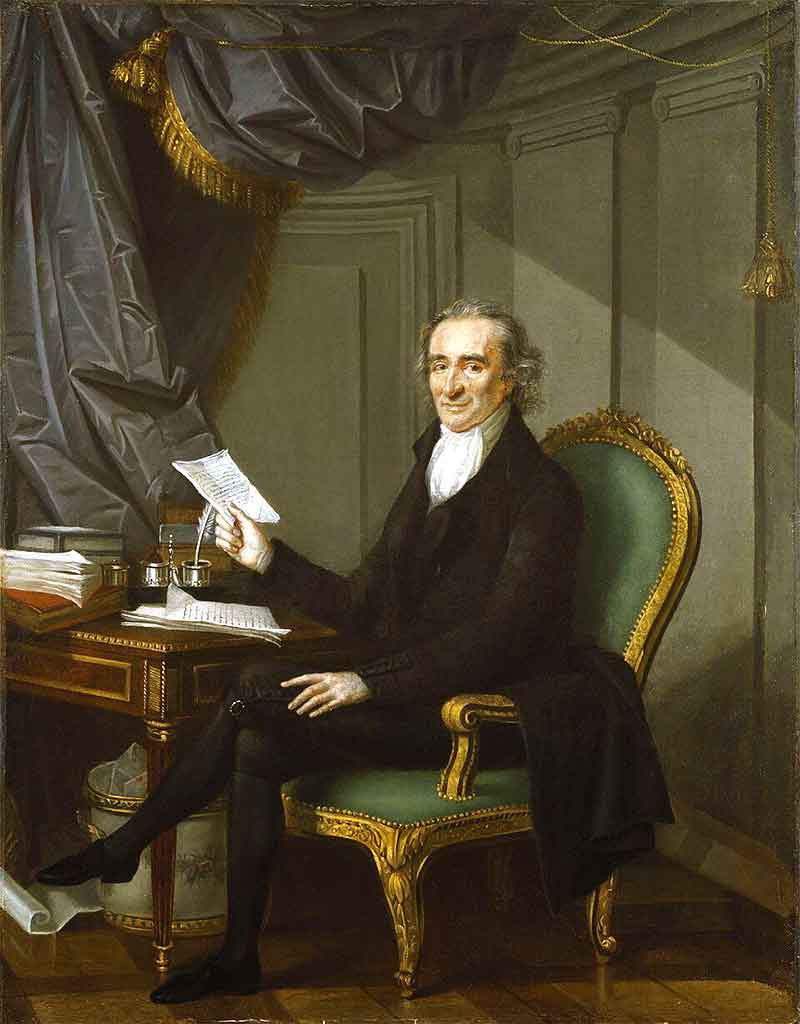
Paine, c. 1791
Despite his personal reservations about the Christian faith that later devolved into deism, Paine expressed in this essay the popular and profound insistence that Divine Providence would sustain the Patriots. Before the harrowing crossing of the Delaware, General Washington ordered his officers to read Paine’s The Crisisaloud to the Continental Army, in the same manner that orders and sermons were read to them. Bolstered by its soaring predictions of success and its commendations of their valor, the patriots won their first victory in over six months at the Battle of Trenton.
The army that had been on the verge of dissolving was invigorated, and the thirteen colonies survived to fight another day. In the darkest hour of 1776, in a year already marked by extraordinary turns of fortune, Providence had used an unlikely instrument—an English-born failure turned American firebrand—to inflame the cause of liberty when it hung by a thread.
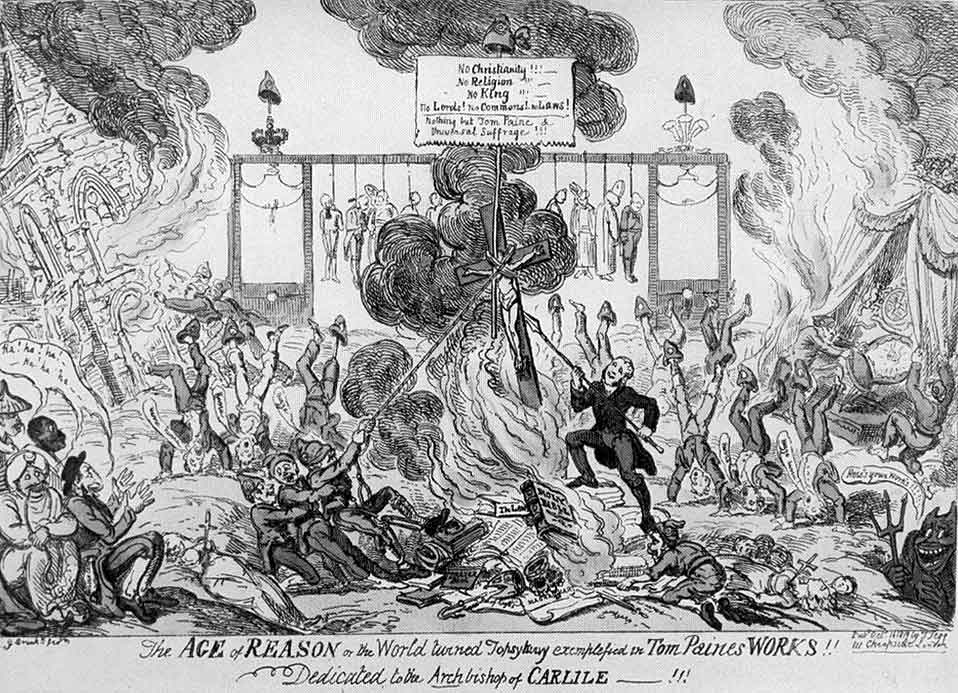
A cartoon criticizing Paine’s The Age of Reason—It is titled ‘The Age of Reason or The World Turned Topsyturvy exemplified in Tom Paine’s Works!!’
After the American Revolution, Thomas Paine’s path took a sharp and ultimately isolating turn. Embracing a more radical deism, he published The Age of Reason, a fierce critique of organized Christianity that scandalized many of his former admirers and cost him the goodwill of large segments of the American public. He threw himself fully into the defense of the French Revolution, only to be imprisoned during the Terror; after his release he accepted the hospitality of the American minister James Monroe, remaining in Monroe’s household for more than a year and a half while recovering his health. From that refuge he turned bitterly on his old ally George Washington, publishing a scathing open letter that accused the president of personal treachery and political hypocrisy for failing to secure his earlier release. Returning at last to America, Paine found himself largely alienated from the very patriots he had once inspired. When he died in 1809, only a handful of people—by most accounts six or seven—attended his funeral.
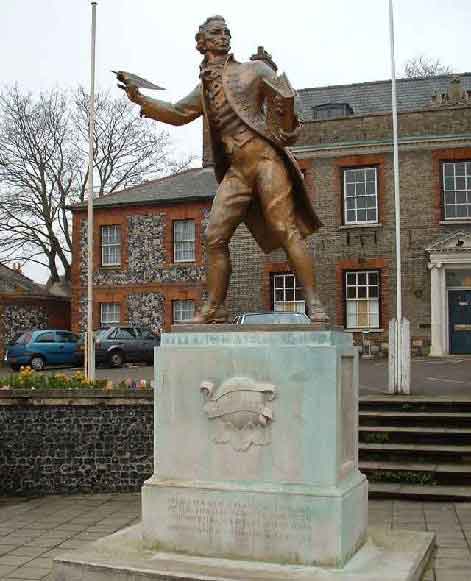
Statue of Thomas Paine in his hometown of Thetford, Norfolk, England