
Profiles of 1776 | Pierre-Augustin Caron de Beaumarchais
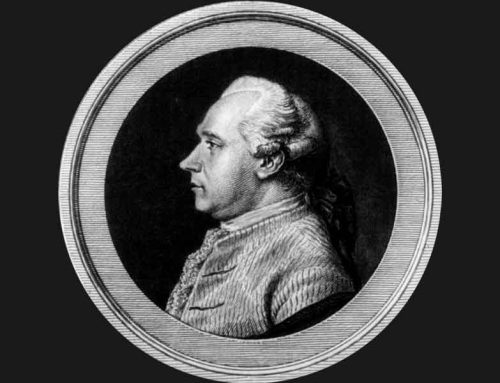
 he greatest of early foreign contributions to the cause of American liberty are owed to the self-made French playwright, inventor, courtier, and secret agent, Pierre Beaumarchais. His tireless advocacy helped turn French strategic interest into concrete arms and supplies for the American cause long before his country supported the colonies publicly. His life story, and that of his involvement, unfolds like material for one of his plays.
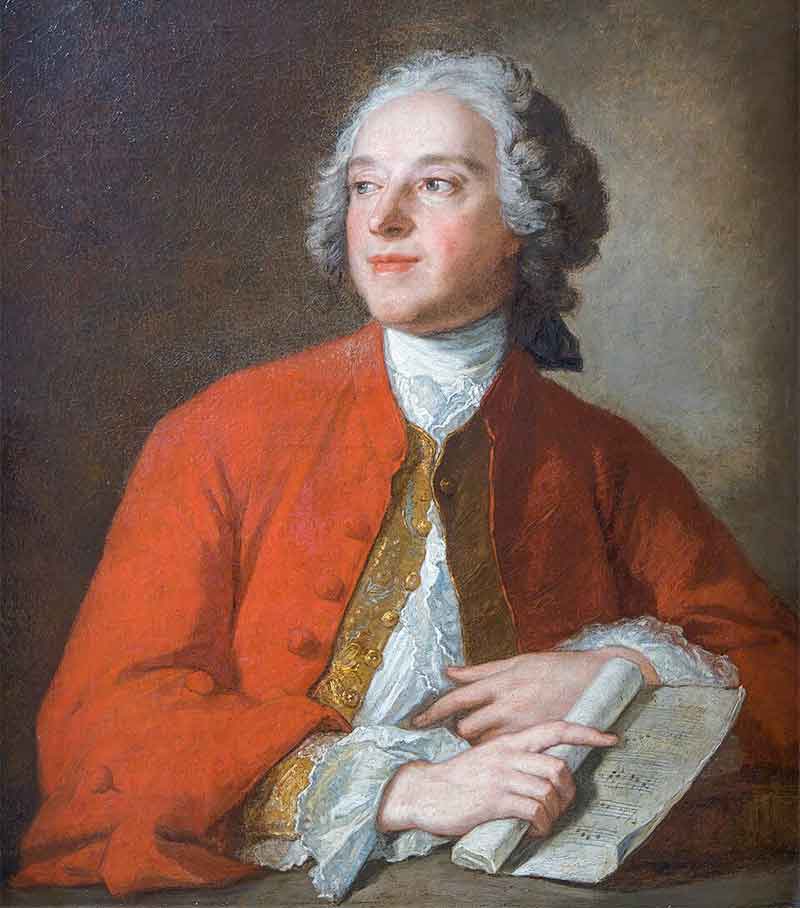
Pierre-Augustin Caron de Beaumarchais (1732-1799)
Born in 1732 among the ranks of the impenetrable middle-class bourgeoisie, Beaumarchais was christened simply Pierre-Augustin Caron, the son of a modest Parisian watchmaker. Almost furiously ambitious to rise above his station and extraordinarily gifted in a variety of capacities, Pierre grew his own clientele among Versailles’ noblemen while he was a teenage apprentice in his father’s shop. So superior was his work that the King granted his father’s shop royal patronage, an honor almost unsupportably wonderful to Pierre’s father.
Yet Pierre remained unsatisfied with simply mending broken mechanisms; he would often add additional features and flourishes of design that his brilliant mind conjured up—these were met with great delight by his noble patrons. He improved a spring invention that garnered recognition from the Academy of Sciences and earned him a spot among the servants living at Versailles.
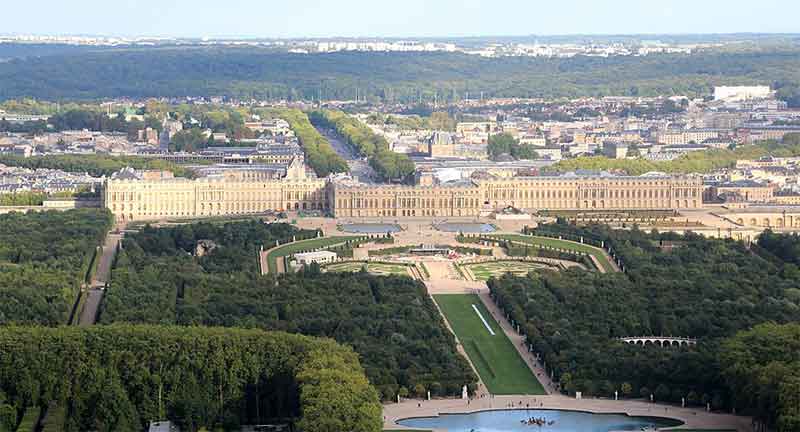
Palace of Versailles, Paris along with a partial view of the extensive gardens
From this rather modest promotion he rose to dizzying heights of reputation by talent, energy, and calculated marriages to wealthy widows. Pierre’s adopted surname, Beaumarchais—by which he is known to history—came from one of these widows.
Soon, Pierre Beaumarchais was a fixture at the French court in a variety of capacities, all of which were rather ingenious and entirely unacknowledged before he invented their roles. His greatest success was becoming the music teacher to the dour, neglected, and easily charmed daughters of the old king, with whom the handsome Beaumarchais was predictably popular. With this gaggle of spinsterly princesses backing him, noblemen indebted to him for work, and wealthy widows giving him their hand in marriage—and their dead husbands’ estates—Pierre-Augustin Caron de Beaumarchais became Lieutenant General of the Royal Hunt, which came complete with the coveted title of nobility. The humble watchmaker’s son had done the impossible in France: he’d become a self-made nobleman.
His ascendancy continued into the 1770s, with his popularity growing at court when he set his hand to writing plays and authored the classic The Barber of Seville. As a man accustomed to intrigue and self-promotion, he also became essential to the King’s foreign ministers as a secret agent for the French government.
This latter occupation led to his decisive work for the American cause in early 1776. For over a decade France had taken great interest in the brewing revolt in the thirteen American colonies, being more than a little pleased at seeing her old enemy, England, in trouble. A month before the Declaration of Independence was signed, France began secretly sending guns, ammunition, and all kinds of war supplies to the Americans.
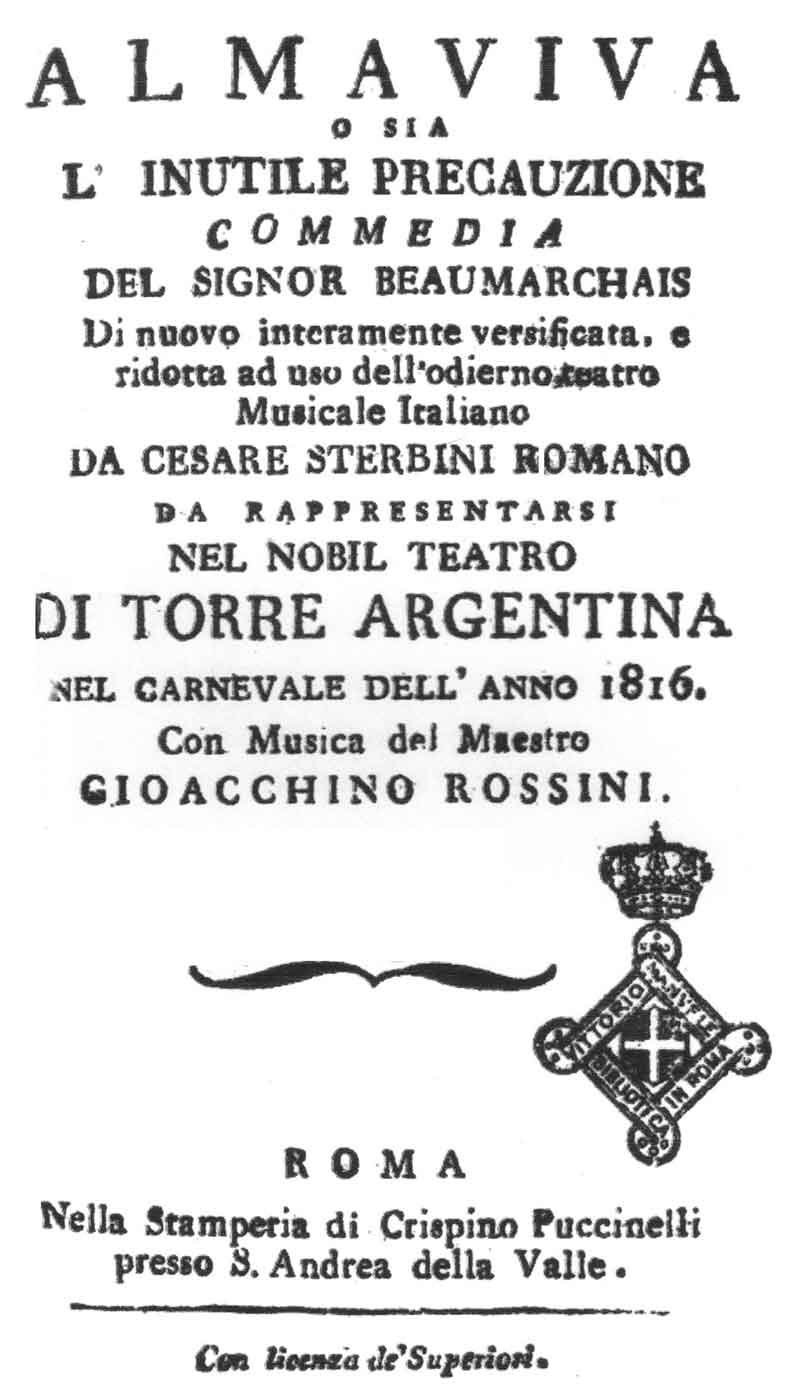
The front page of a copy of The Barber of Seville
Working as a go-between for America’s emissary, Silas Deane, and France’s Foreign Minister, Vergennes, Beaumarchais constructed an elaborate dummy corporation, the Roderigue Hortalez et Compagnie. This company and its fleet of ships became the covert channel through which French (and some Spanish) funds and arms drawn from royal arsenals were sent to the colonies without an open breach of European neutrality.
Beaumarchais was by all accounts delighted to be the chief actor in an international mystery play of such grand proportions, the intrigue and the leverage over court officials being exactly to his taste. However, another and worthier incentive for his work came when he read the Declaration of Independence. The poetically couched claim that “all men are created equal” arrested his attention and resonated with his own struggle to break free from the societal confines of France’s strict class system. Here was an entire country basing itself upon presumptions he’d long held dear but had to disguise beneath sycophantic pretense; from then on his heart seemed to ignite with desire to be of use to the American experiment.
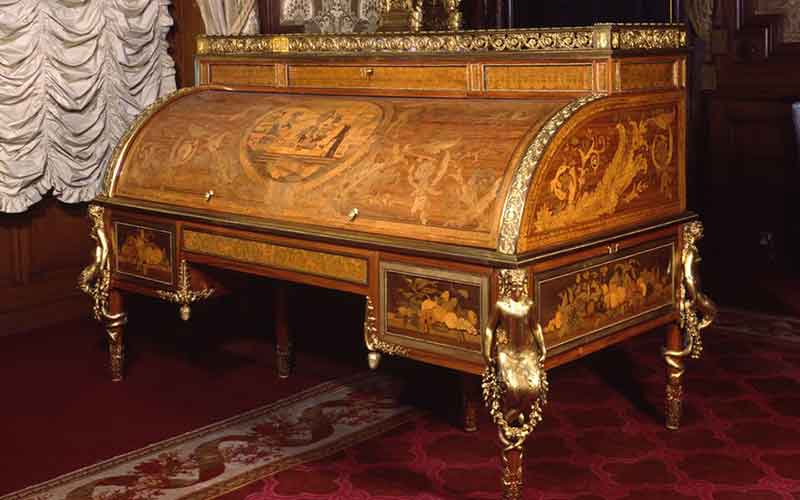
A roll-top desk purported to have belonged to Beaumarchais
He personally met with Silas Deane in Paris in July 1776; the two quickly reached terms: large shipments of muskets, cannon, powder, clothing, and other stores, with Beaumarchais advancing goods and credit under the Hortalez company name. These arrangements in the second half of 1776 laid the groundwork for the critical deliveries that arrived in America in time to equip the campaigns of 1777, including the American victory at Saratoga.
Beaumarchais’ influence is less clearly detailed but nonetheless present in his persuasion of many foreign officers to leave France’s shores—despite the King’s direct decree against such measures—and lend their experience to the Continental Army. He personally lodged, outfitted, and paid for the passage of Von Steuben, the Prussian officer who would become Washington’s drillmaster, and whose drill manuals our army regulations still reference. Of this effort a beaming Beaumarchais wrote a friend that he congratulated himself on having “given so great an officer to my friends, the free men.”
A great blow hit all these covert endeavors, however, when news reached France that Philadelphia had been captured by the British, with Washington’s army and the Congress sent fleeing into the Pennsylvania countryside. It seemed Beaumarchais’ “free men” had failed. But then, one ship later, in came the news of the American victory at Saratoga!
Benjamin Franklin, newly arrived in France and wary of Beaumarchais’ energy and intrigue, hoped this victory might settle the conflict for good. For his part, Beaumarchais was not so sanguine. In a frenzy of excitement, he dashed for his coach upon hearing about Saratoga, eager to be the first to carry the persuasive news to Paris. But, as Franklin would say, “haste makes waste,” and his coach upset and he found himself upside down in the ditch.
He feared that if the Americans made peace with England, then France would be ruined. He was sure England would take revenge on her for the secret help already given, and he would be the first scapegoat offered in diplomatic appeasement. In his mind, there was only one way out now: France must openly join the war!
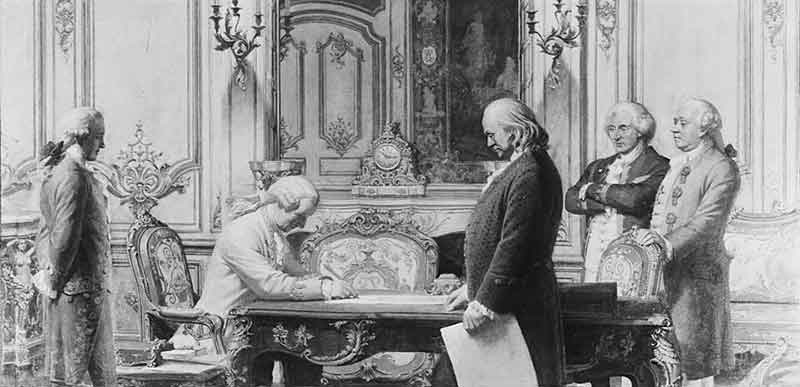
Signing of the Treaty of Amity and Commerce and of Alliance between France and the United States
Of course, we know that Beaumarchais got his wish. In February of 1778 France allied itself with the American Colonies, recognizing them as an independent power and pledging their vast support. The Comte de Vergennes and Dr. Franklin were the most distinguished of the signatories, and Pierre Caron de Beaumarchais was a blithe ghost writer of the treaty. Like the consummate playwright and genius salesman he was, he had advocated and prepared the ground so that the written agreement was ready for King Louis XVI to sign the moment the foreign minister had persuaded the King to do so.
Beaumarchais would go on to continue his support of America’s interests, although now in a public and infinitely more lucrative capacity, as a merchant. He would continue to author plays. His magnum opus was The Marriage of Figaro, which the French King forbade being performed due to its irreverence toward the monarchy. With his typical subterfuge, Beaumarchais appeared to submit but distributed its catchy soundtrack throughout the court anyway, stirring up interest until a petition was at last presented to the king, signed by half of Versailles and the queen herself, begging for it to be allowed. It was just a play, after all.
t’s never “just” anything when it comes to art. In the end, the watchmaker’s son overruled the king. Beaumarchais had his play performed before scores of nobles who clapped, clueless, for performances carefully crafted to ridicule and rebuke the very excesses they themselves represented. The Marriage of Figaro was as a whole ridiculous, but in Beaumarchais’ words, “the only thing more ridiculous than my piece is its success.”
The times were changing. France’s monarchy had backed itself into a contradiction by supporting the American Republic. Unfortunately for individuals like Beaumarchais—and his compatriots, Lafayette and Vergennes—France’s own attempt at liberté, égalité, fraternité plunged the country headlong into the bloodbath of anarchy, then back into tyranny, proving with stark clarity for all the world to note that the prized tree of liberty only flourishes in a society bound by the constraints of Godliness.
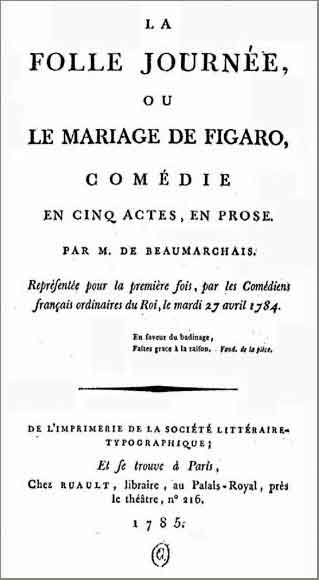
Title page of the first edition of The Marriage of Figaro, 1785
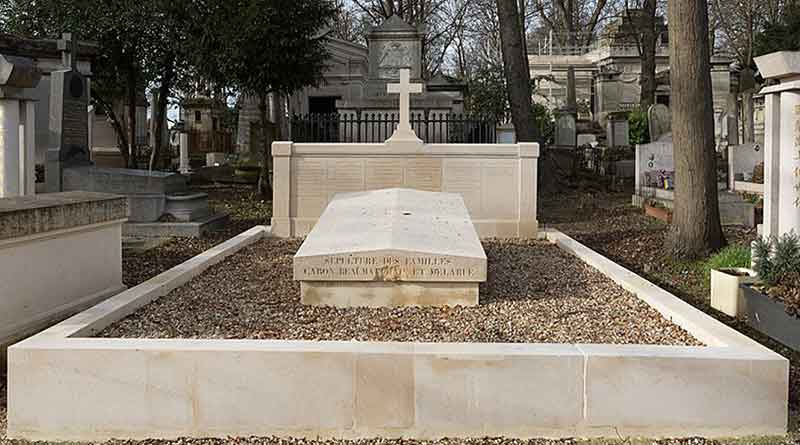
Final resting place of Beaumarchais and his family, Père Lachaise Cemetery, Paris, France