
“‘I will shake all nations, and what is desired by all nations will come, and I will fill this house with glory,’ says the Lord Almighty. ‘The silver is mine and the gold is mine,’ declares the Lord Almighty. ‘The glory of this present house will be greater than the glory of the former house,’ says the Lord Almighty. ‘And in this place I will grant peace,’ declares the Lord Almighty.”—Haggai 2:6-7
Profiles of 1776 | John Hancock
 hile reduced in national memory to little more than his unapologetically large signature at the bottom of the Declaration of Independence, the life and contributions of John Hancock to our founding epoch are numerous and varied, and worthy of broader study.
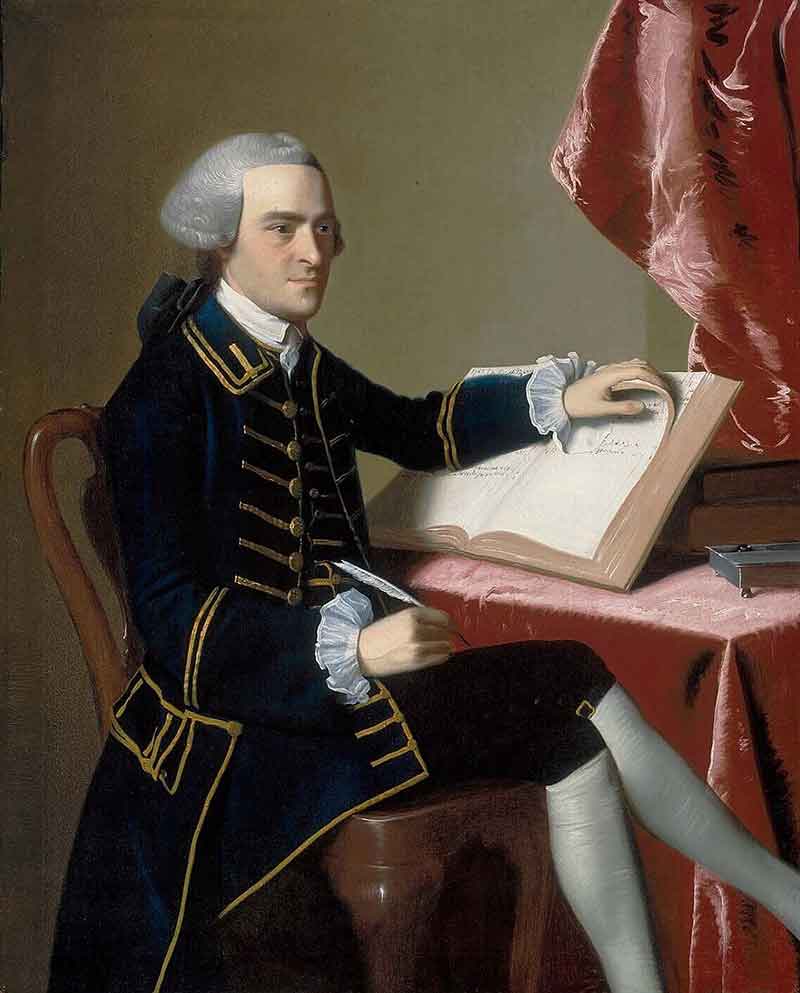
John Hancock (1737-1793)
For while there were many men who wrote and fought and funded the Revolution into being, John Hancock consistently managed to place himself in the thick of things, and to make himself indispensable while doing so. He is lauded as the “purse” of the Revolution, for while others may have given as much or more, none did so as soon or with such abandon as John Hancock. He was also inadvertently the cause of the first shots of the war being fired at Lexington Green on that fateful April day in 1775, being one of the chief objects the British set out to seize—along with powder and arms and his compatriot in the Sons of Liberty, Sam Adams.
So zealous was Hancock in the cause of humanity and of liberty that long before an outright conflict had occurred, it was the talk of Boston how this rich young merchant “poured his heart, soul—and money—into the patriot cause.” One contemporary recalled:
“Charity was the common business of his life. Hundreds of families, from his private benevolence, received their daily bread; and there is, perhaps, no individual mentioned in history, who has expended a more ample fortune in promoting the liberties of his country.”
When in 1766 he was elected, at age twenty-seven, to serve in the state legislature, it was generally remarked to be a wise and good thing, for not only had Hancock proven to be honest in his dealings with his fellows, he was also uniformly generous. Immediately upon taking office, Hancock—who had grown up fatherless and poor—forewent his salary. By electing him, Bostonians had “made that young man’s fortune their own,” in the words of Sam Adams. At that time, no one knew just how true such predictions would prove.
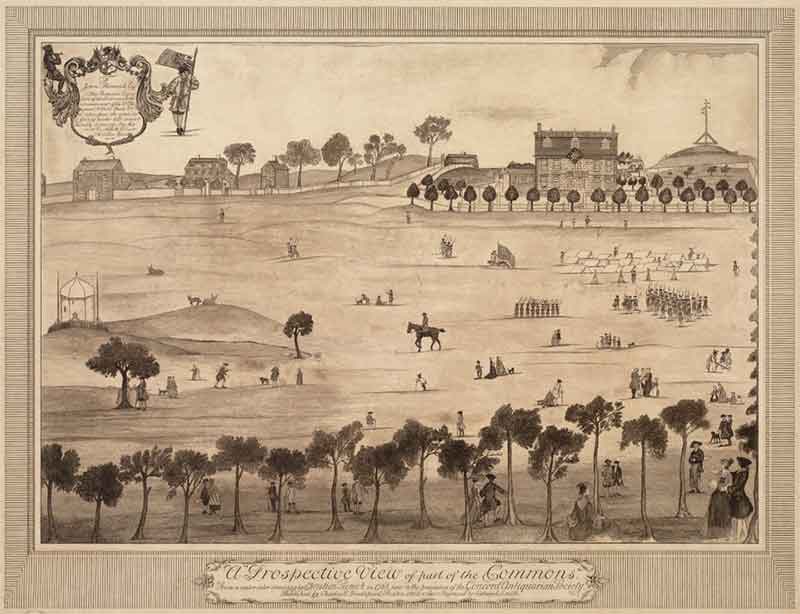
John Hancock’s estate on Beacon Hill, Boston was originally built for his uncle, Thomas Hancock, but inherited by John when his uncle died childless
Having inherited a vast mercantile business from his uncle, with ships and trade being his main source of wealth, Hancock was among those New Englanders first to chafe under the growing imposition of taxes and the Crown’s greatly hated customs officers.
As early as 1768, he clashed with authorities on this matter when one of his ships, the brazenly named Liberty, was seized by the British, with Hancock being accused of smuggling cargo without paying the proper duty. In the words of historian Denis Kiernan:
“This accusation was hardly a shock: Hancock was an unabashed smuggler at a time when smuggling was considered by Americans as the only reasonable response to unreasonable taxation.”
The charges were dropped against Hancock, but the Liberty was pressed into service as a royal vessel. Bostonians took this poorly, a riot ensued—one that Hancock probably did not want—and the ship ended up burned. For better or worse, his name was thus thrust further into the public consciousness. Explosions of public vitriol such as this convinced the British to present a more forceful presence in Boston Harbor, raising tensions that eventually lead to the Boston Massacre in 1770 and the Boston Tea Party three years later.
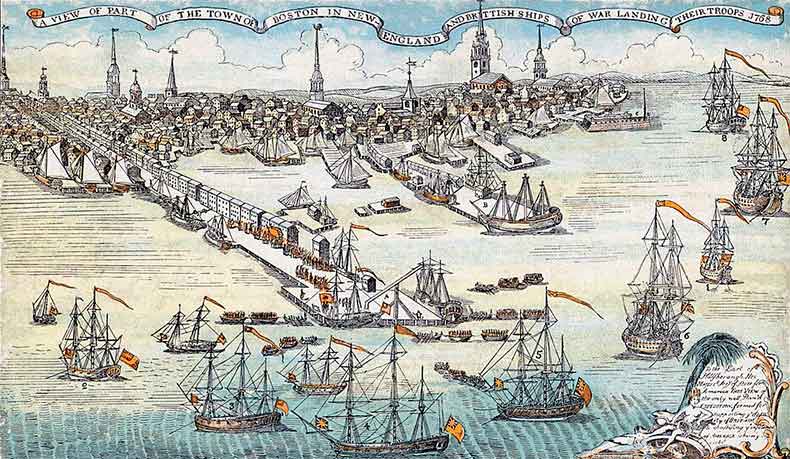
Paul Revere’s 1768 engraving of British troops arriving in Boston was reprinted throughout the colonies.
Soon Boston was filled with regiment after regiment of the King’s soldiers brought in to ostensibly keep the peace; they instead imposed a form of martial law that turned many docile and law-abiding citizens into patriots. The incoming Coercive Acts fully closed the port of Boston, creating mass panic and scarcity. Daily the ranks of Sam Adams’s fiery Sons of Liberty swelled, and their somewhat dubious tactics grew bolder with the backing of John Hancock’s coffers.
For his part, Hancock put the blame squarely on the King himself, stating in an oration on March 5, 1774:
“The town of Boston, ever faithful to the British crown, has been invested by a British fleet; the troops of George the Third have crossed the Atlantic, not to engage an enemy, but to assist a band of traitors in trampling on the rights and liberties of his most loyal subjects; those rights and liberties, which, as a father, he ought ever to regard, and as a king, he is bound in honour to defend from violation, even at the risk of his own life.”
Hancock was elected President of the Massachusetts Provincial Congress of Patriots in October of 1774. In turn, the king’s Governor, General Thomas Gage, began to regard Hancock as a traitor and outlaw. It was under Hancock’s guidance that the citizenry of Massachusetts raised bands of “minutemen,” citizen militia who trained so that they could be ready to join a fight in sixty seconds. They would soon be called upon, and their action would make history.
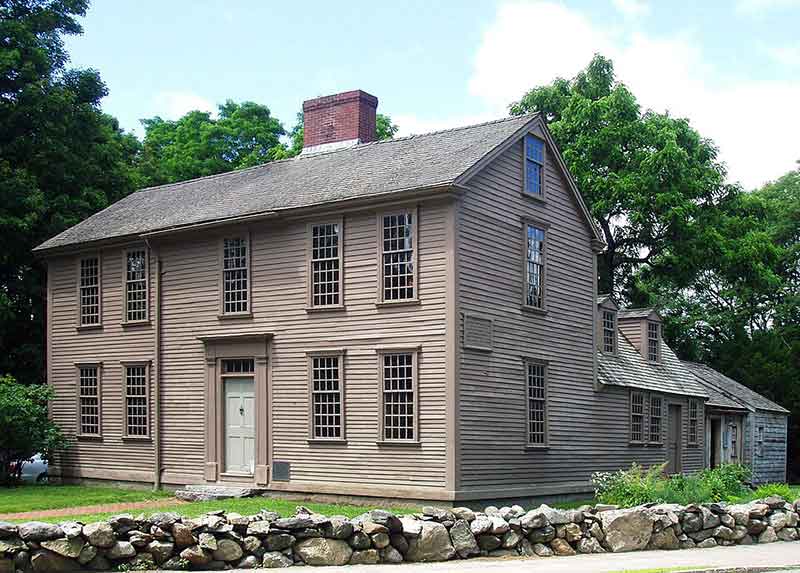
The Hancock–Clarke House in Lexington, Massachusetts was built in 1738 by John Hancock’s grandfather of the same name, having purchased the land in 1699. Hancock himself lived here a few years as a child when his father was the parson, but at the time of the events below, it was occupied by Rev. Jonas Clark who succeeded Hancock’s father as parson.
Then, in April 1775, British troops were sent from Boston to capture Hancock and Samuel Adams at Lexington, as well as stored munitions at Concord. Paul Revere—one of many who spread the warning as midnight riders—was the one to gallop into Lexington and warn Hancock of his impending capture. Hancock was at this time engaged to Dorothy “Dolly” Quincy, who later became his wife, and on that fateful night the two were at a dinner in the parsonage of Rev. Jonas Clarke at Lexington.
Never one to be constrained to any typical sphere of action, Hancock’s initial reaction to the news was to join the minutemen on the village green and take a stand; the parson—with the weighty pleas of Hancock’s fiancée—persuaded him it was prudent to run and avoid being taken captive. He and Samuel Adams, also residing there for the night, fled toward the village of Woburn.
Their escape was narrow enough that they heard the gunshots from the ensuing skirmish, and Samuel Adams exclaimed, “what a glorious morning this is!” as they made good their flight. Governor Gage promptly offered pardons for those who took up arms, but he made exceptions only for “. . . Samuel Adams and John Hancock, whose offenses are of too flagitious a nature to admit of any other consideration than that of capital punishment.“
Undaunted from this close call, these two Sons of Liberty journeyed to the meeting of the highly illegal Second Continental Congress, over which John Hancock would eventually preside as President. Further undaunted in private as well as public life, Hancock chose to wed Miss Dolly Quincy during this turbulent time. They would have two children together, a girl and a boy. Tragically, neither would survive them into adulthood.
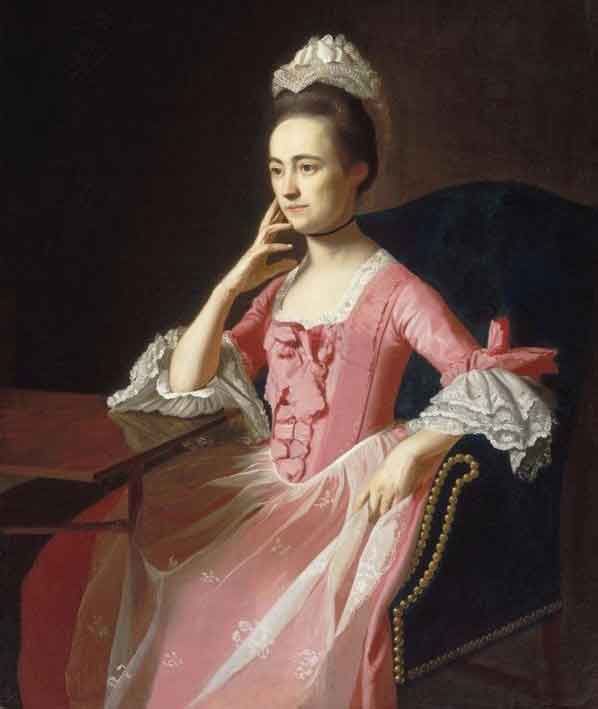
Dorothy Quincy (1747-1830), as painted in 1772
In the capacity of President of the Congress, Hancock was the first to affix his name to the Declaration of Independence on July 4, 1776, placing it boldly large and intentionally central. He was reported to have said, “There! [England] can read my name without spectacles and may double his reward on my head!”
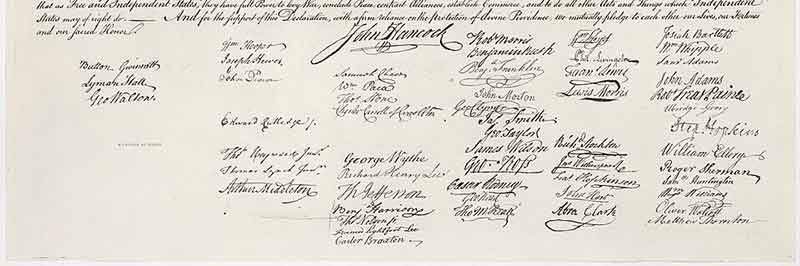
The signature portion of the Declaration of Independence, with John Hancock’s iconic signature prominently visible at the top
The result was that John Hancock’s name became second only to that of George Washington as a symbol of freedom and defiance in the colonies. But it wasn’t the large signature alone that did that; it was Hancock’s vehement willingness to risk all his properties during the protracted siege of Boston that made this millionaire beloved amongst the ordinary men of the cause. His lavish home on Beacon Hill had initially been spared during the British occupation of Boston because General Clinton made it his headquarters, enjoying the opulent comforts it provided and draining the wine cellars. Clinton also hosted grand parties there, and the British gained much amusement from eating off the wealthy rebel’s silver and plate. They also sought out an erstwhile sweetheart of Hancock’s whose house he had bought and furnished, hoping she might betray him, but she refused and took ship to flee Boston for good.
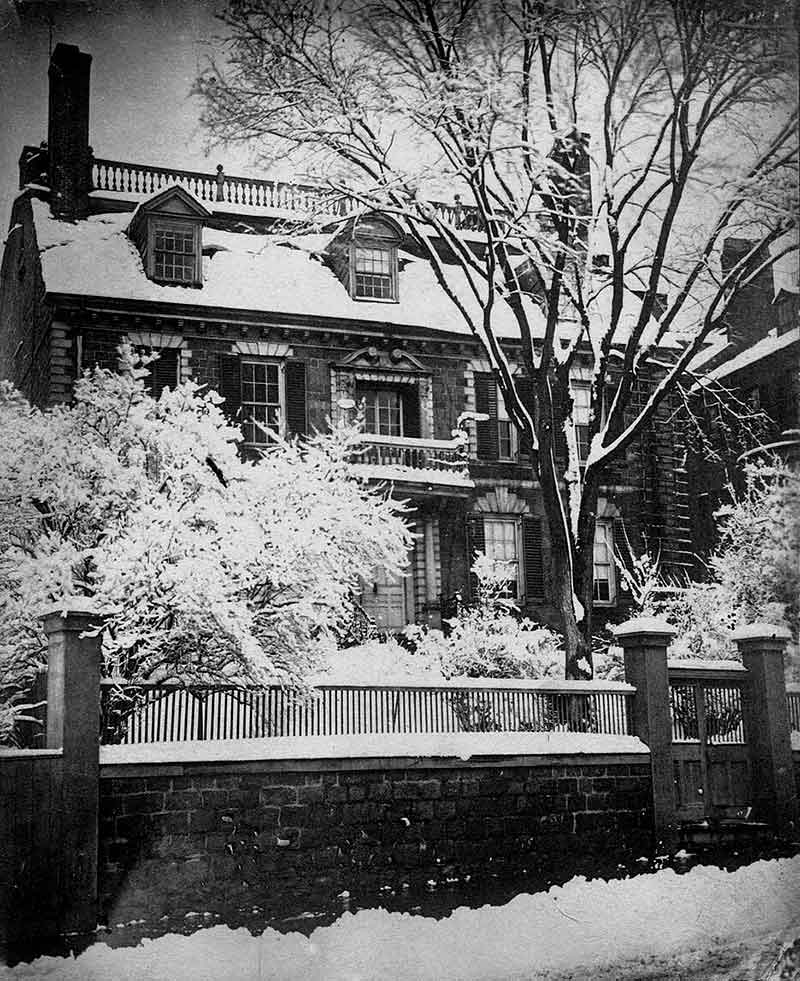
Hancock Manor, Boston, photographed in 1860—the house remained full of the Hancock family’s belongings and exactly as they left it until 1863 when it was sold at auction for $230, emptied, and demolished.
During the siege, General Washington had kept in close contact with President Hancock, fully relying on the latter to supply him with provisions and civil direction in the war. A vote was held in Congress to debate General Washington’s proposal to drive out the British occupiers by bombarding Boston. Far away from the deprivations of the patriot army, many delegates objected to so strong a measure: many had friends and relations still in the town, others had their homes and businesses there, and still more had qualms about destroying property on such a large scale.
None, however, had more to lose from a bombardment than their President. But Hancock’s response to Washington? “Burn Boston, burn. Though it makes John Hancock a beggar—if the public good requires it.”
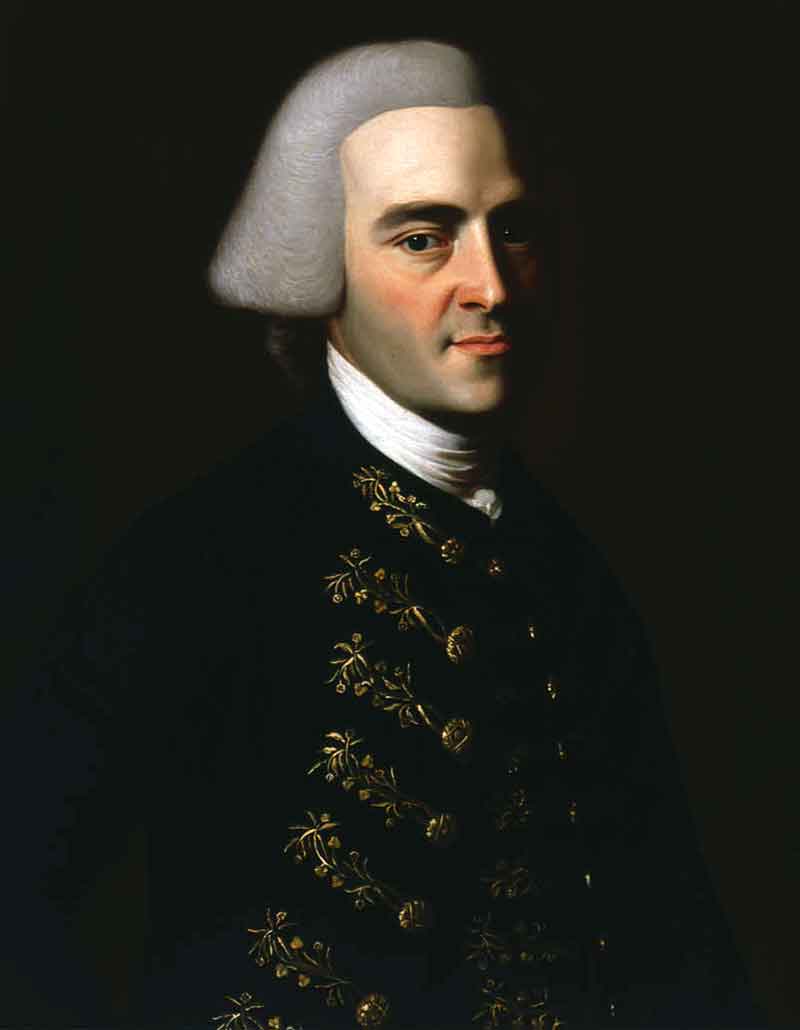
John Hancock in 1770
Much more could be told of this great man: how he served in the Congress long past the opening act of the Revolution, how his hospitality once saved a contingent of our French allies from being lynched by angry Bostonians, how he charmed the southern delegates of the Congress into cooperation with their Yankee compatriots, as well as his exemplary service as Massachusetts’ first elected governor. In this office he died at age fifty-six, the war having eroded his health greatly but not his zeal or charm.
In a request that was atypical for this flamboyant character, Hancock left instructions for his funeral be a quiet affair. He got no such thing. It was a huge procession, all pomp and circumstance, with all of Boston turning out to honor him. Bells rang, soldiers marched, stores closed, flags flew. Once again, second to Washington’s own, the memorial of John Hancock stirred public gratitude to overflowing.
His fellow patriot and erstwhile rival, John Adams, gave this testimony of him:
“Mr. Hancock had a delicate constitution. He was very infirm; a great part of his life was passed in acute pain. . . . Yet it was astonishing with what patience, perseverance, and punctuality, he attended to business to the last. Nor were his talents or attainments inconsiderable. They were far superior to many who have been much more celebrated. No man’s property was ever more entirely devoted to the public.”
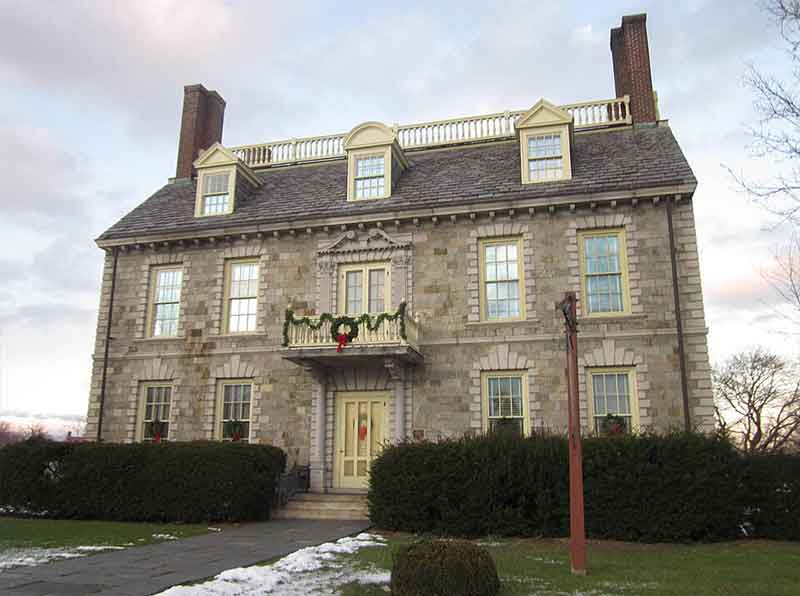
Hancock House—a replica of Hancock Manor, Boston, and reconstructed in Ticonderoga, New York—serves as a memorial and museum to John Hancock’s legacy
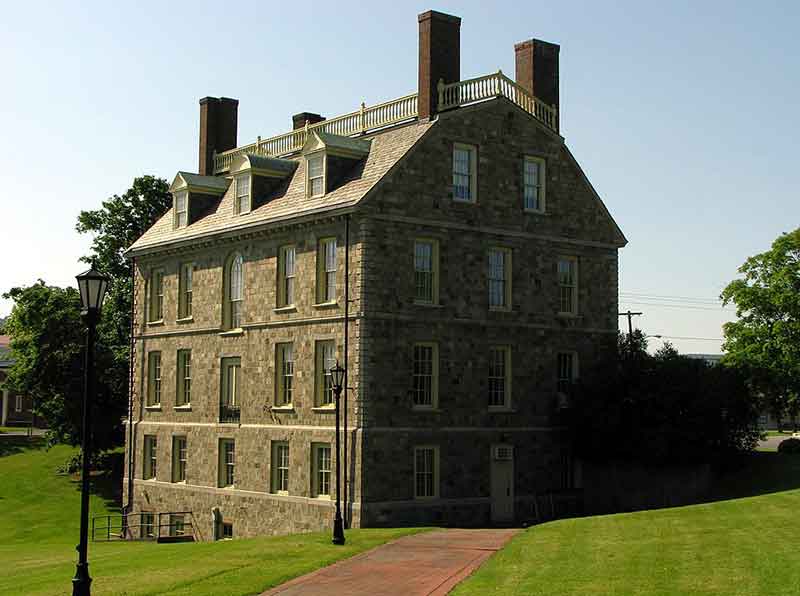
Rear elevation of Hancock House, Ticonderoga, New York
Image Credits: 1 John Hancock, 1765 (wikipedia.org) 2 Hancock Estate (wikipedia.org) 3 Revere’s Boston Harbor (wikipedia.org) 4 Hancock-Clarke House (wikipedia.org) 5 Dorothy Quincy (wikipedia.org) 6 Hancock’s signature (wikipedia.org) 7 Hancock Manor (wikipedia.org) 8 Hancock, 1770 (wikipedia.org) 9 Hancock House, NY (front) (wikipedia.org) 10 Hancock House, NY (rear) (wikipedia.org)