The Birth of Alexander Graham Bell, 1847

2023-02-27T17:40:51-06:00February 27, 2023|HH 2023|

“So God created man in his own image, in the image of God created he him; male and female created he them and God blessed them, and God said unto them, Be fruitful, and multiply, and replenish the earth, and subdue it: and have dominion over the fish of the sea, and over the fowl of the air, and over every living thing that moveth upon the earth.”
—Genesis 1: 27, 28

The Birth of Alexander Graham Bell, March 3, 1847

At the beginning of the 21st Century, American historian Arthur Herman published a book entitled How the Scots Invented the Modern World: The True Story of How Western Europe’s Poorest Nation Created Our World & Everything in It. As lofty titles go, this is hard to surpass. He gives more than passing respect to the “great man theory” of history, citing the lives and ideas of men whose works during the “Scottish Enlightenment” and beyond made the modern world. Not all of them remained in Scotland to accomplish their ends. Alexander Graham Bell’s genius was unleashed on the world from America.


Alexander Graham Bell (1847-1922)

A stone inscription on South Charlotte Street in Edinburgh, Scotland marks the birthplace of Alexander Bell. Although his parents neglected to give him a middle name, he badgered them for one until they relented on his 11th birthday, March 3, 1858. He chose Graham in honor of a friend from Canada. Alexander and his two older brothers attended Edinburgh high school and the Presbyterian Church until their deaths from tuberculosis at the ages of 19 and 25. Alexander went on to study at the University of Edinburgh. His father developed a “visible speech system” he hoped would prove a universal speech prototype for a phonetic alphabet. Speech pathology was never far from Aleck’s mind since his mother lost her hearing and his future wife also became deaf.


Alexander Melville Bell (1819-1905) and David Charles Bell (1817-1902), Alexander Graham Bell’s father and uncle, respectively, who were both elocution and speech scholars, teachers, and authors


A chart of “Visible Speech” for English phonetics, a system developed by
Alexander Melville Bell

After leaving school at fifteen, Alexander lived with his grandfather in London, learning to speak clearly and distinctly; elocution became both his father’s and grandfather’s passion. His father published several books on elocution, one of which sold more than a half million copies in the United States alone. Young Aleck taught himself to play the piano with remarkable skill, conducted various kinds of scientific experiments with his best friend, and learned to use his voice in unique ways, including a kind of ventriloquism with which he entertained family guests. Eventually young Bell could decipher “visible speech” in Latin, Gaelic, and Sanskrit, and pronounce passages without prior knowledge of the pronounced language.


The Bell Homestead National Historic Site, Brantford, Ontario, Canada also showing a monument dedicated by Queen Elizabeth II in 1997

In 1865 the Bells moved to London for continuation of their elocution demonstrations, and for Aleck to attend university, where he continued experiments with electricity and voice. London was the epicenter of the industrial revolution and the air was filled with coal dust smoke, dampness, and severe overcrowding. The two eldest Bell brothers contracted TB and other family members fell ill, including Aleck. The brothers died and the surviving Bells moved to Ontario, Canada, hoping a more salubrious climate would bring better health. In their new home, Aleck’s health improved, he learned the Mohawk language, and transcribed it into “visible speech symbols,” for which he was made an honorary chief. Bell also continued his experiments transmitting sound along a wire by modifying a melodeon.


The carriage house on the Bell homestead used by Bell in his early experiments


A portion of the Bell Homestead’s parlor, restored to the Victorian era style maintained by the Bells, using many of their original furnishings and artifacts, including their melodeon, seen in front of the window at center

Alexander Graham Bell moved to Boston to train the teachers of the Boston School for the Deaf using the Visible Speech System invented by his father, to be used to help “connect the deaf and hard of hearing to the hearing world.” Within a year he established a private practice in Boston, attracting students from all over New England. He encouraged speech therapy and lip reading over sign language, thus furthering the ongoing battle with the convinced sign language advocates for teaching the deaf. One of his earliest students was Helen Keller. Along with teaching, the brilliant Scotsman continued his experiments with the “harmonic telegraph.”


Bell, top right, provided pedagogical instruction to teachers at the Boston School for Deaf Mutes, 1871; throughout his life, he referred to himself as “a teacher of the deaf”

In 1874 he told his father in their house in Ontario that “if I could make a current of electricity vary in intensity precisely as the air varies in intensity during the production of sound, I should be able to transmit speech telegraphically.” Other scientists were working on similar concepts but “as usual . . . with Scottish scientists and engineers, it was his ability to organize and systematize the ideas of others, and beat them to the punch, that ultimately paid off.” He and his friend Thomas Watson devised a telephone which transmitted sounds over a wire, and filed for a patent on St. Valentine’s Day of 1876. His leading competitor was two hours behind in filing! On March 10, Alexander Graham Bell spoke to his friend Watson for the first time, in a different room over a wire. Within two years President Rutherford B. Hayes installed the first telephone in the White House.


Thomas Watson (1854-1934) was an assistant to Alexander Graham Bell, notably in the invention of the telephone in 1876
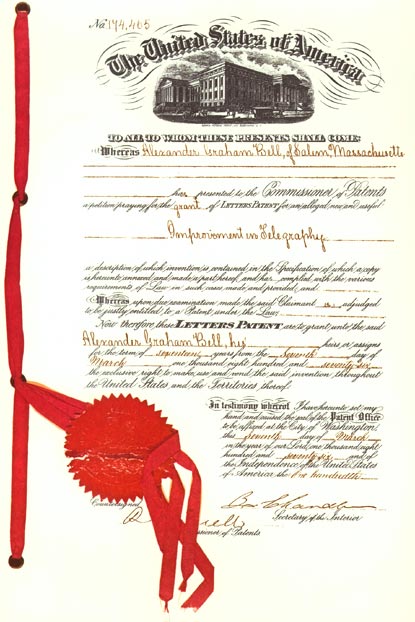

Bell’s patent for the telephone

The telephone “permitted direct, personal, long-distance communication, not just station–to-station [like the telegraph], but person-to-person.” Aleck set up the National Bell Telephone Company in 1877 to manufacture his invention. He had to contend with six hundred lawsuits from the numerous competitors (including Western Union and their resident genius, Thomas Edison) who were late to the patent office or claimed precedent of ideas. Within seven years Alexander Graham Bell had earned more than a million dollars, moved to Washington D.C., built a magnificent home, and continued spending hundreds of thousands of dollars on new research for his work with the deaf, and improving the telephone. Bell Telephone and AT&T helped launch the 20th Century. The rest is history.


Alexander Graham Bell making the first long-distance telephone call from New York to Chicago in 1892


The Bells lived increasingly at their estate in Beinn Bhreagh—meaning “Beautiful Mountain” in Scottish Gaelic—Victoria County, Nova Scotia from about 1888 until his death in 1922, initially only in the summer and then later often year-round. Its landscape, climate, and Scottish traditions and culture were reminiscent of his birthplace in Edinburgh, Scotland.

While Bell was not in the wealth category of fellow Scot Andrew Carnegie or the other industrial giants like Henry Flagler, John Rockefeller, and J. P. Morgan, he had successfully joined the club of brilliant entrepreneurs of the Industrial Age, improved the lives of millions with telephone technology, and invested heavily in improving the lives and abilities of the deaf. Another Scot had taken seriously the biblical injunction to have dominion over the creation, and became an analog creator himself.

*Quotes taken from How the Scots Invented the Modern World by Arthur Herman.


Alexander Graham Bell, his wife Mabel, and their daughters Elsie May Bell (1878–1964) and Marian “Daisy” Hubbard Bell (1880–1962) circa 1885

Battle of Buena Vista, February 1847

2023-02-20T15:06:23-06:00February 20, 2023|HH 2023|

“From whence come wars and fightings among you? come they not hence, even of your lusts that war in your members? Ye lust, and have not: ye kill, and desire to have, and cannot obtain: ye fight and war, yet ye have not, because ye ask not. Ye ask, and receive not, because ye ask amiss, that ye may consume it upon your lusts.” —James 4:1-3

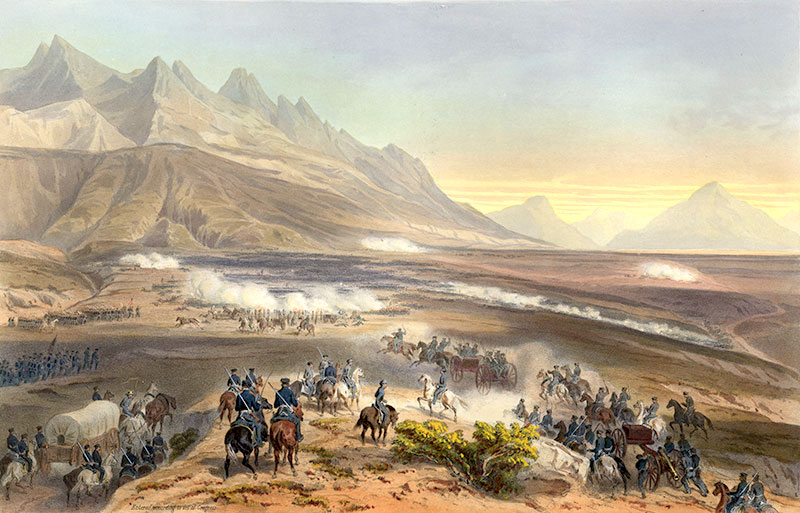
Battle of Buena Vista, February 22-23, 1847

Following the successful fight for Texan independence from Mexico, certain U.S. congressmen and senators began lobbying for adding the Republic of Texas to the United States. A number of states opposed the annexation of Texas, believing it would come into the Union as a slave state, and they were determined not to allow the creation of another Southern State. Nevertheless, after ten years of bitter debate, the Republic of Texas became the 28th state of the Union on December 29, 1845.
Sam Houston’s December 12, 1835 recruitment proclamation as Commander-in-Chief of
the new, paid Army of the Republic of Texas

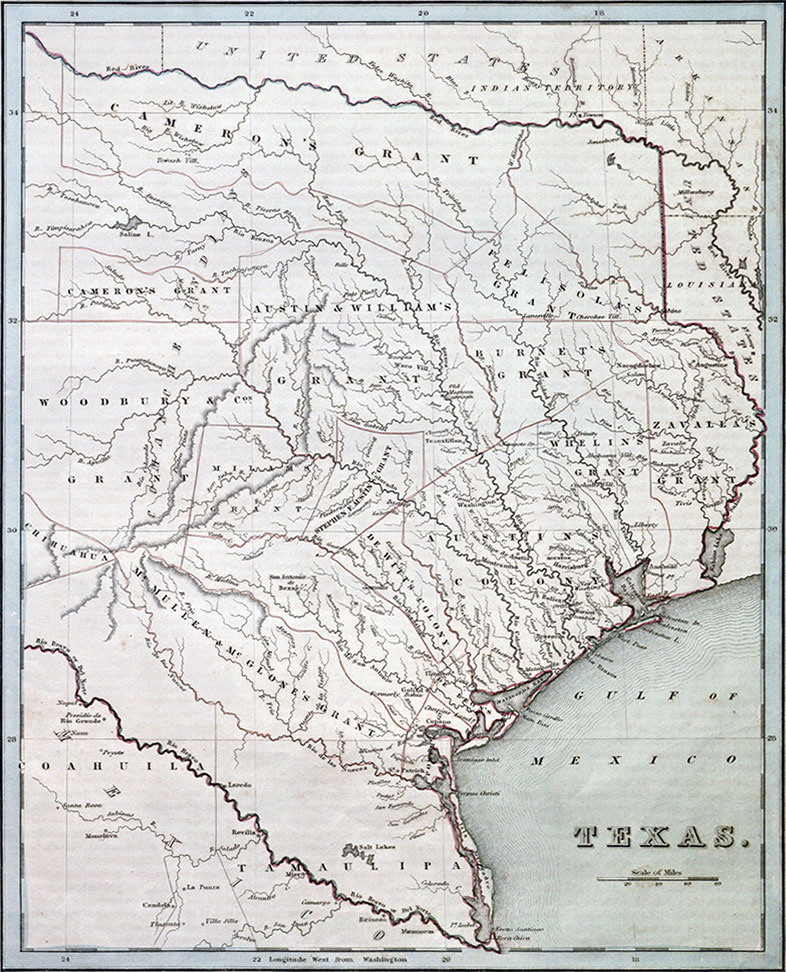
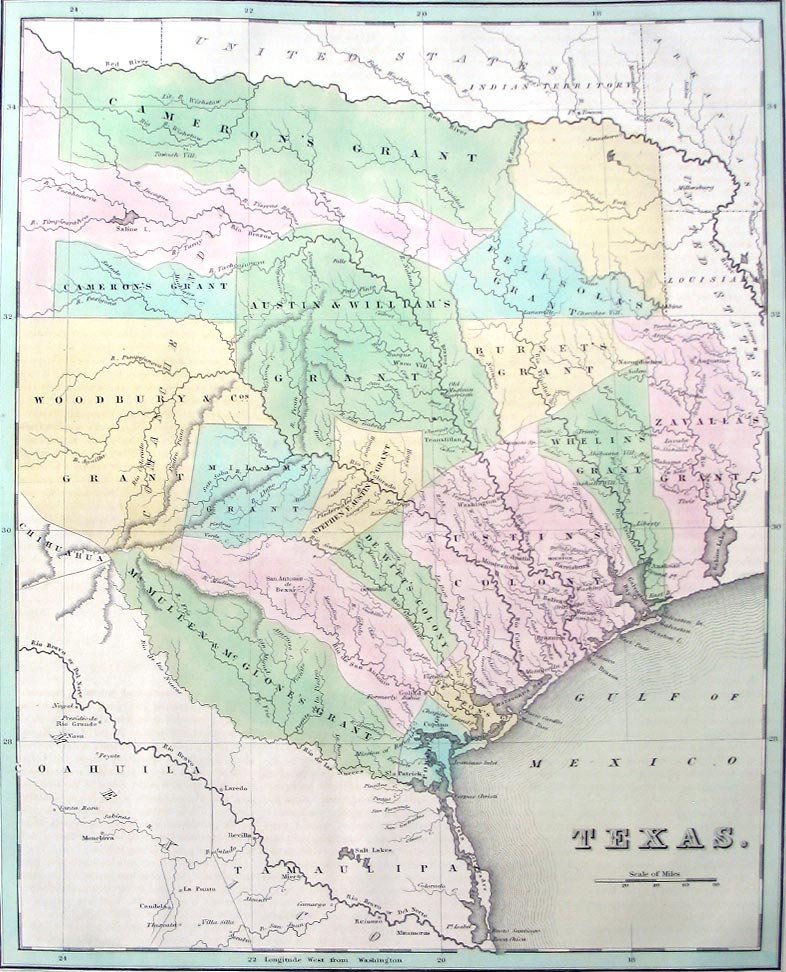
Mexico had never really accepted Texas independence, and rejected that territory becoming a part of the United States. The Mexicans considered the Nueces River the southern boundary of their Texas province; Texas claimed the Rio Grande as the southern boundary. The enemy claimants to the land between those rivers clashed several times before American President James K. Polk ordered troops to retaliate against Mexican forces. The clashes resulted in a declaration of war by both parties and the Mexican/American War exploded along the no-man’s land between the rivers.


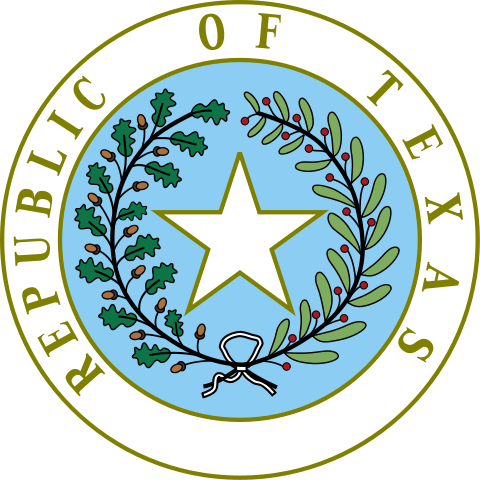
Seal of the Republic of Texas, 1839-1845


An 1838 map of the Republic of Texas showing the Rio Grande as the southern boundary, as recognized by the Republic of Texas…


…Versus a map of the same time and by the same cartographer showing the Nueces River as the southern boundary, as recognized by Mexico

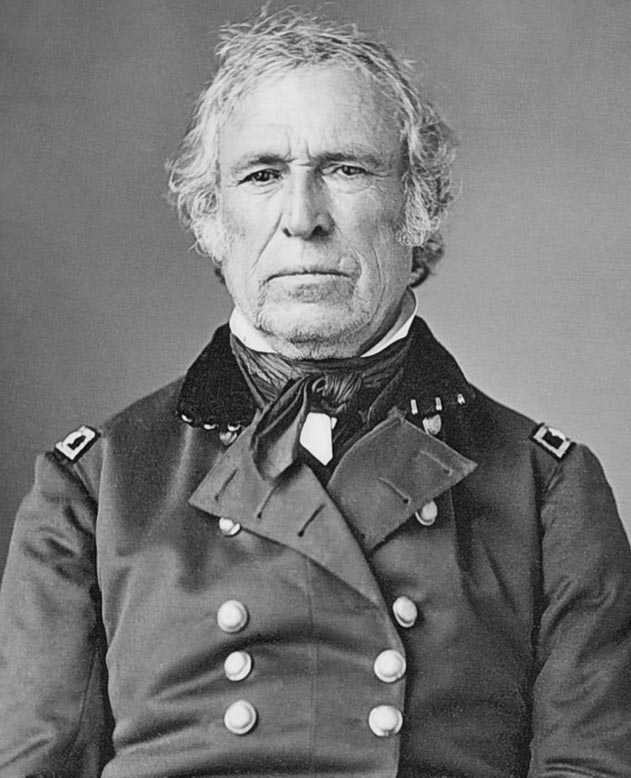
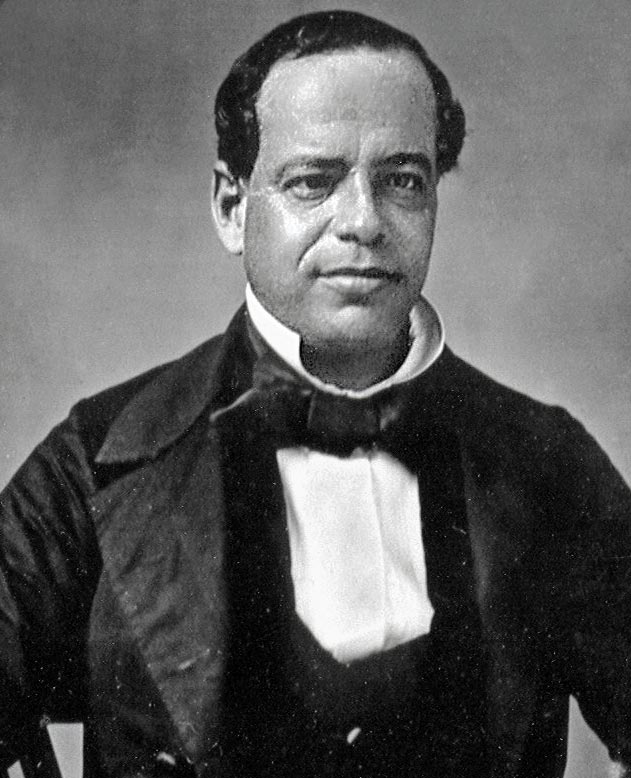
General Zachary Taylor and about 4,700 American infantry and cavalry were ordered by the President and the overall American commanding General Winfield Scott to remain near Monterrey, close to the Rio Grande border. Taylor instead moved south to a more strategic blocking position. At the same time, the commanding General of the Mexican Army, Antonio Lopez de Santa Ana, led his forces within five miles of Taylor’s command, capturing a hundred American troopers.

The Mexican army outnumbered Taylor about 20,000 to 5,000. The disparity in numbers was offset somewhat by the Mexicans’ lack of weapons for all the soldiers, many of whom were green troops, never having fired a gun anyway. Santa Ana’s force included about 5,000 women. Attrition by the cold weather, sickness, and desertions cost the Mexican General several thousand of his army. Near the Hacienda de San Juan de Buena Vista, Santa Ana struck the drawn up American army.


The Battle of Buena Vista took place near the village of Buena Vista in the state of Coahuila, about 7.5 miles south of Saltillo, Mexico

General Taylor’s second in command, General John Wool, made the disposition of regiments from Indiana, Kentucky, Arkansas, and Texas, as well as his artillery batteries. Santa Ana chose to attack on George Washington’s birthday, an auspicious boost to American morale. Some of the enemy soldiers assumed, like the generality of Americans today would also likely believe, that President Washington was in command, though having died some 47 years earlier.


Zachary Taylor (1784-1850), commander of the American troops


Antonio de Padua María Severino López de Santa Anna y Pérez de Lebrón (1794-1876), usually known as Santa Anna, commander of the Mexican troops

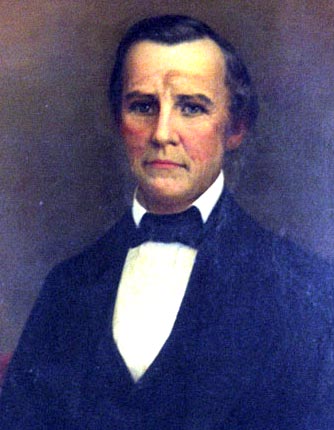
The Mexican commander sent a demand for Taylor to surrender before the battle began, outnumbering the Americans 4-1. Taylor’s reply, given by his aide William Wallace Bliss, curtly rejected Santa Ana with these words: “I beg leave to say that I decline acceding to your request.” At half past three in the afternoon, the Mexican skirmishers struck the left flank of the American battle line, without much loss on either side. Nightfall ended the introductory phase of the battle. The following morning 7,000 Mexican soldados struck the left flank in force, while an attack force feinted toward the right flank to hold those regiments in place, driving the Indiana brigade from the field, and forcing the Illinoians into a fighting withdrawal. With the rout of the American cavalry, Colonel Archibald Yell—former congressman and governor of Arkansas, but inexperienced and inept general—was killed. Yell County and the Yell Rifle were named after him and three of his subordinates and his son all became Confederate generals in the next war.


Archibald Yell (1797-1847) was killed in action at the Battle of Buena Vista


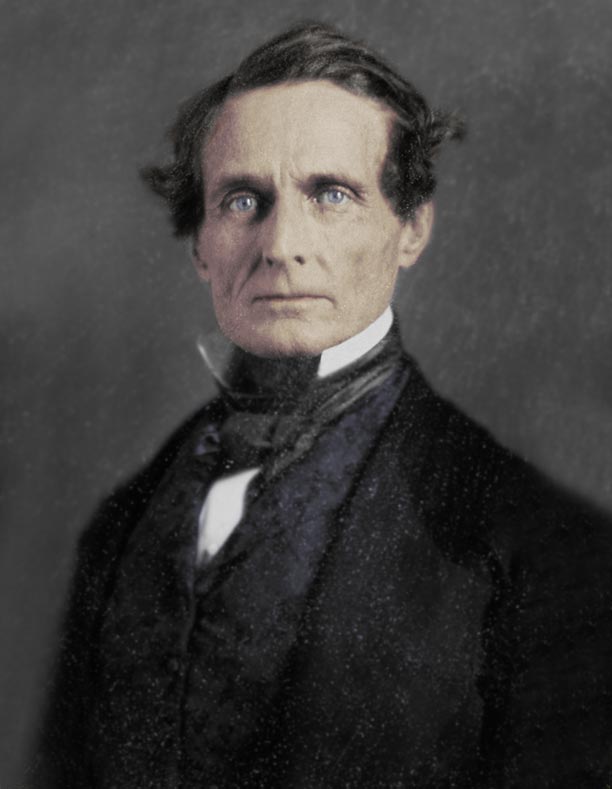
Jefferson Davis (1808-1889)


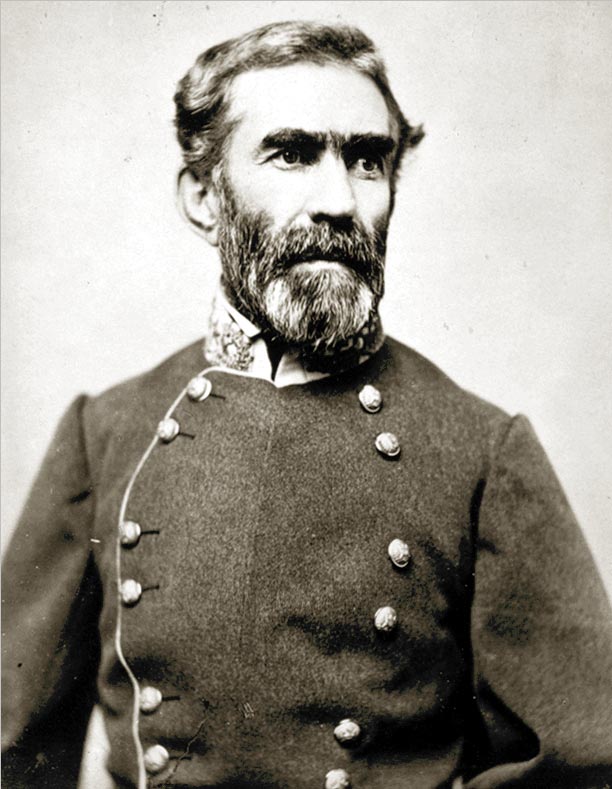
Gen. Braxton Bragg (1817-1876)

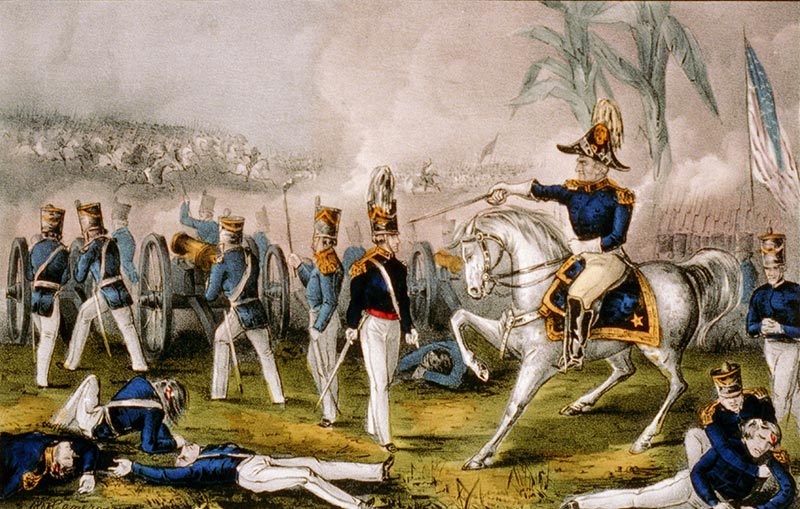
Colonel Jefferson Davis and his Mississippi riflemen moved up to defend the hacienda, routing the attackers at that point of the battlefield. Davis was wounded. General Francisco Perez resumed the battle on the American left flank with infantry and artillery. At a crucial point in the battle, Captain Braxton Bragg arrived with his artillery and ordered to double shot his guns with canister to repel the infantry attack. As has been often said, Taylor rode that order to Bragg right into the White House.


A contemporary illustration depicting Gen. Zachary Taylor ordering Capt. Braxton Bragg to double-load the cannons at the Battle of Buena Vista

With the close of the second day of battle, Santa Ana held a council of war with his generals and decided to break off the engagement, though some of his generals thought that one more day of battle would bring the victory. In any case, both sides claimed victory and had fought bravely and ferociously, and had the casualties to prove it. The Mexican Army, in this first major battle, had captured cannons, flags, and rifles, now on display in Mexican museums, suffered more than 3,000 casualties, and caused the Americans around 600. Zachary Taylor had been left in command of the battlefield and became the first great hero of the War with Mexico. It took about two months for the news to spread and the result was “an outpouring of praise in poetry and prose, music, and art.” There are at least nine U.S. towns in nine states named Buena Vista.


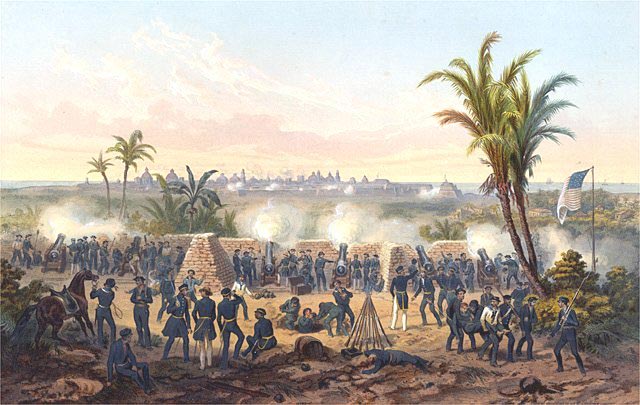
Winfield Scott’s battery is set up overlooking the port city of Vera Cruz, Mexico during the Siege of Vera Cruz, March 9–29, 1847

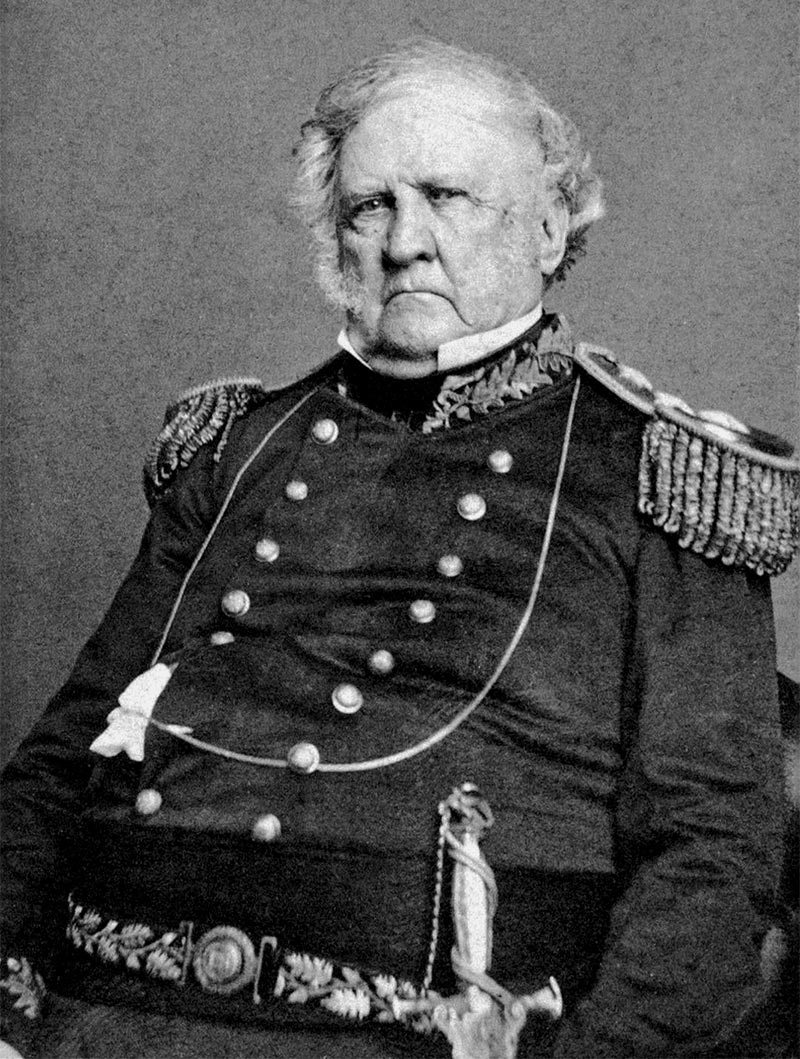
At the same time of the battle, General Winfield Scott (known as “old fuss and feathers”) successfully landed another American army at Vera Cruz and began the campaign against Mexico City. Vera Cruz was a “walkover” since the main Mexican army was in the north fighting Taylor. Although both Scott and Taylor associated with the Whig Party opposed to President Polk, Taylor was kept on the shelf as much as possible to allow the weaker political prospect, Scott, to prosecute the war and garner further accolades. As Providence ordered things, Taylor was elected President anyway, and the William and Mary graduate Scott remained as the highest-ranking American general since George Washington, and was still in the saddle (metaphorically, since he was 6’5” and grew to over 300 pounds), when the Civil War began. Many of the Generals on both sides of that war fought in Mexico with one of the two Army Commanders. Colonel Jefferson Davis married his commanding officer’s daughter, Sarah Knox Taylor.


General Winfield Scott (1786-1866) in 1862

Learn Texas History Where it Happened!

Join us on a three-day car tour across the Lone Star State as we offer a gripping overview of some of the state’s defining moments. We will visit the iconic Alamo where Davy Crocket, Jim Bowie, William Travis and other freedom lovers made their gallant stand against Santa Anna and the Mexican Army. You will see the cannon that inspired the patriots of Gonzales in their “Come and Take It!” response to a tyrannical order. We will walk the San Jacinto Battlefield where Texas Independence was won, and much more. All along the way Mr. Potter will be noting God’s providence in the affairs of men. Learn More >

James Renwick, Last Covenanter Martyr, 1668

2023-02-13T16:27:12-06:00February 13, 2023|HH 2023|

“You have not yet resisted to the point of shedding blood in your striving against sin;” —Hebrews 12:4

James Renwick, Last Covenanter Martyr, 1668

Upon the “Restoration” of King Charles II to the English monarchy in 1660, after the Commonwealth period of Oliver Cromwell, the persecution of resisters of royal tyranny returned with a vengeance. The first to fall in England were the regicides—anyone directly responsible in some way for the trial and execution of Charles I. In Scotland, the men considered the most uncompromising Covenanters* were targeted first—the Marquis of Argyll, Sir Archibald Johnston of Wariston, and Rev. James Guthrie. For the next twenty-eight years, the names on the rolls of the martyred Scots Presbyterians mounted, as they were hunted by the army and special forces, especially on Sundays, to catch them worshipping in places and ways not prescribed by the government.
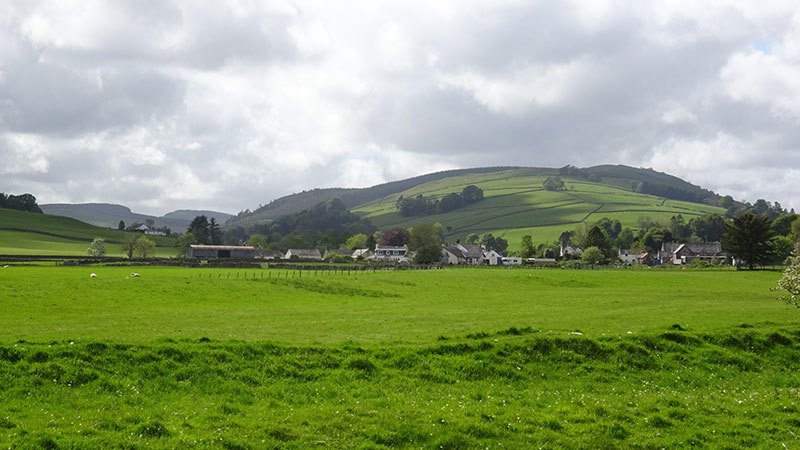

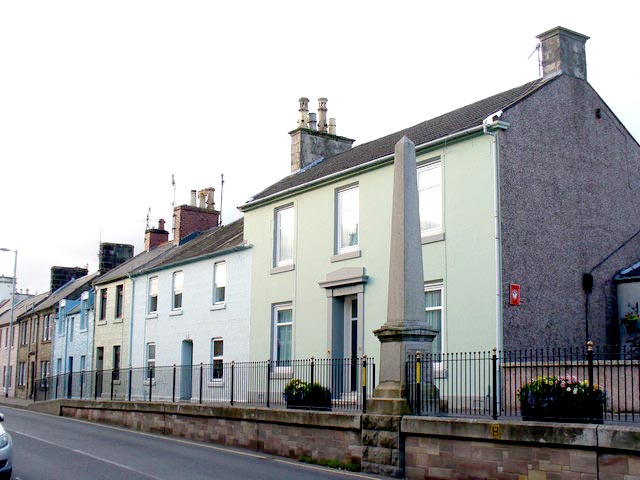
The Scottish village of Moniaive in the Parish of Glencairn, in Dumfries and Galloway, southwest Scotland, birthplace of Rev. James Renwick, Covenanter preacher and martyr

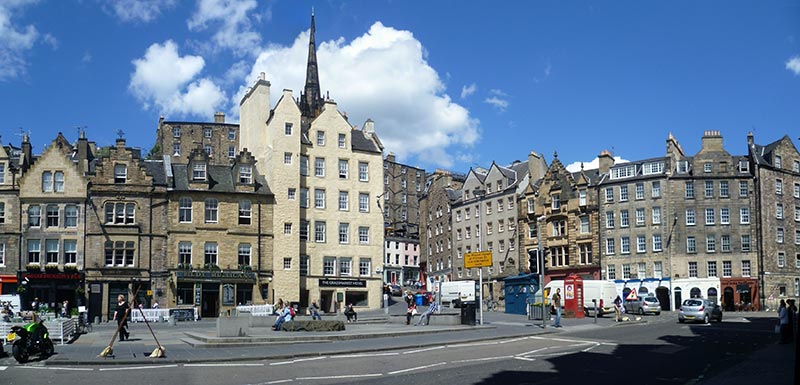
Hundreds were executed for “treason,” that is, not accepting the king as head of the Church. Thousands were killed in battle, accused of revolution for defending their homes, tens of thousands were exiled or banished abroad as slaves. Perhaps up to 18,000 Scots Presbyterians—men, women and children—were imprisoned, tortured, banished or killed, for “the Crown and Covenant of Jesus Christ,“ mostly by fellow Scots serving their English masters. The Rev. James Renwick was the last Covenanter martyr executed in Edinburgh, in the Grassmarket, two days after his 26th birthday on February 17, 1688.


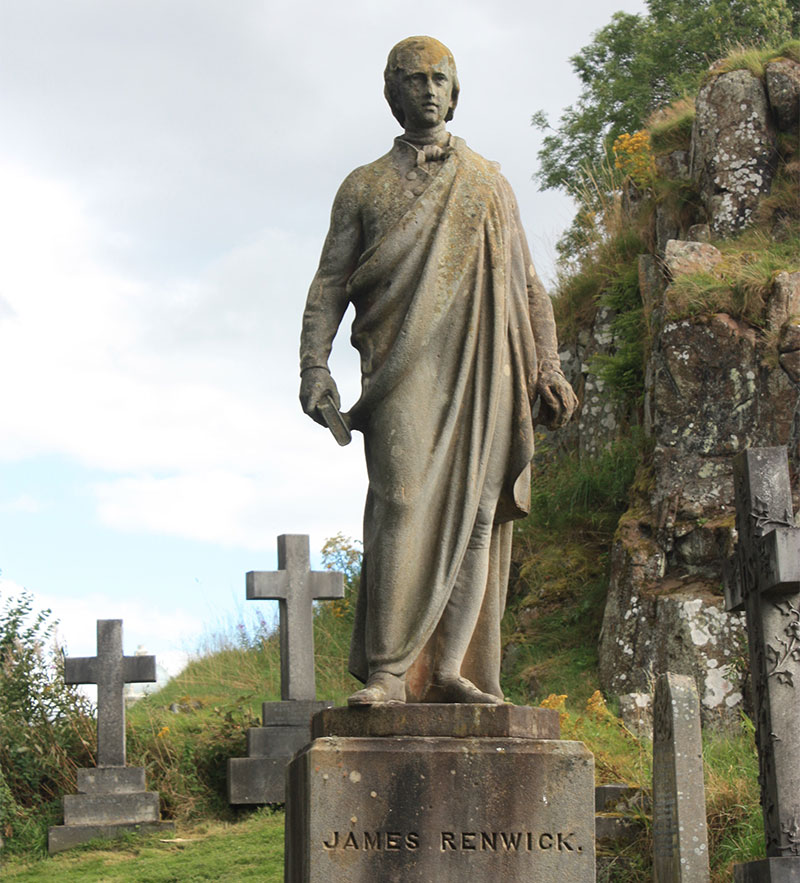
Statue of James Renwick (1662-1688), Valley Cemetery, Stirling, Scotland

James Renwick was born in a cottage of the farm of Knees in Dumfriesshire, the son of a weaver and adherent of the Covenant. His parents trained him well in the faith: he could read the Bible by age six. Renwick worked his way through the University of Edinburgh tutoring the children of local gentry. He failed to graduate because he refused the “Oath of Allegiance,” which implied recognition of the Royal authority over the Church. After he witnessed the execution of Rev. Donald Cargill in July of 1681, Renwick decided he too would adhere to the Covenant. He joined with the “Societies”—illegal Covenanter assemblies. The following year he sailed to Holland, where he received his license to preach from the hands of the Scottish presbytery in exile.


Rev. Donald Cargill (1619-1681) whose martyrdom Renwick witnessed


The Sanquhar Declarations Monument in Sanquhar, Scotland, memorializes the Sanquhar Declaration: a speech read by Michael Cameron in the presence of his brother, the Covenanter leader Richard Cameron, accompanied by twenty armed men in the public square of Sanquhar, Scotland, in 1680, disavowing allegiance to Charles II and the government of Scotland, in the name of “true Protestant and Presbyterian interest”, opposition to government interference in religious affairs

Young Renwick slipped back into Scotland and began preaching in Conventicles (illegal worship services) around Lanarkshire, a particular hotbed of Covenanter resistance. Historians believe he baptized more than six hundred children in his brief ministry, their having been denied the sacrament by the government-appointed ministers. James’s name became linked with the most powerful of the field preachers, and a leader of armed resisters, Rev. Richard Cameron, “a preacher with fiery passion.” In 1680, Cameron, with twenty armed men, had published a declaration at Sanquhar, disowning King Charles II as a tyrant, and declaring armed resistance to his attacks on the Kirk. A price of 5,000 Merks was placed on Cameron’s head for treason. Renwick and some two hundred followers issued a Second Sanquhar Declaration in May of 1685, protesting the crowning of James II as King, and accusing him of “murder and being a papist.” With a price on his head, Renwick dodged the patrols and hunters looking for him for three years.


Rev. Richard Cameron (ca. 1648-1680)


North-east corner of the Grassmarket in Edinburgh where, until 1764, public hangings took place on a spot just to the left of the yellow traffic sign

Nonetheless, Renwick kept up criticism of both the compromising ministers and the Royal authority over the church. He continued to preach at Conventicles, attended by hundreds in the fields and barns. Living out of doors so much broke his health and he had to be carried to some of the meetings of the Societies. In February of 1688, the authorities discovered James Renwick hiding in a home in Edinburgh. Sentenced to death, several reprieves gave his friends time to persuade him to petition for his life, which he refused. On February 17, Rev. James Renwick mounted the scaffold in the Grassmarket before a massive crowd, where he had seen other defenders of the Covenant martyred.


The “shadow of the gibbet” and Covenanter Memorial in the Edinburgh Grassmarket


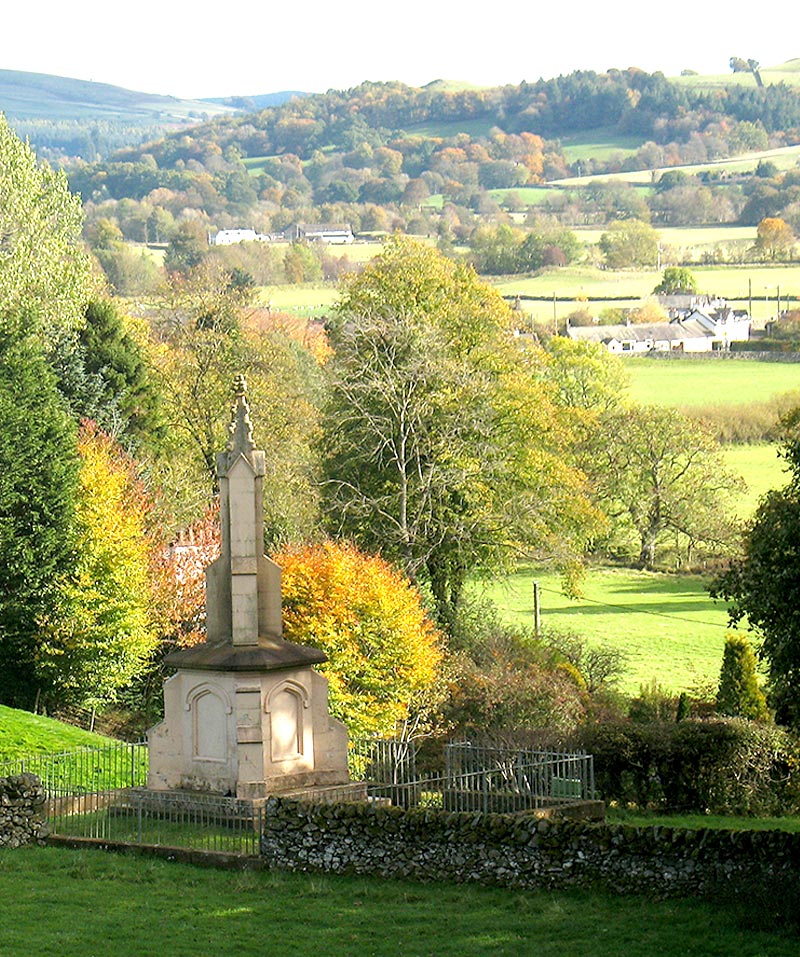
A memorial to James Renwick, overlooking his hometown of Moniaive, Scotland


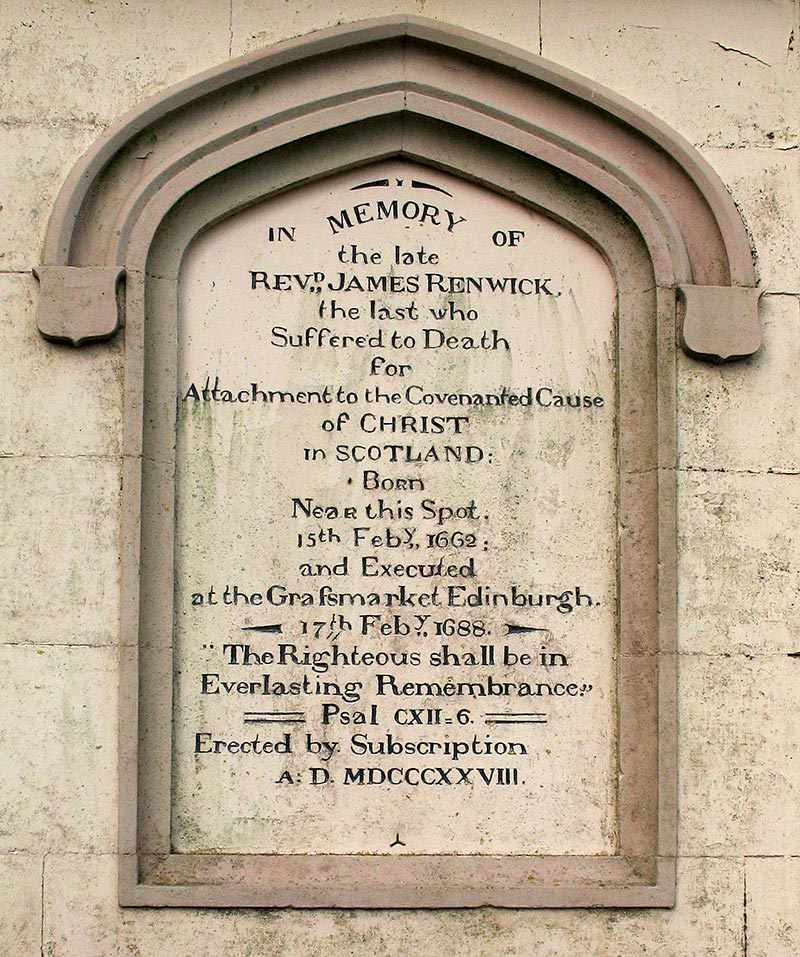
The inscription on the Renwick Memorial, Moniaive, Scotland

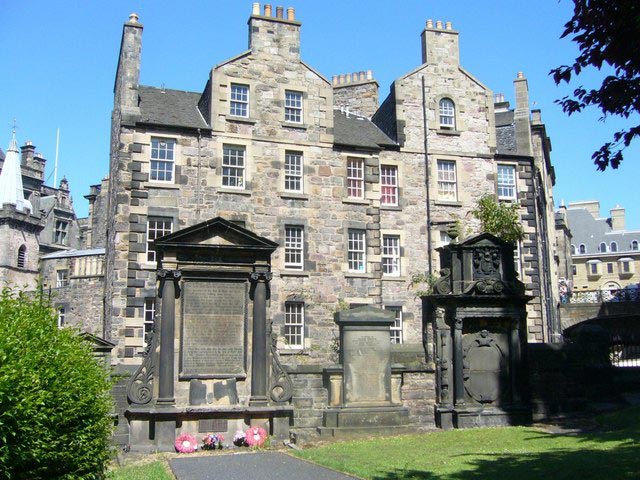
On our Lowlands tour of Scotland, we stay at a hotel fifty paces from that very spot, now marked by a memorial to the Covenanters. Renwick’s grave in Greyfriars’ Kirkyard, just up the street, memorializes his life and death, and a fine monument to him stands in the cemetery at the Church of the Holy Rude (which is also part of our tour) in Stirling, near similar memorials to Rev. James Guthrie and the two Margarets of Wigtown, all willing to die for Christ as Head of the Church and Lord of their lives.


Martyrs’ Monument, Greyfriars Kirkyard, Edinburgh, Scotland, commemorating James Guthrie, James Renwick, the Marquis of Argyll and the other Covenanters who died during ‘The Killing Time’ (1661–88)

*Covenanters were those people in Scotland who signed the National Covenant in 1638. They signed this Covenant to confirm their opposition to the interference by the Stuart kings in the affairs of the Presbyterian Church of Scotland. The Stuart kings harboured the belief of the Divine Right of the Monarch. Not only did they believe that God wished them to be the infallible rulers of their kingdom, they also believed that they were the spiritual heads of the Church of Scotland. This latter belief could not be accepted by the Scots. No man, not even a king, could be spiritual head of their church. Only Jesus Christ could be spiritual head of a Christian church.


The inscription on the side of the Martyrs’ Monument in Greyfriars Kirkyard

Scotland Tour Filling Fast!

Our nation has more ties to Scotland than any nation in the world. For two weeks Bill Potter, Colin Gunn and a host of local Scottish churchmen and historians will lead 35 adventurous souls on an unforgettable providential history tour of the land of the ancient Celts and fiery Covenanters in Scotland. We will follow the history of the Church from Columba—an outcast monk on the tiny island of Iona—through fiery John Knox, Samuel Rutherford, William Guthrie, Richard Cameron and the godly Covenanters who met in the fields and defied tyrannical monarchs to the death. Learn More >


Resources for Further Study

Preacher to the Remnant, The Story of James Renwick by Maurice Grant, Scottish Reformation Society, 2009

The Birth of Charles Dickens, 1812

2023-02-06T12:01:30-06:00February 6, 2023|HH 2023|

The Birth of Charles Dickens, February 7, 1812

For more than a century, the literary world proclaimed Charles Dickens the greatest novelist in the English language. With the deconstruction of literary standards and the moral turpitude that is celebrated in modern novels, Dickens no longer ranks where he once stood among English writers. Nonetheless, his impact was such that his characters remain in the corporate memory of educated people and his influence on the language is still deeply imbedded. His personal life experiences became the birthplace of Dickens’s incredible literary success, and his status as a social reformer and wit remain undiminished in a few surviving university literature departments and popular culture.

Charles Dickens (1812-1870) in his study at home, Gad’s Hill

This author of fifteen best-selling novels of the Victorian Era was born on February 7, 1812 in Portsmouth, Hampshire, England, the second of eight children born to a naval pay clerk. Charles described himself as “a very small and not-over-particularly-taken-care-of-boy.” He became a voracious reader of exciting novels and a well-educated student at a dissenter school. His father had the bad habit of living beyond his means and ended up in debtor’s prison in London when Charles was eleven. His mother and the younger children stayed with his incarcerated father while Charles boarded with an old and poor friend of the family. He later was assigned to live in the back-attic of a member of the “insolvent court.” In each case, the people he lived with became the later models, “with a few alterations and embellishments,” for characters in his books, famously described in detailed and colorful prose. He spent Sundays with his family in prison, later the setting for Little Dorrit.


Dickens’ birthplace, 393 Commercial Road, Portsmouth, Hampshire, England


What remains today of the Second Marshalsea prison

Dickens got a job pasting labels on pots of boot black ten hours a day for just a few shillings a week to help out his parents and siblings. That experience among the working poor and roustabouts of the back alleys contributed to his later interest in social and work reforms, as well as providing another source of characters like old Fagin the master pick-pocket in Oliver Twist. The future author already demonstrated the sponge-like memory of youth, and his profound feelings that came with his troubled family like a plague. Upon receipt of a legacy from his mother, Charles’s father left debtor’s prison and reestablished his family in better circumstances.


An illustration from Dickens’ Oliver Twist, where Oliver famously asks “Please sir, may I have some more?” after finishing his meager rations

Charles got a job as a junior clerk in a law office and found that his abilities to mimic people made him a popular figure. He spent a multitude of hours at the theatres, where he studied famous performers. Joining a relative as a court reporter for four years taught him the ins and outs of “going to law,” that especially afflicted the poor. His experiences at Grey’s Inn Court provided a wealth of material for books such as Nicholas Nickleby and Bleak House. At the age of twenty, Charles Dickens decided on trying the theatre, a likely place for him given his entertainment abilities and zeal to be famous. In one of the historically interesting twists of providence, he missed his audition due to a cold, and settled on being a writer instead.

Dickens began as a political reporter in Parliament, recording the day-to-day debates and controversies of the politicians, as well as the campaign events of MP wannabes. His well-received articles and reports introduced him to important literary salons in London, and his friendships led to meeting his future wife, Catherine Hogarth, daughter of George Hogarth, news editor and friend of Sir Walter Scott. Dickens’s first runaway best seller—which began in installments—was the Pickwick Papers, featuring the clever, streetwise, and humorous Sam Weller, hired by Mr. Pickwick. With continued popular serials and their attending financial success, Dickens married Catherine Hogarth who, in time, bore him ten children


Catherine Thomson “Kate” Dickens, née Hogarth (1815-1879), wife of Charles Dickens

Charles Dickens’ home, Gad’s Hill

Dickens is most often portrayed by friends and family as a firm Christian, and he did write a little book for his family entitled The Life of Our Lord, about Jesus Christ. He eschewed both Roman Catholicism and Evangelical Protestants, embracing a kind of liberal Anglicanism which promoted entertainments on the Sabbath, denied the inerrancy of Scripture, and evinced an attraction to Unitarianism, and later in life, “the paranormal.” He separated from his wife in 1858 and she took one child, never to see him again, leaving the other nine with him. Dickens was enamored with an eighteen-year-old actress, leaving her a substantial legacy upon his death; he never divorced.


Ellen Lawless Ternan (1839-1914) was a young actress who became Dickens’ companion from 1857 until his death in 1870


This prefabricated Swiss Chalet was a Christmas gift to Dickens by actor and friend Charles Fechter. Dickens had a brick-lined tunnel dug between his house’s front lawn (across the street) and the chalet. During the spring and summer months, he worked on many of his later novels in his study on the top floor, including A Tale of Two CitiesGreat ExpectationsOur Mutual Friend and the unfinished The Mystery of Edwin Drood.

David Copperfield was Dickens’ favorite novel, and the consensus among his biographers suggest it was the most autobiographical of his books. Just prior to the American Civil War, he published what proved to be among his most popular works, both “raging successes”: A Tale of Two Cities and Great Expectations. Charles Dickens embarked on numerous “reading tours”—hundreds of them in fact—around England, Scotland, Ireland, and America. He was easily the most popular and successful writer of the Victorian era, attracting hundreds of thousands of readers and admirers, including Queen Victoria and his literary friends in the United States and France, like Emerson, Wadsworth, Longfellow, and Irving, Viktor Hugo and Alexandre Dumas. They too remembered and referenced Tiny Tim, The Artful Dodger, Little Dorrit, Scrooge, Oliver Twist, David Copperfield, Madam DeFarge, Wilkins McCawber, and the dozens of other creatively named characters of his unforgettable tales.


The title page from an 1850 copy of David Copperfield—the first edition in novel rather than serial form—signed by the author as a gift to John Elliotson


An 1867 illustration of a crowd gathered outside Steinway Hall in New York City to buy tickets for a reading with Charles Dickens

As a philanthropist, Dickens contributed to numerous social reform projects and groups in England, and supported the Tory Party, even considering a run for Parliament at one time. He died of a stroke in 1870 at the age of fifty-eight and was buried in Poets Corner in Westminster Cathedral. He left substantial annual sums to his wife and children. The poverty of his childhood, though resurrected in some of his novels, never touched his own family.


Charles Dickens’ grave in the Poet’s Corner of Westminster Abbey


A portion of Poet’s Corner in Westminster Abbey, London, England

Dickens’ novels have never gone out of print, and have generated more than two hundred movies and plays. His powers of description and character were peerless, and people still quote his critiques of social stratification. As a writer, he was and is, not without critics. Today especially, his work is attacked as “too sentimental,” and “too English,” “commonplace” and worthy only to be buried in the crater named after him on the planet Mercury. These critics can join Professor Literary Ignoramus and his CRT pals from the history department and return to Bedlam together, where they can “learn world history by starting at the present and move forward, allowing us to get rid of the historicality of Western-hegemonized false narratives in male gender perspectives.”*

*Quote of a modern university professor of “World History” in P.J. O’Rourke’s, CEO of the Sofa, p.140.


Created in 1875, this painting whimsically portrays Dickens dozing in his study, surrounded in his dreams by characters from his stories

Go to Top