The Fall of Constantinople, A.D. 1453

2024-02-15T12:39:04-06:00May 28, 2018|HH 2018|

“Draw thee waters for the siege, fortify thy strong holds: go into clay, and tread the mortar, make strong the brick kiln.” —Nahum 3:14

The Fall of Constantinople, May 29, A.D. 1453

In one of the greatest sieges of all time, Sultan Mohammed II, on May 29, A.D. 1453, captured the last Christian bastion in the Middle East, Constantinople, which had withstood every assault for 1,100 years. With the total collapse of the Byzantine Empire, the Muslim hordes were free to attack the West, where the symbolic capital of Christian Europe, Vienna, lay astride the Danube River — the city with the largest German-speaking population on the continent. Constantinople’s final collapse came with a huge cost to the Islamic army and total destruction of the defenders. The downfall of the Byzantine Empire also brought the dominance of the Ottoman Turks in the Middle East and parts of southern Europe until the twentieth century.
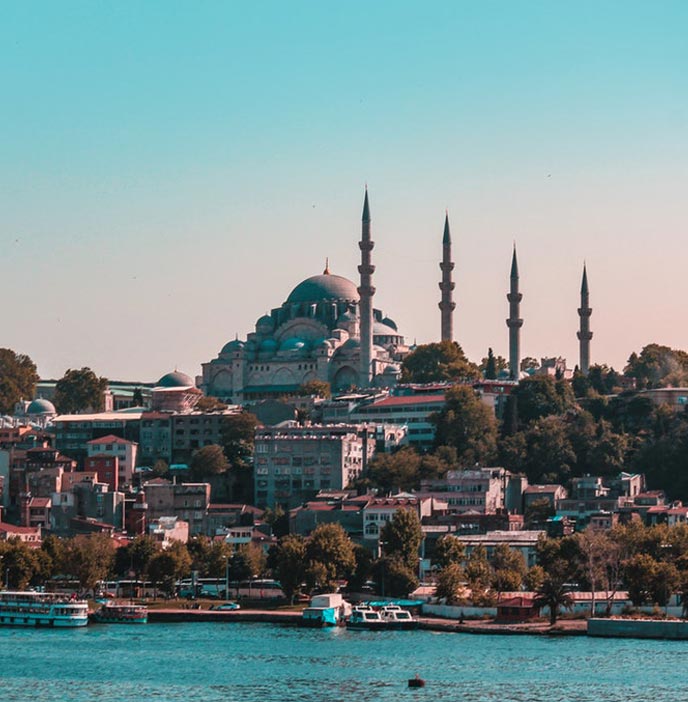

Modern-day Istanbul
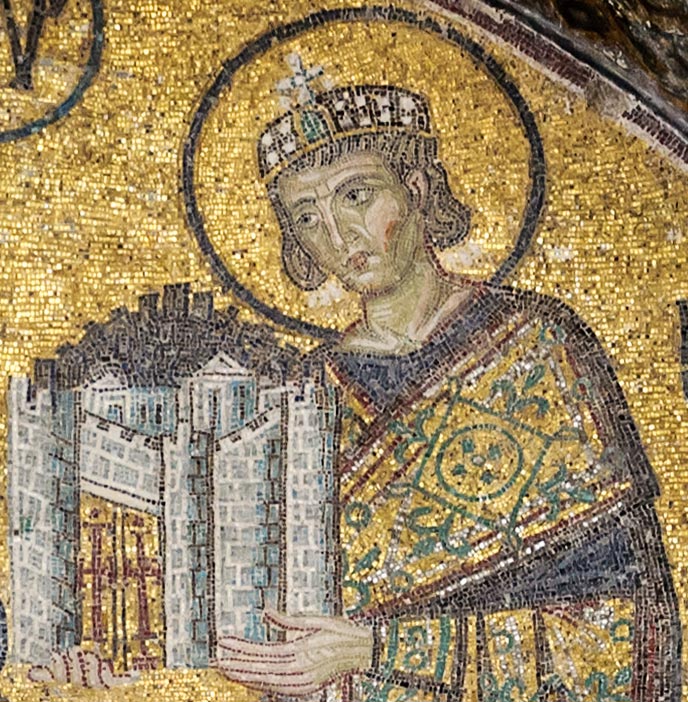

Constantine mosaic in Hagia Sophia

Now known as Istanbul, Constantinople was established by Constantine the Great in A.D. 323. The city walls loomed over the strategic straits that separated Europe from Asia, and served as the political and religious capital of Christendom in the East. Guarding both the Bosporus and the Dardanelles Straits, this mighty city also became the nexus of commerce, communication and invasion between the Black Sea and the Mediterranean. When the followers of Mohammed swept into Africa and the Middle East from the 7th to the 15th Centuries, Constantinople proved to be the one rock against which their heathen militant armies constantly broke. The forces of Eastern Orthodoxy and Islam contended for ascendancy in the region for all of those 700 years. In the 12th Century, Christian knights from Western Christendom conducted crusades to liberate the “Holy Land” from the Muslims and build up certain strongholds to protect pilgrimage routes to Jerusalem. Some of the crusaders attacked their fellow religionists of the Byzantine Church and even looted Constantinople. After a couple hundred years, the western knights were driven away by the followers of Mohammed. In 1452, Sultan Mohammed II decided that Constantinople must fall.
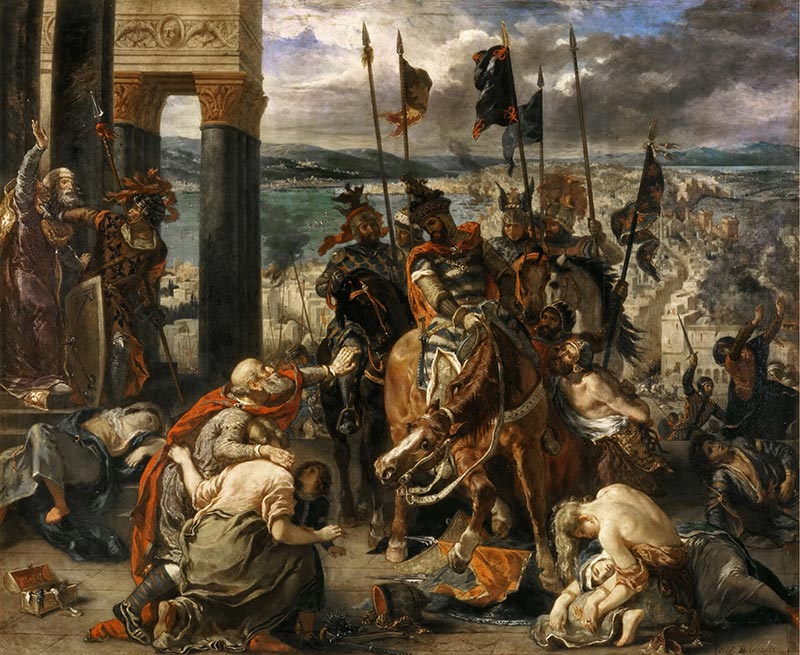

The Entry of the Crusaders into Constantinople, by Eugène Delacroix, 1840
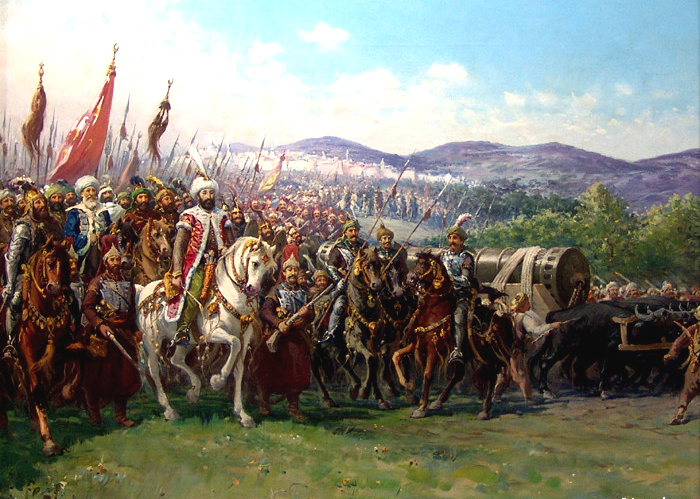

Mohammed II and his army approach Constantinople

The Byzantine emperor Constantine XI Paleologus could count on only 5,000 local and 2,000 foreign troops to defend the triple walls that would have to be breached by the enemy. He also had the services of the renowned siege defensive expert, Giovanni Giustiniani, who brought 700 knights and archers from Genoa and the Greek island of Chios. Mohammed II threw against the walls of the city 70,000 regular troops and 20,000 men known as Bashi-Bazouks, who were fighting only for the loot of the city if it fell. The Janissaries, young men captured from Christian families as slaves and raised as fanatical Moslem suicide special forces troops, were there in abundance. The attackers were also well supplied with artillery, including a cannon called “the Basilica,” 27 feet long and capable of throwing a stone ball of 600 pounds.
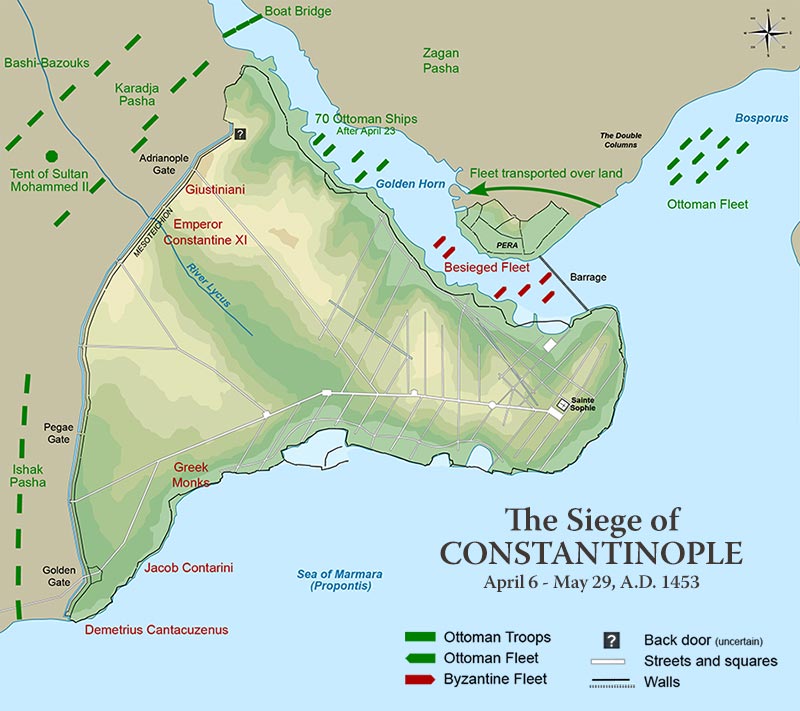
After 12 days of bombardment, several breaches in the walls appeared, but the soldiers who stormed the weakened walls were thrown back with heavy losses. The attack on the city began on April 6, but a month later, the Sultan’s soldiers were no closer to taking the city and had suffered many dead and wounded. Attempts at digging mines under the walls to blow them up were all discovered and the attackers were roasted with “Greek fire” or drowned by flooding. Siege towers were destroyed by fire and wave after wave of attackers — including the Janisseries — were hurled back by the exhausted defenders. On May 29, in the midst of waves of attacks, some Turks found a small door in the wall — probably accidentally left open — and made their way inside, seizing a tower and running the Sultan’s flag up the flagpole. The defenders fell back and then their defenses collapsed.
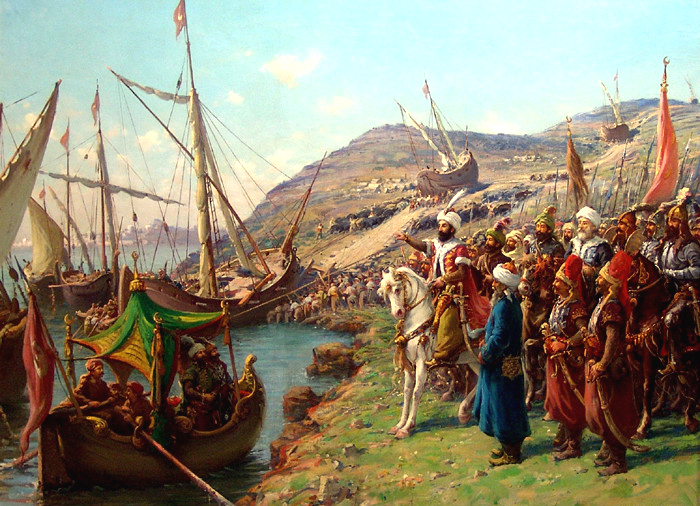

The Ottoman Turks transport their fleet over land into the Golden Horn

The people inside the city were killed or enslaved, probably about 50,000. A few surviving soldiers managed to escape, though their commander, Guistiniani, succumbed to wounds. Constantine XI died in battle. The Turkish armies moved westward and laid siege to Vienna, a military conflict with the West that would last another couple hundred years and some would say is continuing now, by other means. Sixty years after the fall of Constantinople, Martin Luther posted his 95 Theses, and the harried Holy Roman Empire, distracted by the aggressions of the Muslims, would not be able to focus attention on what otherwise would have been the destruction of the Protestant Reformers.
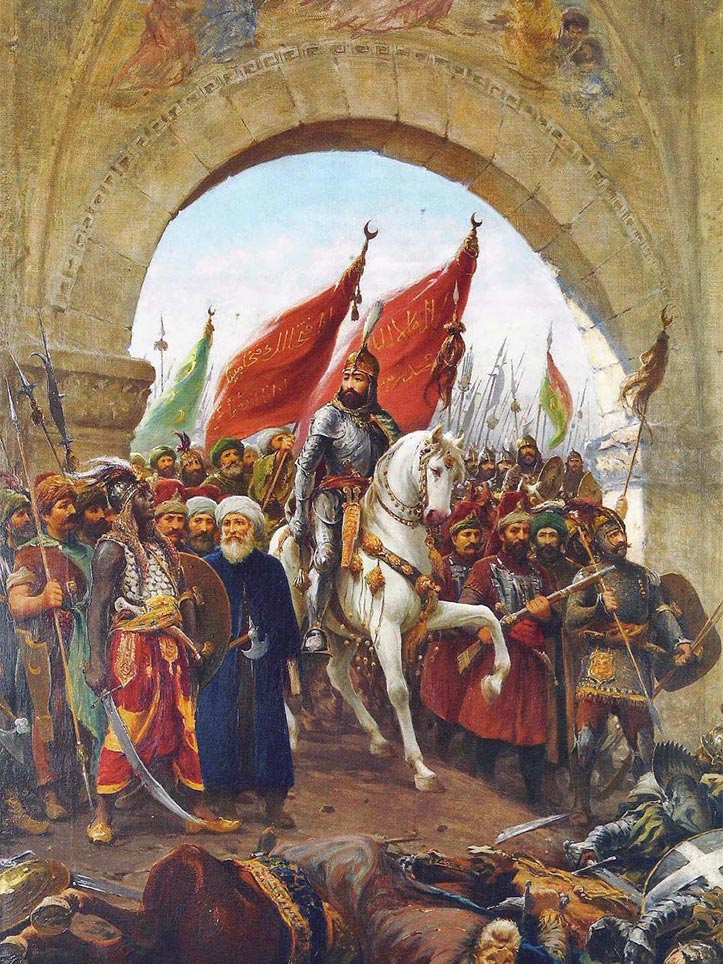

Mohammed II. (c. 1430-81) enters Constantinople

John Wesley Powell’s Grand Canyon Expedition Begins, 1869

2018-05-21T20:41:56-05:00May 21, 2018|HH 2018|

“The Earth is the Lord’s and all it contains, the world and those that dwell in it, for he has founded it upon the seas and established it upon the rivers.” —Psalm 24:1-2

John Wesley Powell’s
Grand Canyon Expedition Begins,
May 24, 1869

Until the year 1869, no (known) human being had ever successfully descended the Colorado River through the Grand Canyon, or mapped its course. A few natives lived at various spots at the base of the canyon, planting a few rudimentary crops and living isolated lives along the treacherous river, but to the United States government, the canyon was a blank space on the map. A 5’6”, one-armed Union Civil War veteran assembled a group of mountain men, adventurers, and social misfits to shoot the unknown rapids, climb the cliffs, and map the Grand Canyon, a feat so daring that, had Las Vegas odds makers existed, they would have given the expedition virtually no chance of survival, much less success. John Wesley Powell beat the odds.
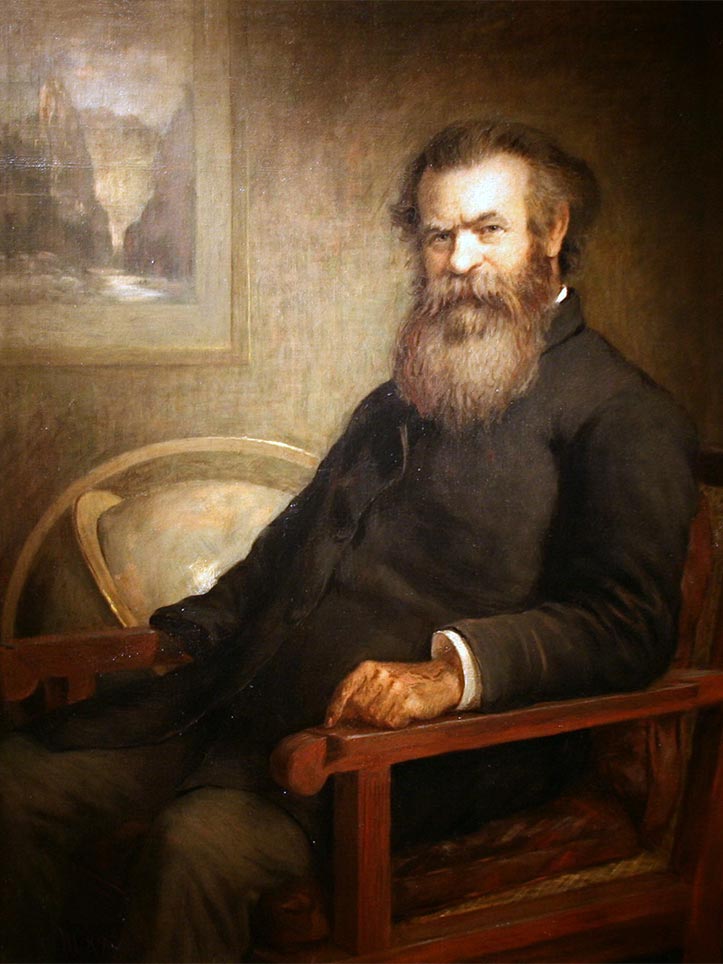
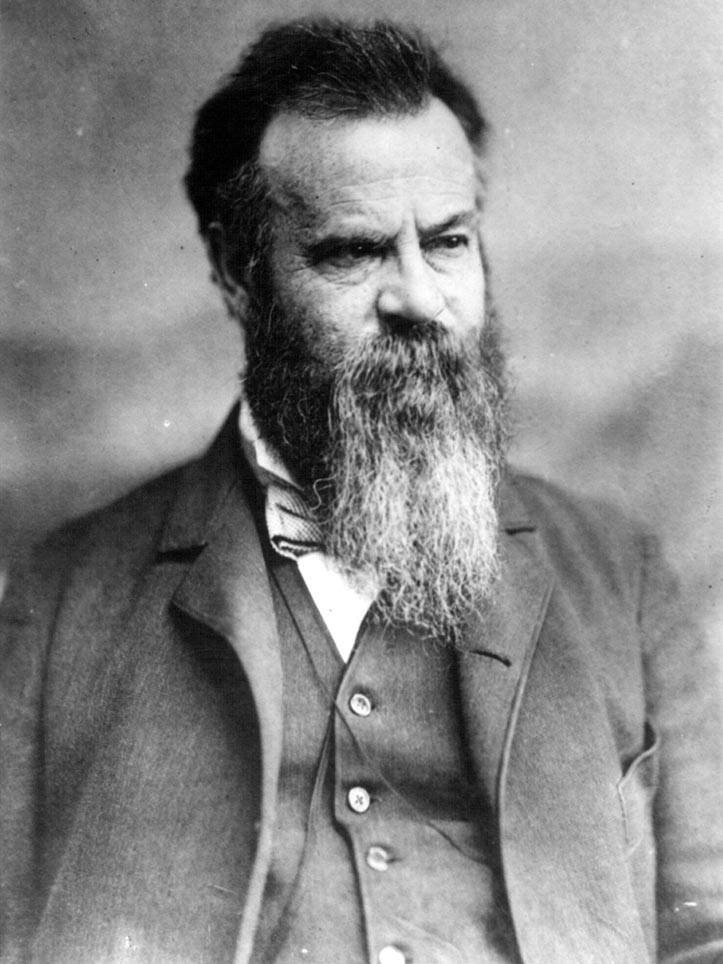
John Wesley “Wes” Powell (1834-1902)

Born to an itinerant Methodist preacher in New York, Powell grew up in Wisconsin and Illinois. A young man full of wanderlust, he walked across Wisconsin, rowed the Mississippi from Minnesota to the sea, and the Ohio River from Pittsburgh to the Mississippi. By the age of twenty-five he was a member of the Illinois Naturalist Society. He studied at Illinois College (later called Wheaton) and at Oberlin. He came away an ardent abolitionist, but not a graduate. Although he lost his right arm as an Illinois artillery officer at the Battle of Shiloh, the tough naturalist continued to fight on through the war in a number of big battles, ending the war as a brevet Lieutenant Colonel, though he always thereafter went by “Major.”


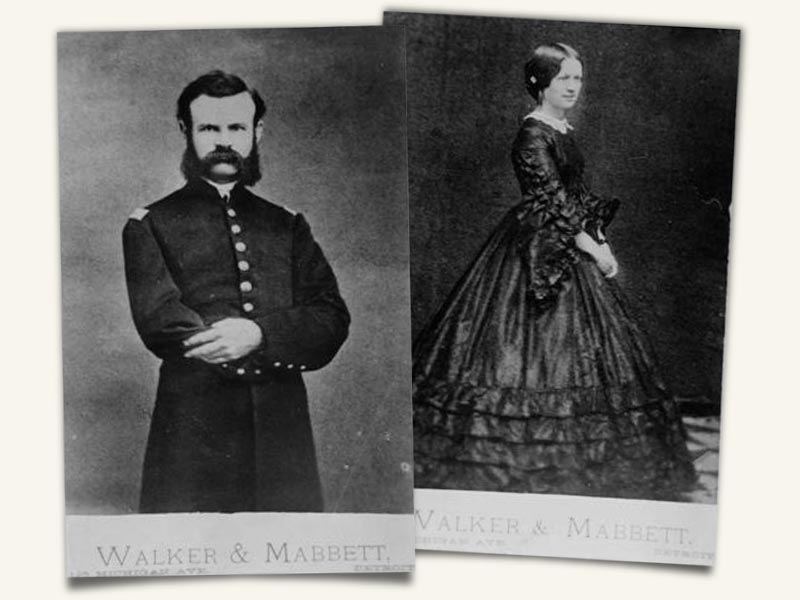
Portraits of John Wesley Powell and his wife, Emma, in Detroit

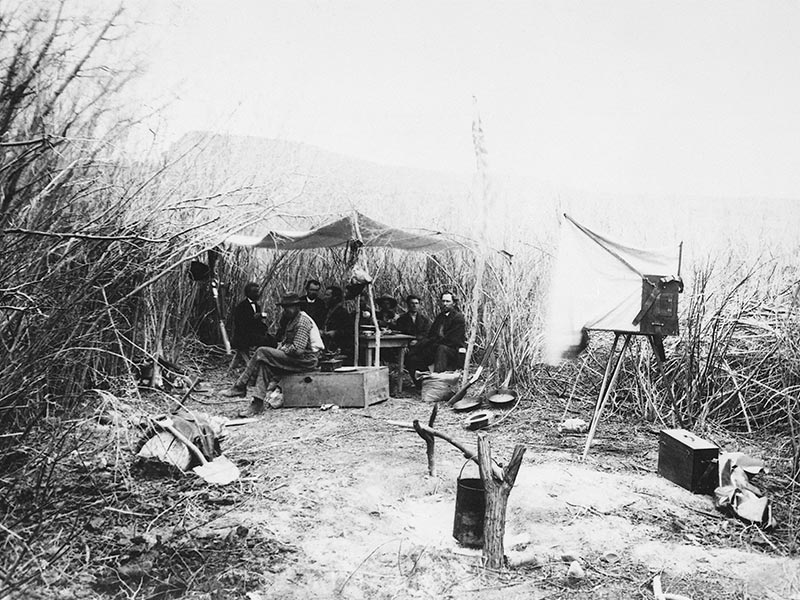
While a professor of geology at Illinois State, and an enthusiastic promoter of Darwinian evolution, Powell gathered a diverse group of adventurers to join him in an attempt to survey the Grand Canyon in 1869. They set out on May 24 from Green River, Wyoming for what became an astoundingly arduous descent of the river on four small wooden boats, hauled there from New York on the transcontinental railroad. They traversed 930 miles of river over a three-month period.


First camp of the expedition, in the willows — Green River, Wyoming

Among the hardships encountered were rapids (which they named, and which retain their monikers to this day) which shattered their boats, hunger when no deer or sheep could be shot, accidents and sickness. They lost all their instruments and charts in the raging torrents. Although they began with eleven men, one left after a few weeks, three tried to walk out through the desert wastes, just days before the unforeseen end of the trip, and died — allegedly murdered by Mormons or Indians, or perhaps just dying of thirst in the desert.


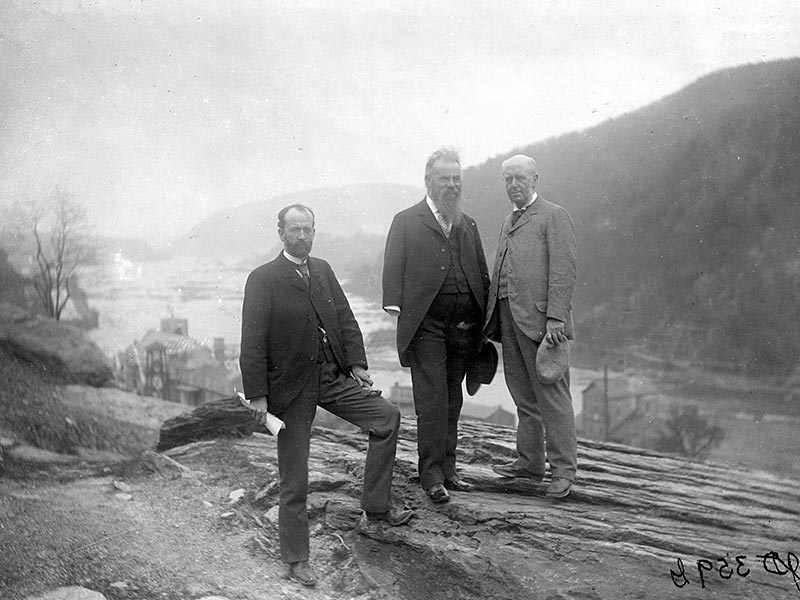
John Wesley Powell (middle) on a geological field excursion to Harpers Ferry, WV in 1897

In the end, the voyagers made it through the last canyon, almost miraculously, and announced to the world their feat of endurance and perseverance. Other adventurers tried to emulate the trip and died in the attempt. Powell led a second expedition which covered some of the area of the first, and successfully mapped a good portion of the river and canyon. He ended his days as the curator of the Bureau of Ethnology at the Smithsonian Institute in Washington, D.C. Powell based all his studies and reports on evolutionary theory, and most of his conclusions regarding native Americans and the geology of the canyon are worthless. Nonetheless, the heroism of the men of the expedition and, ultimately, his leadership, captured the imagination of the whole nation and reinforced the drive toward conquering all of North America and beyond.


Powell as second Director of the US Geological Survey (1881–1894)


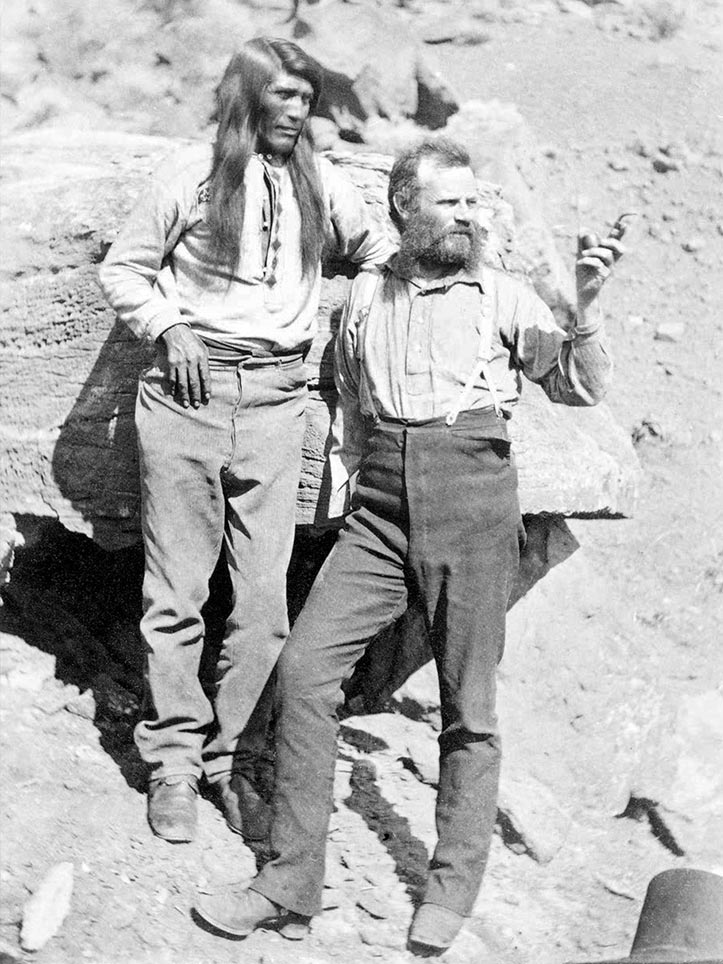
Powell with Native American Tau-gu, ca. 1873 on his second expedition to the canyon

More than six hundred people have died in the Grand Canyon since Powell’s day, though dams, safety rails, and National Park Service regulations have tried to ameliorate the death toll. We cannot even surmise how many may have died when the great flood of Noah’s day covered the earth in judgement and created the canyon in the first place. Still a place of spectacular beauty and mystery, the Grand Canyon and its rivers are not tame, and are still owned by the Creator, regardless of government interventions.

America Declares War on Mexico, 1846

2018-05-21T20:42:46-05:00May 14, 2018|HH 2018|

“From whence comes wars and fighting among you? Come they not hence even from lusts that war in your members?” —James 4:1

America Declares War on Mexico,
May 13, 1846

On December 29, 1845, The Republic of Texas became the 28th State of the United States. The legislation admitting Texas did not define the borders of the new state. The government of Mexico protested loudly that Texas was still a Mexican state, although the Texians had revolted ten years earlier and defeated the Mexican army to secure their claim of independence. The Texans asserted that their southern border extended to the Rio Grande River. Mexico claimed that the Texas boundary ended at the Rio Nueces, two hundred miles north of the Rio Grande. A patrol led by Captain Seth Thornton along the river triggered a war that changed American history.
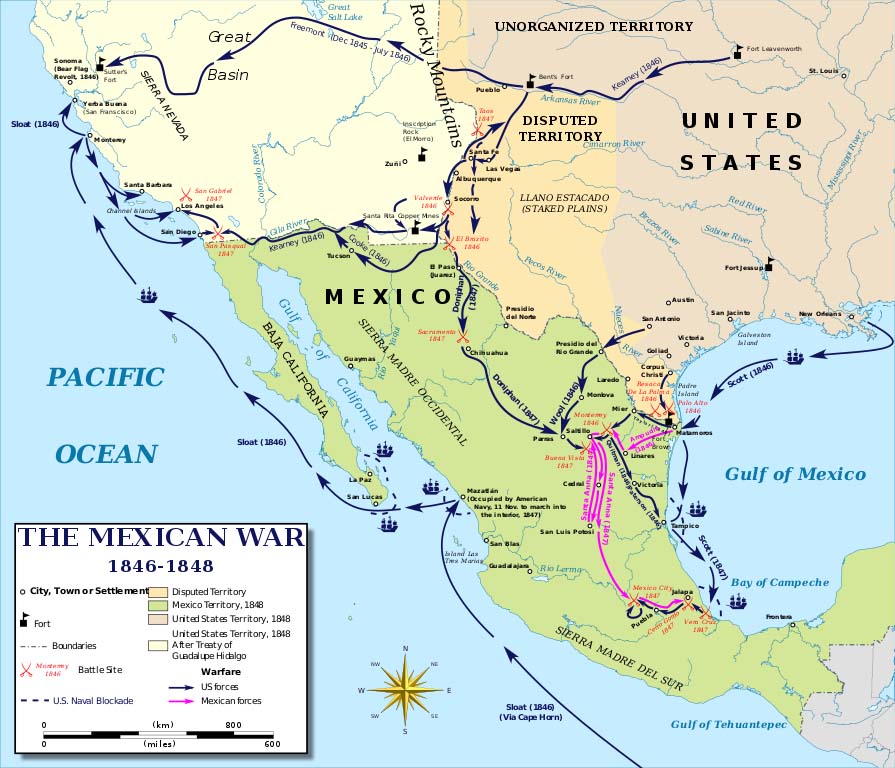
Map of the Mexican-American War

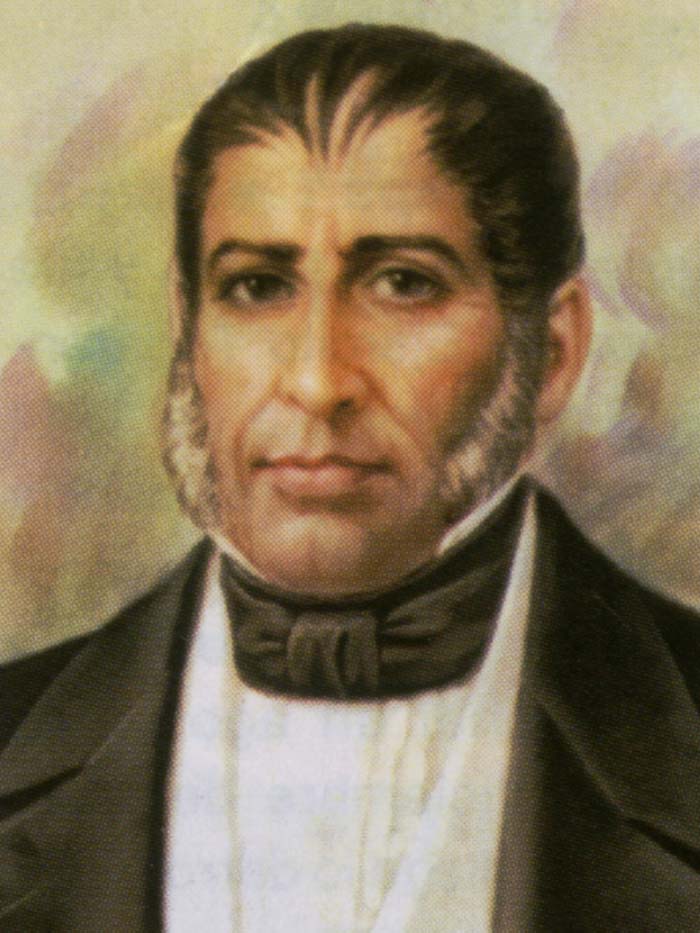
After Texas joined the Union, Mexico withdrew diplomatic relations. In August, 1845, President Polk sent (future President) General Zachary Taylor with about 4,000 soldiers to what is now Corpus Christi, just inside the disputed territory. In December, Polk sent an emissary to the latest President of Mexico, General José Herrera, offering to pay the three million dollars in claims by Mexican citizens against Texas and to purchase northern Mexico for another 25 million, an offer rejected by Herrera after it was leaked to the Mexican press, who screamed for the President’s head if he went along with the plan. Instead, he sent General Mariano Paredes with 8,000 troops (who had defeated and deposed the previous President, Santa Ana) to prevent American troops from invading Mexico. Paredes marched to Mexico City and installed himself as President.


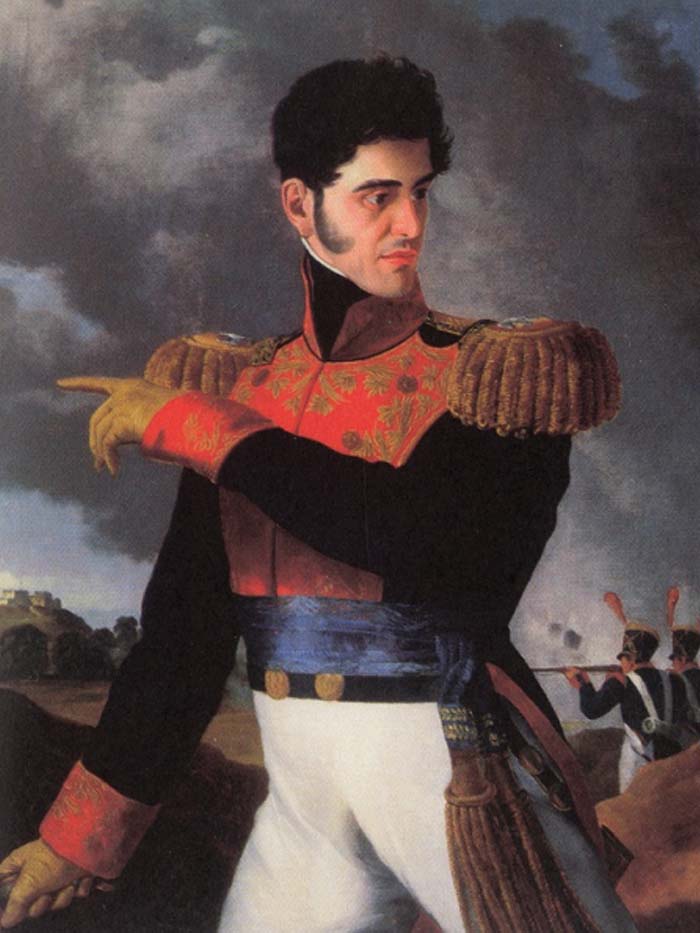
Antonio López de Santa Anna (1794-1876)


José Joaquín de Herrera (1792-1854)

On March 8, Polk ordered Taylor to march to the Rio Grande. Taylor stopped across the river from Matamoros and constructed a star fort, later named Fort Brown. On April 23, Mexican General Mariano Arista sent a thousand troopers across the Rio Grande to cut off Taylor from potential reinforcements. Hearing of the movement, Taylor sent two patrols, one upstream and one down, to locate the Mexican force. Captain Thornton’s patrol ran into an ambush and was wiped out. Eleven American dragoons were killed and forty-six captured.

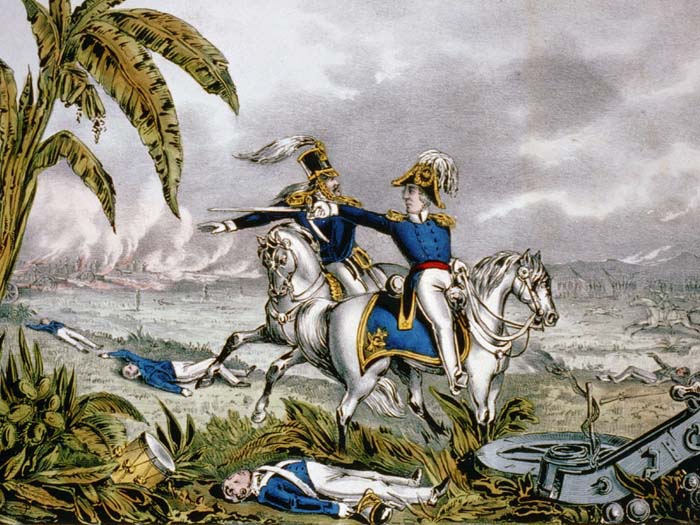
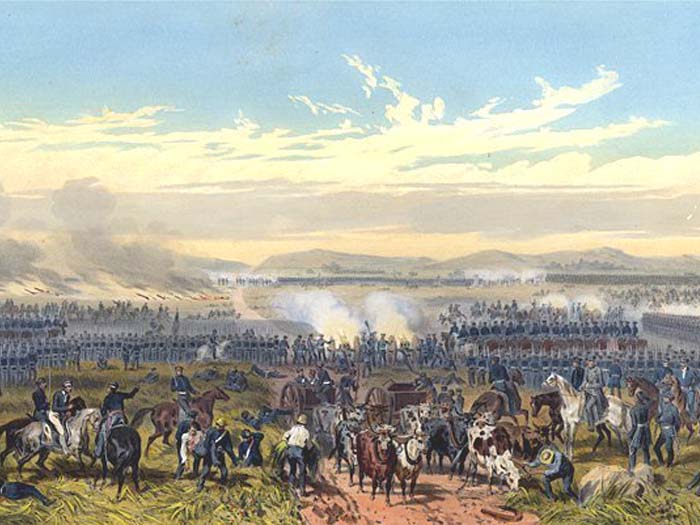
With the beginning of hostilities, Taylor left Fort Brown garrisoned with 500 or so soldiers (who in a couple days were bombarded by besieging Mexicans) and marched the rest of his men up river to resupply. On his return trip, the American army was cut off from the fort and confronted by Arista’s main force — 3,700 Mexican soldiers and eight cannon against 2,200 American soldiers and ten cannon. The resulting Battle of Palo Alto ended when the Mexicans withdrew having suffered heavier casualties, as the U.S. artillery “tore lanes and vistas” through the infantry lines. Both sides fought well and bravely.


Battle of Palo Alto

On May 9, the two armies fought the Battle of Resaca de la Palma, resulting in heavier casualties on both sides, but again an American victory. Reinforcements arrived and Arista withdrew across the river and retreated two hundred miles. On May 11, President Polk received word of the ambush of Captain Thornton and asked Congress for a declaration of war. On May 13 he got it.


Taylor at the Battle of Resaca de la Palma

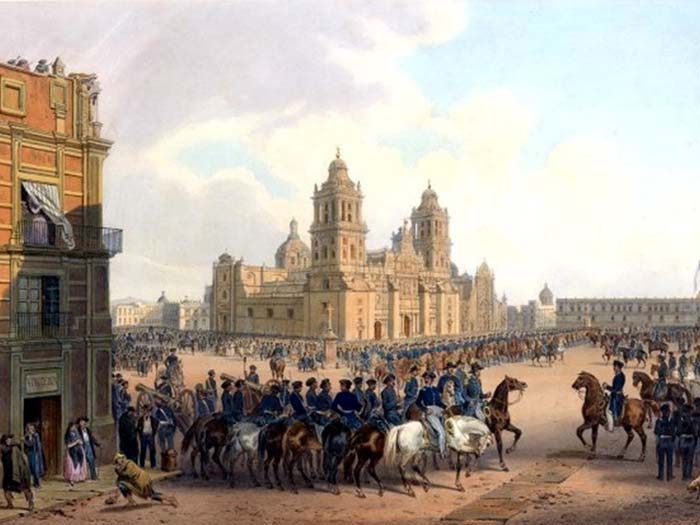
The War with Mexico lasted two years and resulted in an overwhelming victory for the United States, including the capture of Mexico City. The Treaty of Guadalupe Hidalgo gave the United States the territory that would become the states of California, New Mexico, Colorado, Arizona, Nevada, Utah, and slivers of Wyoming, Kansas and Oklahoma. The meandering Rio Grande has reclaimed the ambush site where the war began; it is now safely in Mexican hands and Fort Brown is now a golf course. Captain Thornton died before the walls of Mexico City. His second in command, William Hardee, became a Major General of the Confederacy fifteen years later. The conflict was very controversial in the United States, especially in New England. The disagreements in Congress over how to incorporate the new territories into the Union launched the debates that led to the American Civil War. Small incidents of the past sometimes lead, in the providence of God, to history-changing events.


Fall of Mexico City

George Whitefield Preaches in Philadelphia, 1744

2018-05-08T15:30:06-05:00May 8, 2018|HH 2018|

“And he gave some as apostles, and some as prophets, and some as evangelists, and some as pastors and teachers, for the equipping of the saints for the work of service to the building up of the body of Christ.” (Ephesians 4: 11, 12 NASB)

Whitefield Preaches in Philadelphia,
May 10, 1744

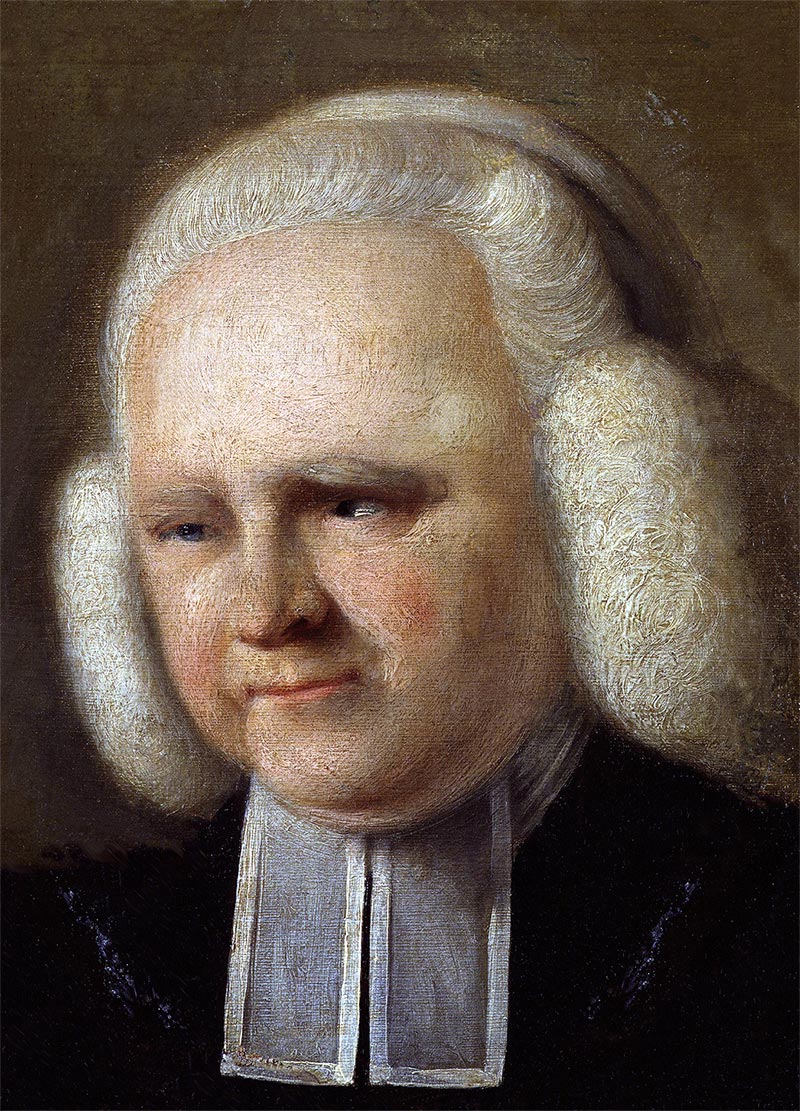
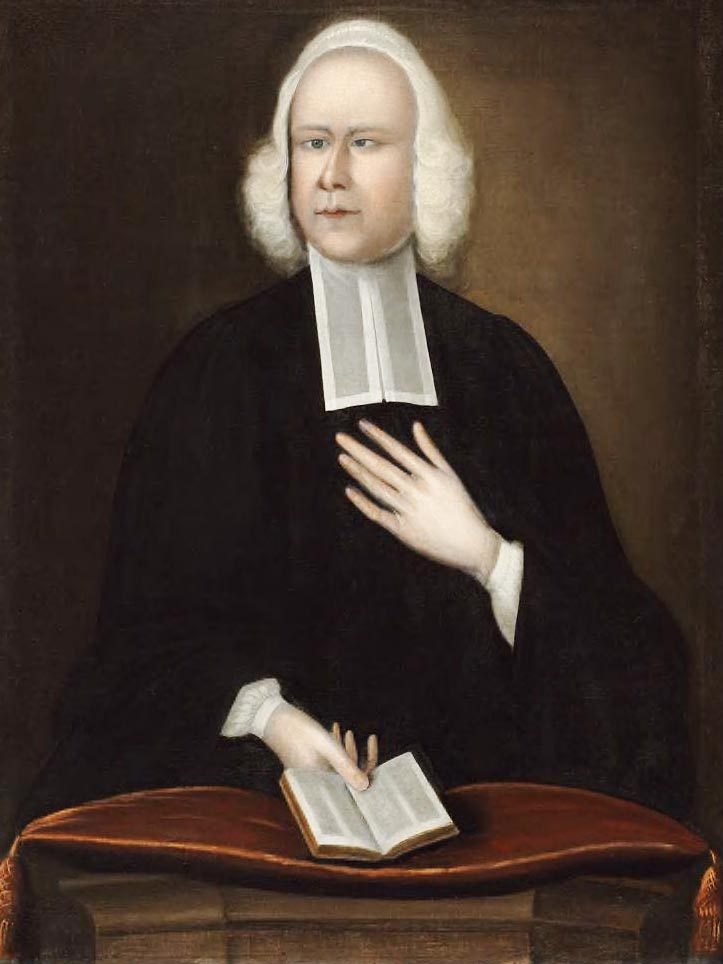
In his lifetime he preached an estimated 18,000 times and reached about ten million hearers. His sermons were reprinted countless times, and people in frontier regions were converted and blessed without ever hearing his stentorian voice. He lived in the middle of the 18th century, so he spoke without electronic amplification or collecting his auditors in sports stadiums. He preached fourteen times in Scotland, once to a crowd estimated at 20,000. In Boston, Massachusetts he addressed about 20,000 people on Boston Commons in a colony with a total population of about 17,000. He was cross-eyed and mocked by his enemies as “Dr. Squintum”, and was consistently opposed by the mainstream clergy, both conservatives and liberals. He was a bold Calvinist in theology and gave no altar calls, only calls to repentance and faith. Multiple thousands came to sincere faith in Christ. He was evangelist George Whitefield, likely the most famous individual in American colonial history.


George Whitefield (1714-1770)

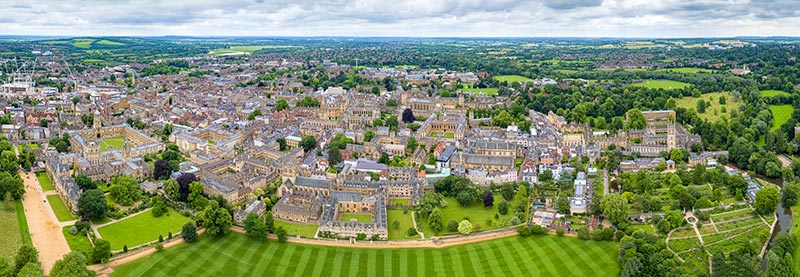
George Whitefield was born the seventh child and fifth son of a Gloucester inn-keeper. He exhibited an academic aptitude, but due to his low estate, entered Oxford as a servitor. While there, he fell under the influence of John Wesley and became a member of The Holy Club, a group of students whose main concerns were prayer, Bible study and piety. Whitefield had been attracted to the theatre and considered acting as a career. A deep spiritual awakening deflected his thespian pursuits, but the skills of public speaking in dramatic fashion never left him. They would, in fact, characterize his impassioned preaching of the Gospel.


Aerial view of the University of Oxford

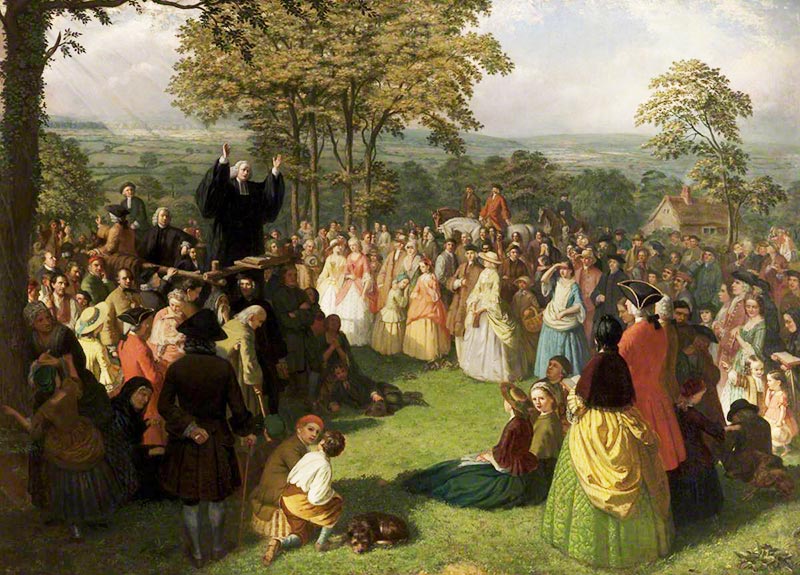
Ordained as a minister in the Church of England, Whitefield early on sailed to Savannah, Georgia as parish priest. He would become closely associated with Bethesda Orphanage there his entire life. After a short tenure, he returned to England and began an evangelistic preaching ministry throughout the United Kingdom. With his powerful voice and animated style, Whitefield expounded the Scriptures, especially those regarding repentance and faith. Along with the Wesley brothers, these revivals within Anglicanism and among dissenting denominations resulted in what would eventually be known as Methodism, an entirely new denomination in itself. Their appeals for “heart religion” often met with an outpouring of emotional responses and professed conversions to Christ, and the formation of new chapels and churches where none existed before.


George Whitefield preaches to a crowd gathered in Bolton, England in June 1750
( CC BY-NC-ND ArtUK.org )

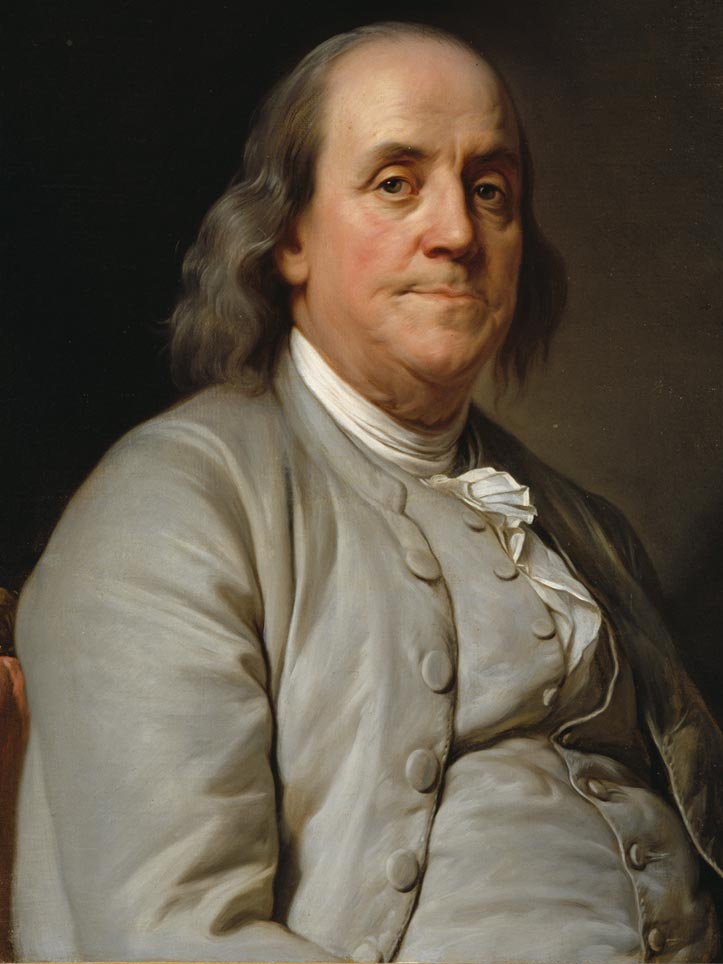
Whitefield returned to America in 1739 where, it turned out, the fields were “white unto harvest.” His first tour extended from New York to Savannah, with perhaps his most successful preaching stop in Philadelphia. Sensing a potential economic opportunity for his printing business, Benjamin Franklin negotiated the right to print the twenty-four-year-old Whitefield’s sermons and books, and though not a believer himself, also attended the services. The two men remained correspondents and close friends till Whitefield’s death in 1770. Whitefield crossed the Atlantic thirteen times and became the central figure of the “Great Awakening” in America.


Benjamin Franklin (1706-1790)

As historian Thomas Kidd observed:

“Whitefield played a key role in the emerging Anglo-American evangelical movement, but we should remember that the majority of conversions and revivals of the Great Awakening happened without him.


George Whitefield at the pulpit

Nonetheless, his trips to America, Scotland, and England resulted in multiple thousands of conversions. Sometimes churches were split, in other cases, pastors guided converts into the churches and continued preaching the new birth after the itinerant left. Controversy followed in the wake of the unapologetically Calvinistic Whitefield throughout his years of ministry, resulting in a break with John and Charles Wesley over their intransigent Arminian theology and perfectionism. Whitefield was also the most vocal advocate of preaching the Gospel to the slaves and took every opportunity to do so himself. He was mocked, beaten, and publicly ridiculed, but never lost sight of his calling as an evangelist. Lionized as the greatest preacher of his day, Whitefield holds a unique place in the history of revivals and the effect of the Gospel in America. Whitefield died in 1770, age fifty-five and was buried in Newburyport in Massachusetts. Few men in history have been so used of God to lead multitudes of people to personal faith in Christ. Would that more Whitefields be raised up and bring a new spiritual awakening in our country today.


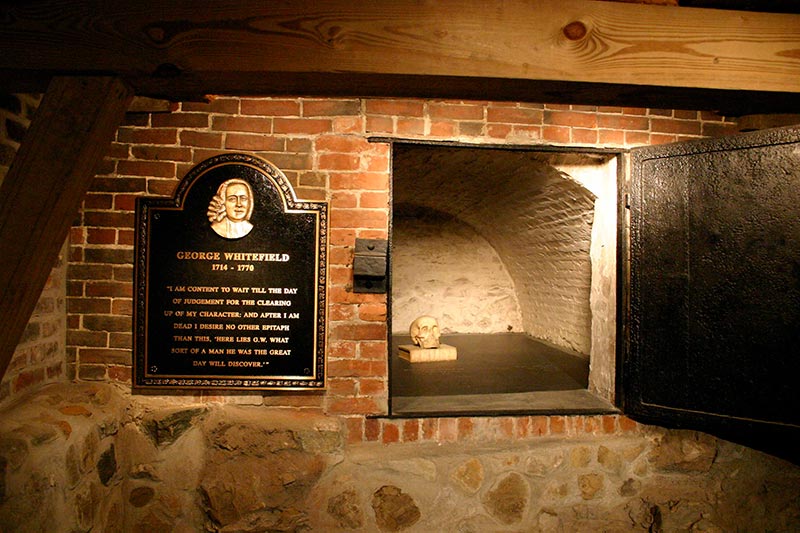
Whitefield’s grave in the crypt of Old South Presbyterian Church, Newburyport, MA
( (CC) Dr Digby L. James )

Go to Top