Visigoths Take Rome, A.D. 410

2022-08-29T16:37:38-05:00August 29, 2022|HH 2022|

“Then the iron, the clay, the bronze, the silver, and the gold were crushed together, and became like chaff from the summer threshing floors; the wind carried them away so that no trace of them was found. And the stone that struck the image became a great mountain and filled the whole earth.” —Daniel 2:35

Visigoths Take Rome, A.D. 410
Empires and tribes come and go throughout history. The prophet Daniel boldly predicted the rise of the following few empires, each of which would succumb to a stronger foe. The last of his imperial forecast is generally accepted as the Roman Empire, led by the “Eternal City” of Rome. When the Roman legions expanded their empire by conquest through Gaul, they came into contact with a variety of tribes who supplied Rome’s enemies with weapons, raided across the Rhine River against Roman strongholds, and refused to submit to Roman rule. Julius Caesar in the 1st Century BC referred to those people as the Germani. He bridged the Rhine and carried out punitive expeditions against them; Augustus tried to establish Roman hegemony in Germania Antiqua in 7 BC. In 9 AD, a Roman-trained German ally named Arminius led a Roman army under General Varus into a huge ambush, which wiped out the VII, VIII, and XIX Legions in the Teutoburg Forest (probably in Lower Saxony), killing 15,000-20,000 Romans and auxiliaries.
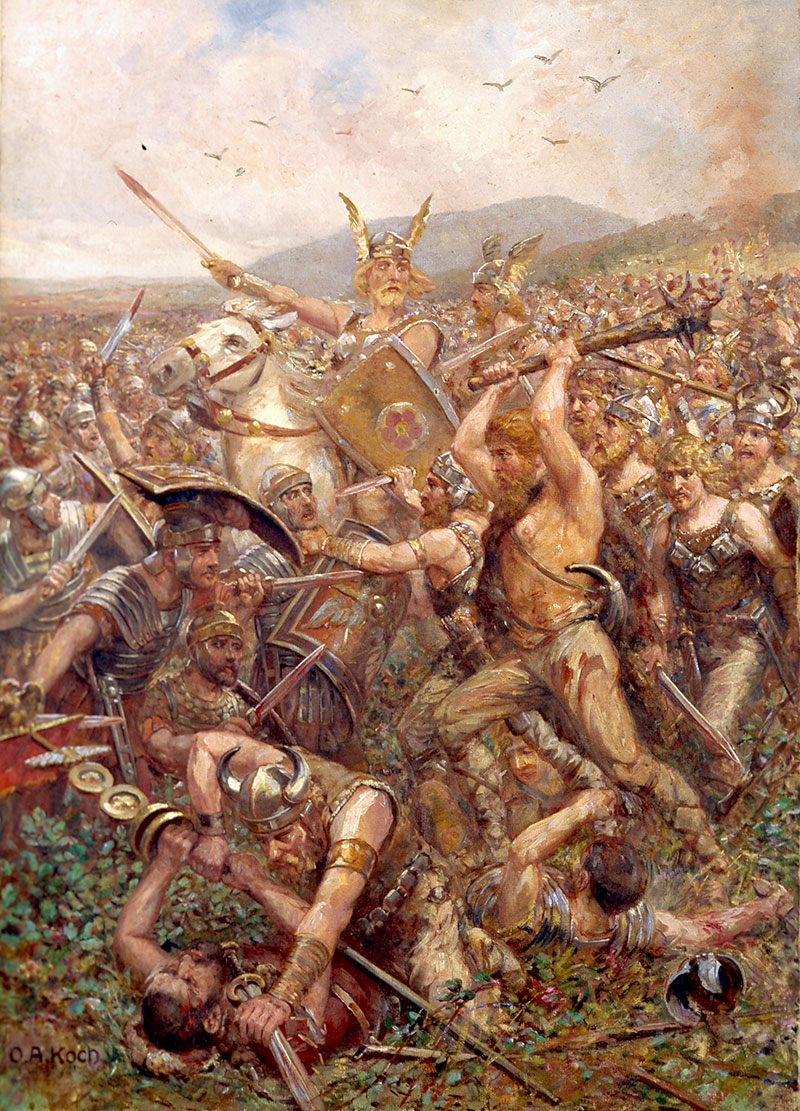

Germanic troops under Arminius attack and decisively defeat Roman troops under Varus at the Battle of Teutoburg Forest in 9 AD

Revenge campaigns into Germania recovered the lost Roman Standards in succeeding years, but the Rhine remained the important dividing line between Roman Territory and the German tribes across that river and the Elbe. From the first to the fourth century, trade flourished between Rome and Germania, with occasional clashes between certain tribes and Romans. In the fourth and fifth centuries, a nomadic German people known as the Goths fought against Roman rule. A breakaway tribe, the Visigoths, under pressure from a central Asian nomadic people, known as the Huns, forced them off their land. With permission from Valens, the Emperor of the Eastern Roman Empire, the Visigoths settled across the Danube River in Roman territory. The taxes levied by the Romans with the duplicitous treatment they endured, caused the Germanic settlers to revolt and plunder the Balkan provinces of Rome. The Visigoths faced the Roman army on the plains of Adrianople in 378, where they slaughtered the Romans and killed the emperor in battle.
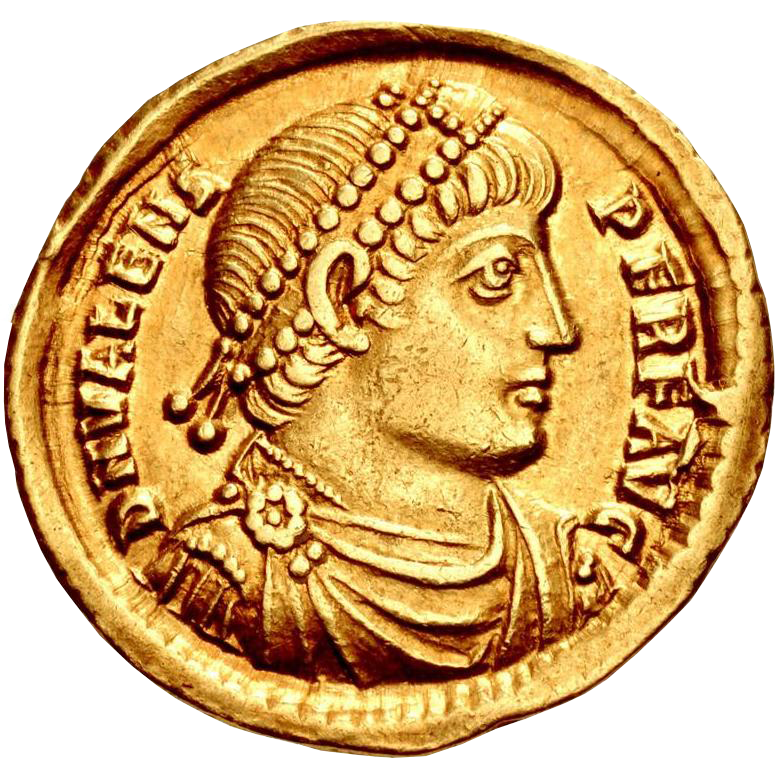

Roman Emperor Valens (328-378)
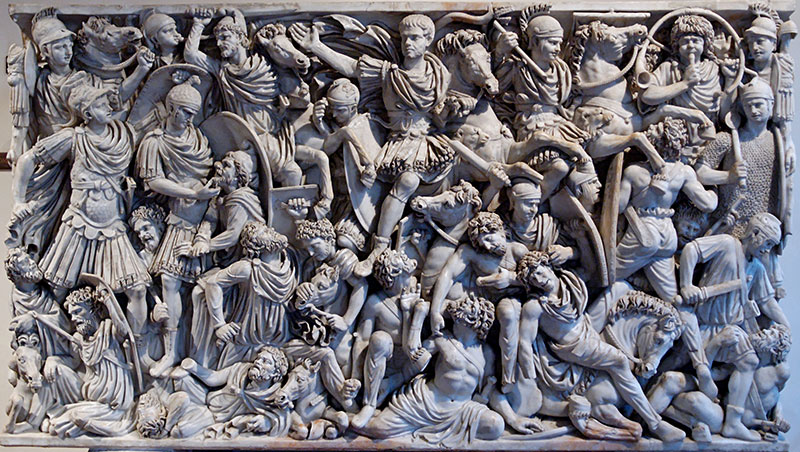
An elaborate relief depicting a battle between Roman and Germanic peoples

For several more years the Visigoths wandered in search of a land in which to live. The new Emperor offered them the province of Moesia, where they settled and converted to Arianism, a heresy that denied the deity of Christ but accepted most other Christian beliefs. Roman Emperor Theodosius welcomed Visigoth leader Alaric into an alliance in which the latter led an army against the Franks who had risen against the Romans again. Although a Roman citizen, Alaric did not receive the recognition and reward that he deserved for his military successes. With the death of the Roman emperor and the breakdown of the Roman field forces, Alaric returned to Moesia as “king of the Visigoths.” In 408, Alaric laid siege to Rome with 30,000 men. After negotiation with the Senate, the starving Romans paid a large ransom and Alaric left, but not till he also liberated 40,000 Gothic slaves.
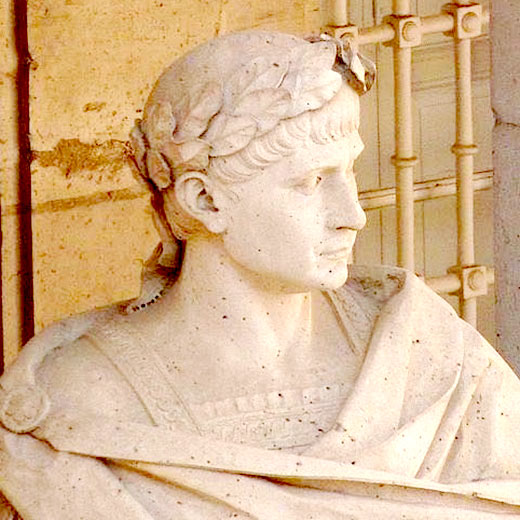

Theodosius I (347-395) was Roman Emperor from 379 to 395
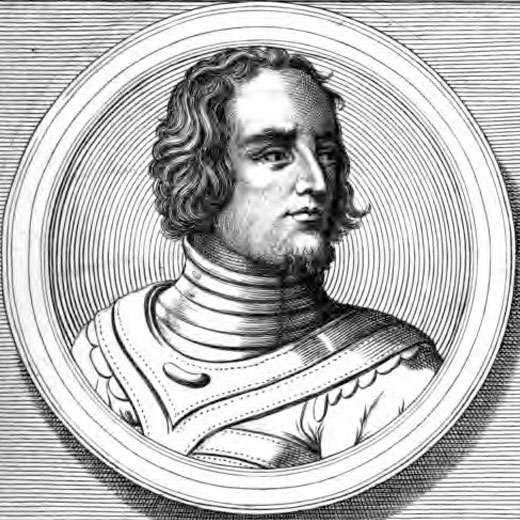

Alaric I (c. 370-410) was the first king of the Visigoths, from 395 to 410

The first decade of the fifth century had already proven disastrous for the Roman Empire. Vandals, Sueves, and Alans crossed the Rhine into Gaul. Britain rose in rebellion. Alaric took the occasion to invade Noricum (modern Austria) and demanded 4,000 pounds in gold to not invade Italy again. General Stillicho—ruling regent of the western empire—paid the shake-down money, perhaps hoping to use Alaric against his multiplying enemies. A bureaucrat of the emperor betrayed and murdered General Stillicho, thus eliminating Alaric as an ally. Olympius, the same bureaucrat, had tens of thousands of Goth wives and children of Gothic soldiers serving in the Roman army put to death. 30,000 Gothic soldiers defected to Alaric. Denied recognition by Emperor Honorius, acceptance of the Visigoths within the empire, and perhaps, thwarted for imperial office, Alaric marched into Rome on August 24, A.D. 410, and turned his soldiers loose for three days to sack the Eternal City. Imperial Rome had finally fallen to “barbarians.”
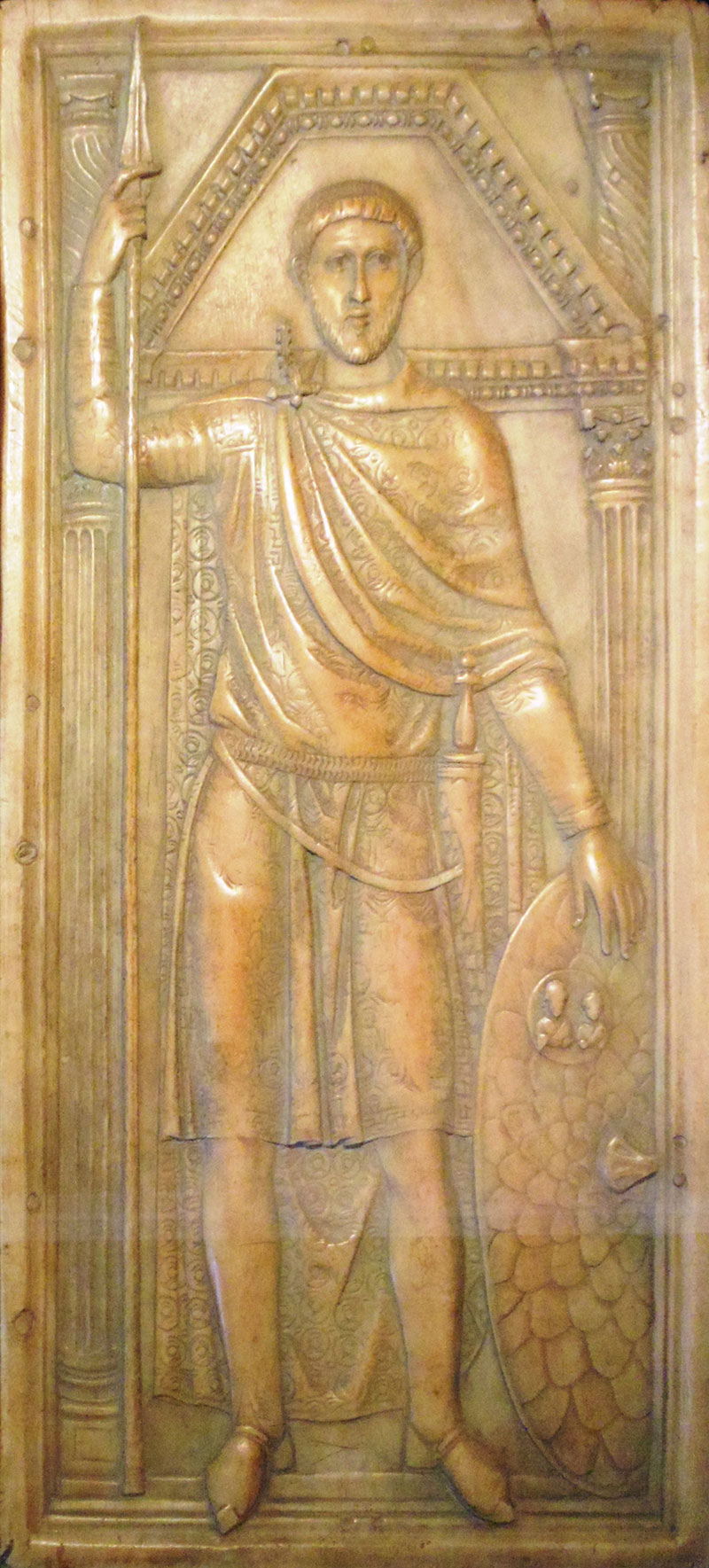

Flavius Stilicho (c. 359-408) was a military commander in the Roman army who, for a time, became the most powerful man in the Western Roman Empire
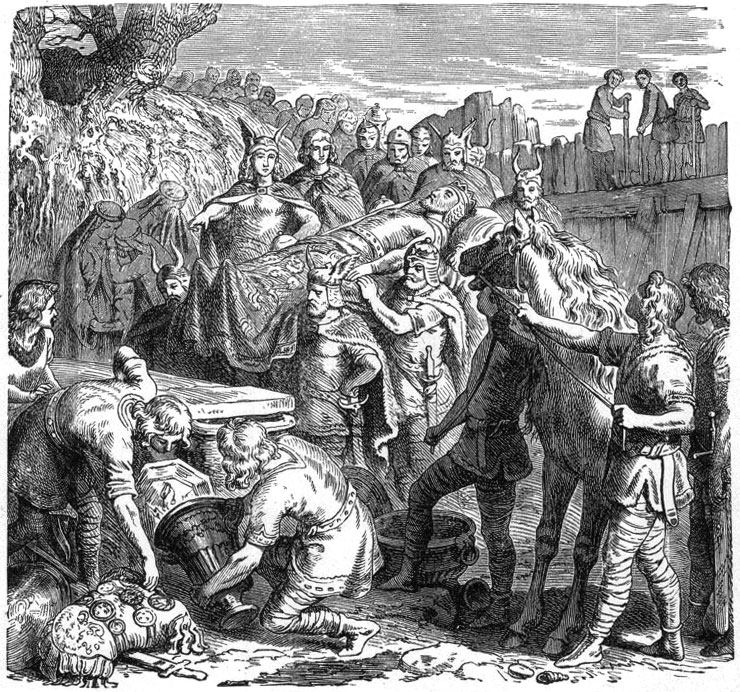

The burial of Alaric in the bed of the Busento River

Japan Formally Surrenders in WWII, 1945

2022-08-29T15:40:53-05:00August 29, 2022|HH 2022|

“For indeed, a person does not know his time: like fish that are caught in a treacherous net and birds caught in a snare, so the sons of mankind are ensnared at an evil time when it suddenly falls on them.” —Ecclesiastes 9:12

Japan Formally Surrenders in WWII,
September 2, 1945

On September 2, 1945, Japan signed the “instrument of surrender” to the Allied forces, aboard the battleship USS Missouri. The United States hoped that the war would have drawn to a close after the eighty-two day battle of Okinawa April through June, which had cost Japan about 110,000 killed and the destruction of more than 1,400 aircraft and sixteen naval warships, compared to some 20,000 American dead, 763 aircraft lost and twenty-three ships sunk. A post-war Japanese memorial on Okinawa contains the names of 240,734 dead, which includes more than 40,000 civilians who died in the campaign. While the Americans planned the invasion of the main Japanese islands over the next two months, and conducted a “conventional” firebombing campaign against Japanese cities, almost obliterating forty-two of them, they also explored diplomatic means to end the war with the unconditional surrender of Japan.
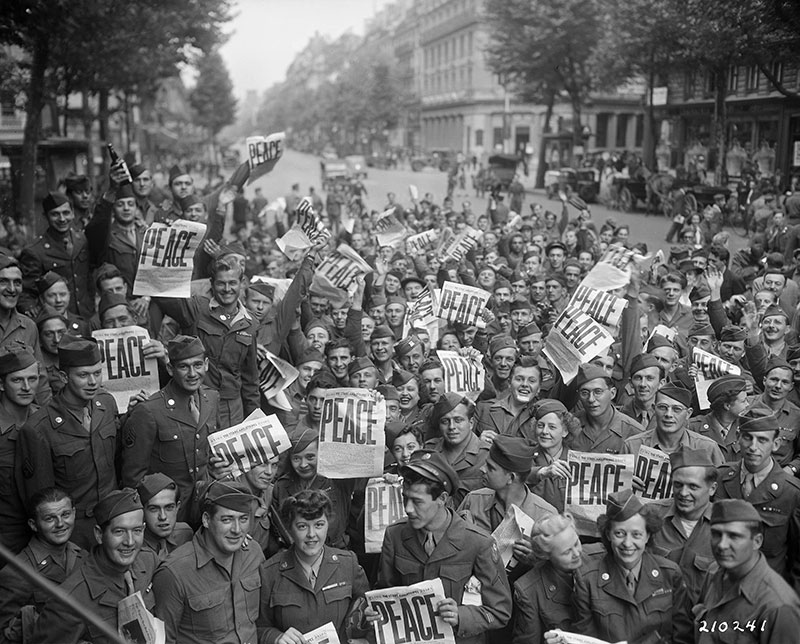
American military personnel gather in Paris on August 15, 1945 to celebrate the unconditional surrender of the Japanese
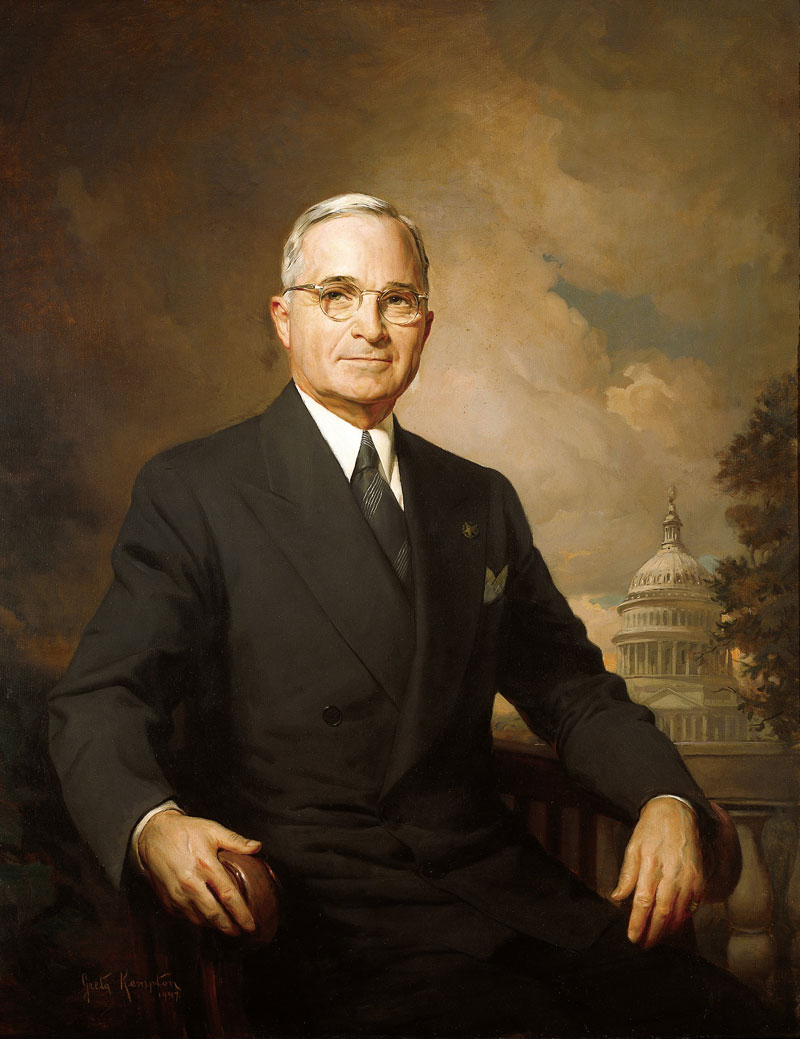
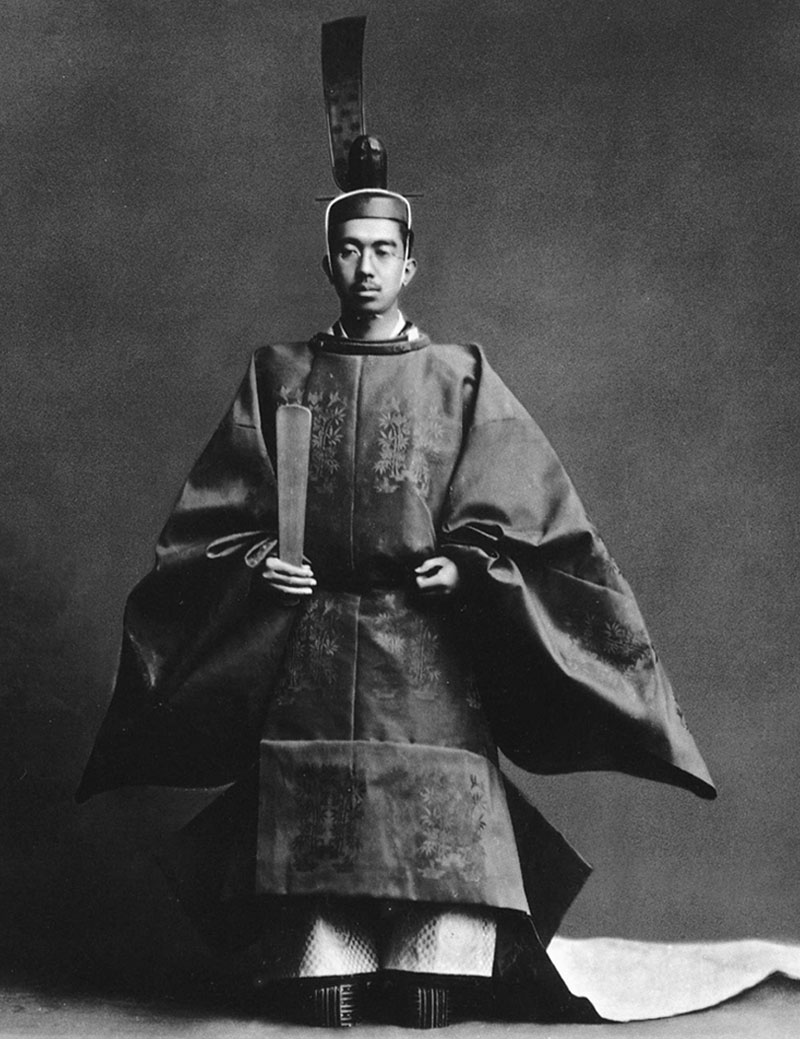
The Americans were aware that Japanese Emperor Hirohito was interested in finding a diplomatic solution to end the war. The Joint Chiefs in Washington, D.C. remained unconvinced that the more hard-line military leaders of Japan were not determined to fight it out to the last Japanese standing. While the atomic bombs that were developed over the previous three years were on their way to Tinian Island in the Marianas, the decision makers at the Pentagon weighed the issues attendant to using such imprecise weapons that would kill many more civilians than military personnel, regardless of the military value of Hiroshima, Nagasaki, and the other potential targets.


Harry S. Truman (1884-1972) was the 33rd president of the United States, serving from 1945 to 1953


Emperor Shōwa (1901-1989)—commonly known in English-speaking countries by his personal name Hirohito—was the 124th emperor of Japan, ruling from 1926 until his death in 1989

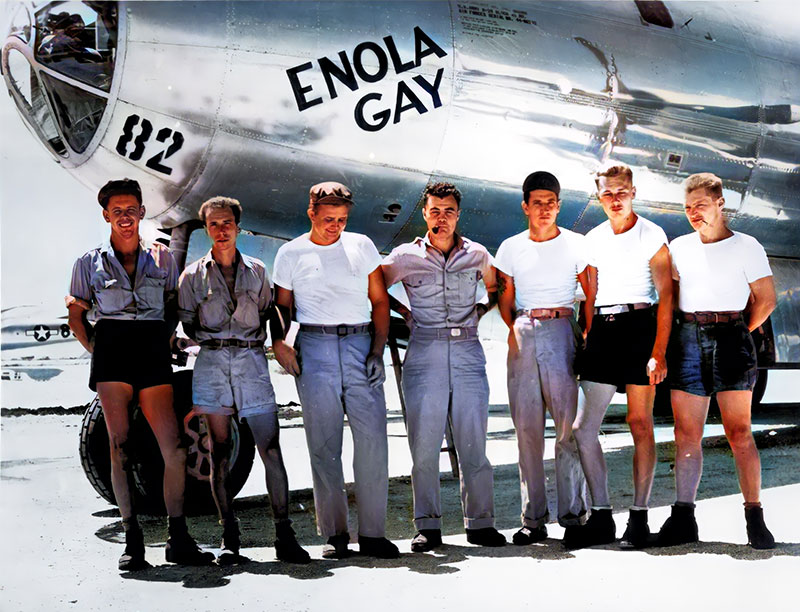
In the end, President Harry “the buck stops here” Truman gave the go-ahead to drop the bombs, accepting responsibility for the consequences. Theodore “Dutch” Van Kirk, the navigator of the Enola Gay (the B-29 Superfortress that carried the nuclear bomb “Little Boy,”) told me personally that he had no qualms whatsoever, then or now, dropping the weapon on Hiroshima on that fatal day, which killed immediately upwards of 66,000 Japanese, mostly civilians, mostly women and children. Probably more than 20,000 more died lingering deaths from the nuclear fallout. His rationale was that it saved many more American lives by preventing the necessity of invading mainland Japan, a sentiment shared by every World War II veteran I have ever met. Nonetheless, the “pragmatic” decision has become, over the years, one of the most controversial in all military history.

The Enola Gay and some of her crew—Theodore “Dutch” Van Kirk is third from left
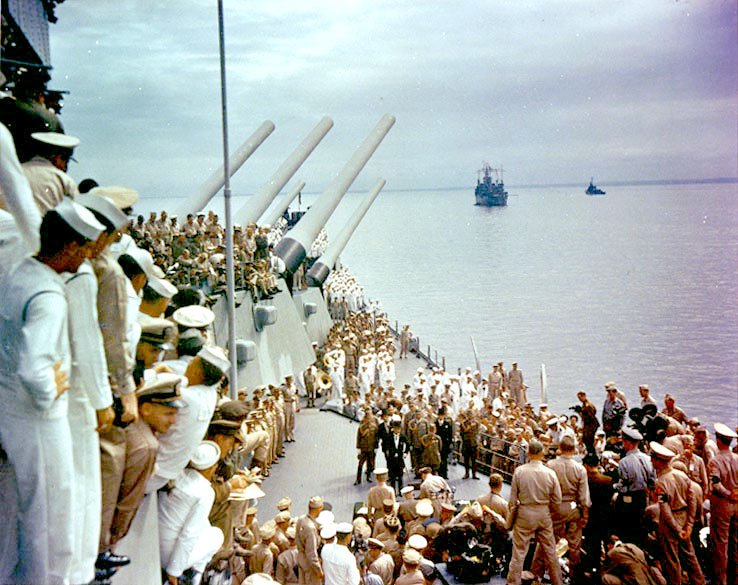
After the second bomb was delivered on Nagasaki, Japan agreed to the American terms of surrender. The President, a Missouri native, chose the USS Missouri, one of the newest American battleships, as the site for the formal signing of the surrender documents. Lieutenant Commander James Starnes—at age 24, the youngest navigator of a capitol ship in the U.S. Navy—through a series of providential circumstances held that position when the Missouri entered Tokyo Bay. He discovered that among his duties was Officer of the Deck, responsible for ceremonial occasions from 8:00 to 12:00 Noon! He told me in an interview in 2007 that he searched out the tallest and biggest men in the Missouri crew to form an honorary guard gauntlet for the Japanese dignitaries (typically slight in stature), generals and diplomats, to walk between as they were piped on deck; a not-so-subtle message for the former enemies to witness. A flyover by hundreds of bombers and fighter planes “that darkened the sky at three hundred feet,” reinforced the impression of American military might.


A Japanese delegation arrives aboard the USS Missouri as her crew looks on.

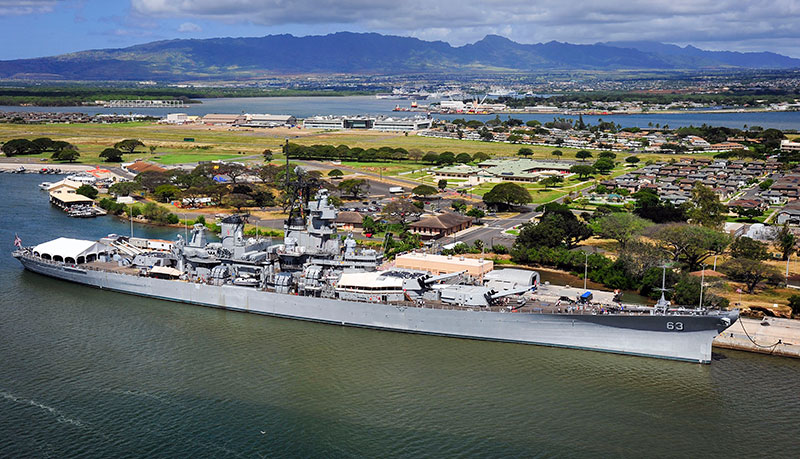
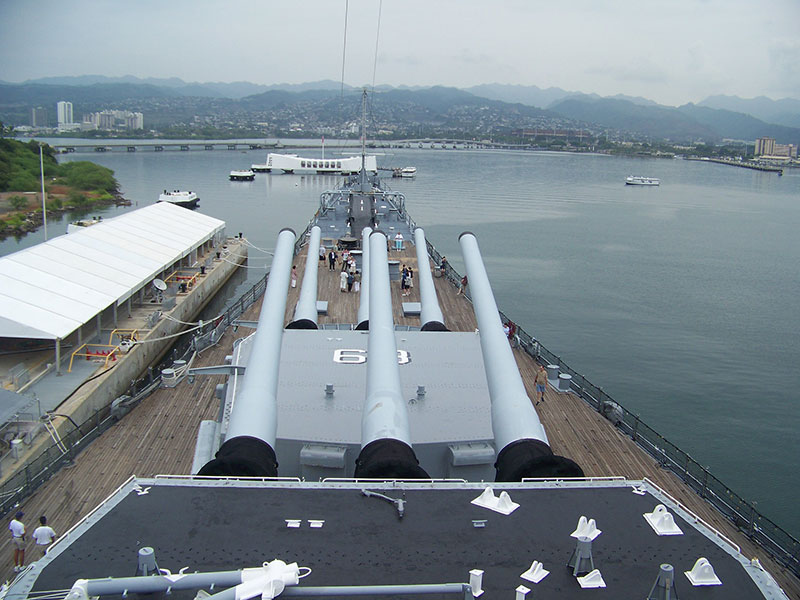
General Douglas MacArthur, Admiral Chester Nimitz, and representatives of nine Allied Nations awaited General Yoshijiro Umezu, Chief of the Japanese Army General Staff, and Foreign Minister Mamora Shigamitsu, and their entourage, who signed the surrender document, now housed at the National Archives in Washington, D.C. It was last displayed in public in 2015. The ceremony aboard the battleship lasted 23 minutes and was broadcast throughout the world. The flag that flew on the Missouri is at the United States Naval Academy Museum in Annapolis. The USS Missouri is anchored at Brown’s Island at Pearl Harbor and is a floating historic site that tells the story of the ship’s service in the Second World War, and especially, the surrender ceremony that made it one of the most famous ships in history. “Dutch” Van Kirk died in 2014, age 93 and Jim Starnes followed him in 2016, age 95, both living out their final years in peace at Stone Mountain, Georgia.


The USS Missouri watching over the sunken USS Arizona in Pearl Harbor, poignant representations of the beginning and the end of WWII for the USA


An aerial view of Pearl Harbor, showing the Battleship Missouri Memorial on Ford Island, Joint Base Pearl Harbor-Hickam and the Waianae Mountains


Resources for Further Study

  • For a detailed description of the surrender aboard the USS Missouri, see Surrender, September 2, 1945 by Lt Cmdr James L. Starnes, a short account of his service, based on interviews.

Thomas Watson’s Farewell, 1662

2022-08-15T14:11:34-05:00August 15, 2022|HH 2022|

“Preach the word; be ready in season and out of season; reprove, rebuke, exhort, with great patience and instruction. For the time will come when they will not endure sound doctrine.”
—II Timothy 4:2,3

Thomas Watson’s Farewell, August 17, 1662

Thomas Watson was one of the best known and most reprinted preachers in England’s history. On August 17, 1662 he preached his last sermon to the congregation he had served as pastor for the previous sixteen years, St. Stephens, Walbrook. Little is known of his early years or personal history, but we assume his birth around 1620 in Yorkshire. He first appears as a student at Emmanuel College, Cambridge, where tradition says he was an intense scholar, completing his Master of Arts in 1642. Watson’s life parallels in the same time period many famous Puritan preachers in Britain—John Owen, Richard Baxter, Thomas Brookes, John Bunyan, Robert Traill, Samuel Rutherford, and many others of note.
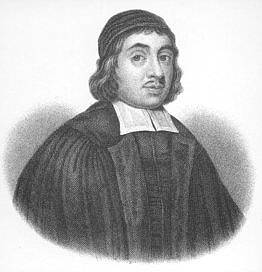
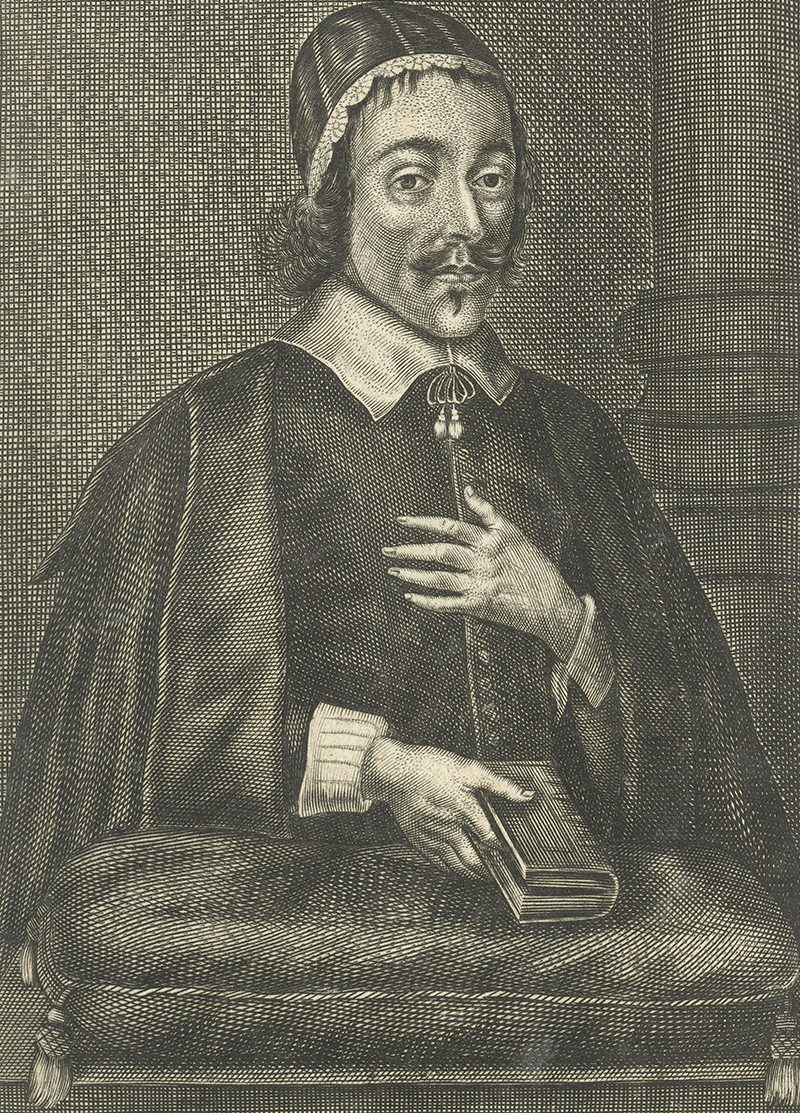
Thomas Watson (c. 1620–1686)


Emmanuel College Chapel, Cambridge

Watson began his ministry in the household of Lady Mary Vere, the widow of Sir Horace Vere, baron of Tilbury. Calling a young minister to preach and teach in a nobleman’s estate gave a young man his first experience in the ministry as well as a steady income and confirmation of his divine calling. Sometimes, in days of persecution, private ministry was a means of protection from government interference. In 1646 he accepted the very public call to St. Stephens. His ministry reached far beyond his own congregation as his sermons were often published and series became books. His erudition, simplicity, and practical applications are still helpful and eagerly studied among Reformed preachers to this very day. Watson was beloved and oft quoted by that “prince of preachers,” Charles Haddon Spurgeon, in the 19th Century.


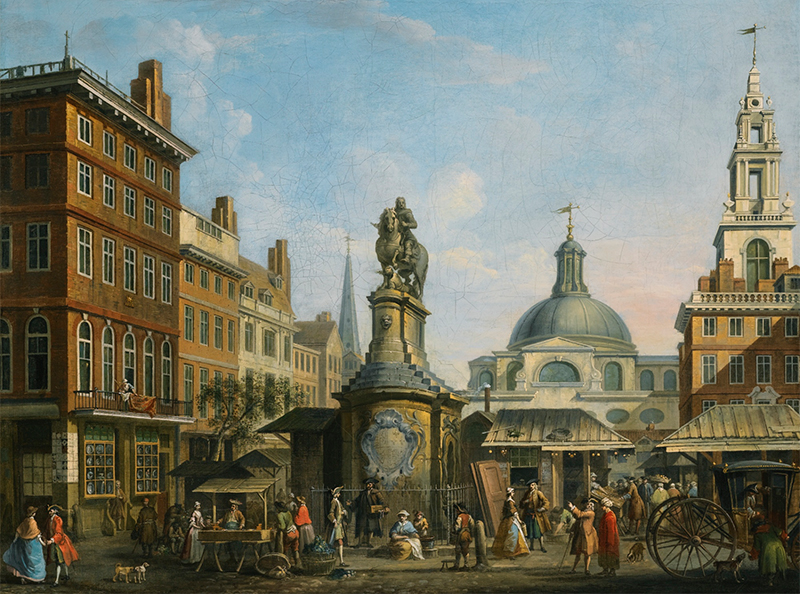
The former Stocks Market in central London showing St Stephen Walbrook church in the back right of the painting, as well as a statue in the forefront of King Charles II mounted on a horse and trampling Oliver Cromwell

The First English Civil War erupted as a struggle between Parliament and King Charles I, in the year that Watson finished his degree at Cambridge. By the time he accepted the call to St. Stephens, the King had lost the war and was held for disposition by Parliament and the army. Watson married at that time, the daughter of another pastor, and over his lifetime had seven children. The harmony and accord of the Westminster Assembly which had produced the Westminster Confession of Faith by 1647, masked the party spirit that divided the kingdom politically, over the next several years. The Scots and the presbyterian party in Parliament, including a number of Puritan divines, Watson among their number, believed the King should be restored, but without authority to dictate to the church how they should conduct the worship of God.


Christopher Love (1618-1651), Puritan minister executed by Parliament in 1651 for his support of the restoration of Charles II

Watson appeared before Oliver Cromwell, the head of the Army, to protest the execution of Charles I. In 1651 Watson was arrested and imprisoned with several other pastors for corresponding with Charles II, hoping to restore the monarchy. The Parliament executed Pastor Christopher Love for treason, but pardoned Thomas Watson upon his petition for mercy. He returned to his ministry in Walbrook in 1652, and gained great renown for his preaching and teaching for ten more years. Watson was among the 2,000 ministers ejected from their pulpits in 1662 for rejecting the Act of Uniformity issued by Charles II. Ironically, the very King with whom Watson had conspired to return the throne to the Stuart monarchy, forced the Anglican Prayer Book and liturgy on all the churches.


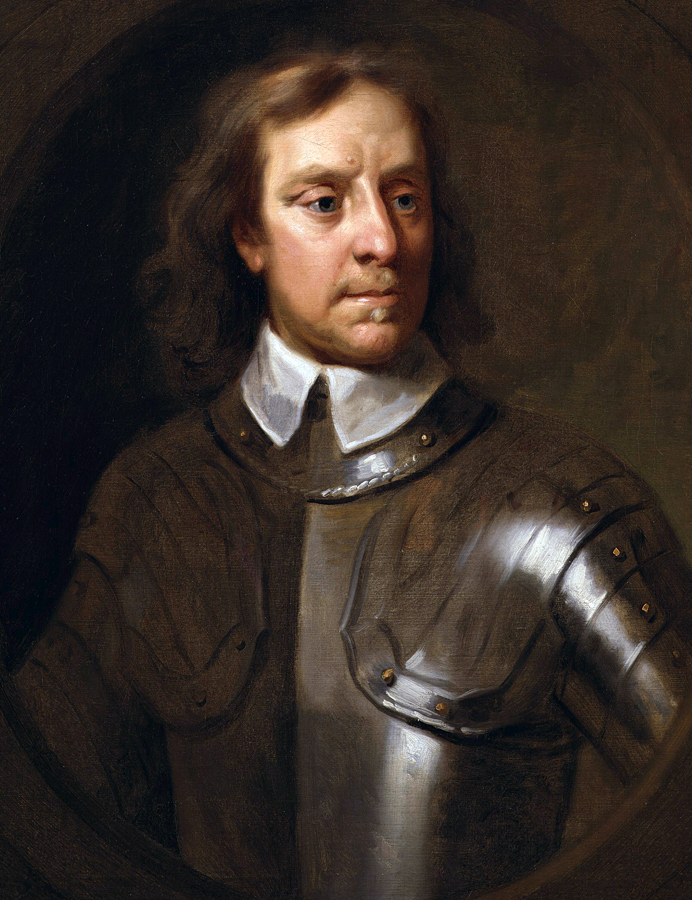
Oliver Cromwell (1599-1658)


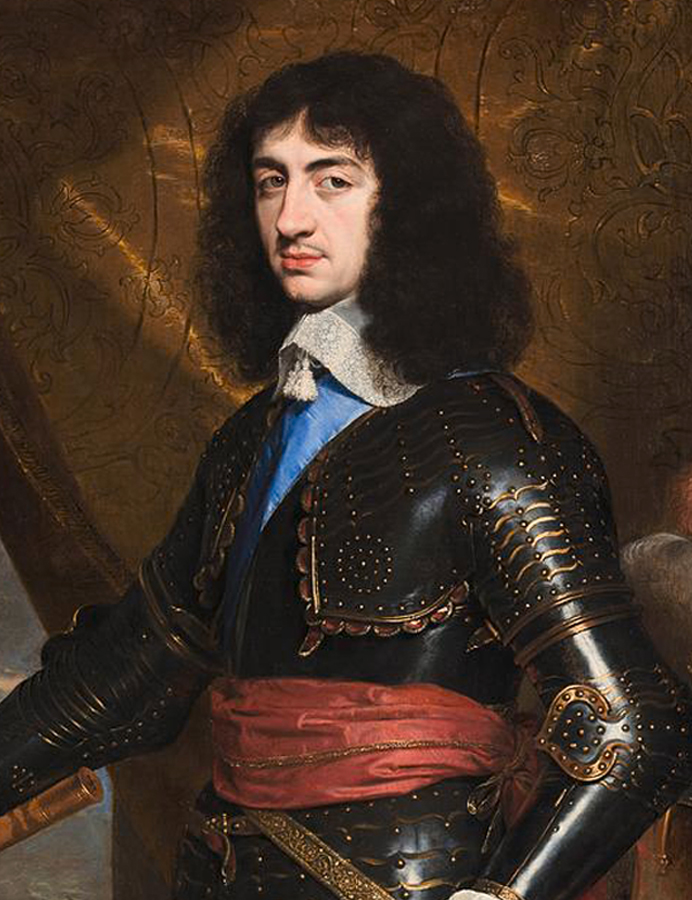
Charles II (1630-1685)

Watson preached several farewell sermons to his congregation before his ejection the third week of August, 1662. Among his last words to his beloved people were these:

“Every day think upon eternity. Oh, eternity, eternity! All of us here are, ere long—it may be some of us within a few days or hours—to launch forth into the ocean of eternity….The thoughts of eternity would make us very serious about our souls….Oh how fervently would that man pray that thinks he is praying for eternity. Oh how accurately and circumspectly would that man live who thinks that upon this moment hangs eternity….The thoughts of eternity would keep us from grieving overmuch at crosses and sufferings of the world. Our sufferings, says the apostle, are but for a while. What are all the sufferings we can undergo in the world in comparison with eternity? Affliction may be lasting, but it is not everlasting. Our sufferings are not to be compared to an eternal weight of glory.”


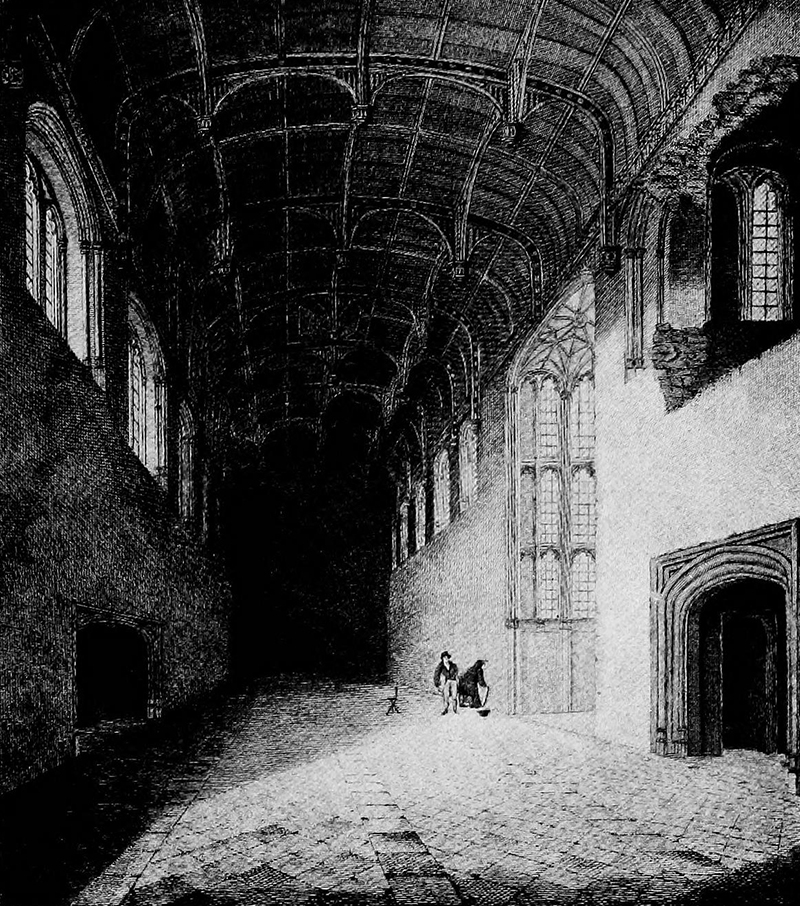
Crosby Hall, where Watson held services for some time following the Declaration of Indulgence

Watson continued to preach secretly in private for ten years—in barns, homes, and woods. After the Great Fire of London in 1666 he prepared a large room for public worship and welcomed all who wished to attend, risking fines and imprisonment. With the Declaration of Indulgence in 1672, Watson, one of the best known nonconformists, obtained a license for “Crosby Hall” and continued to preach. He was joined by Stephen Charnock for several years. He died in Barnston in 1686 while in earnest prayer, a practice for which he was well known, even by Anglican bishops! He was buried there beside his father.


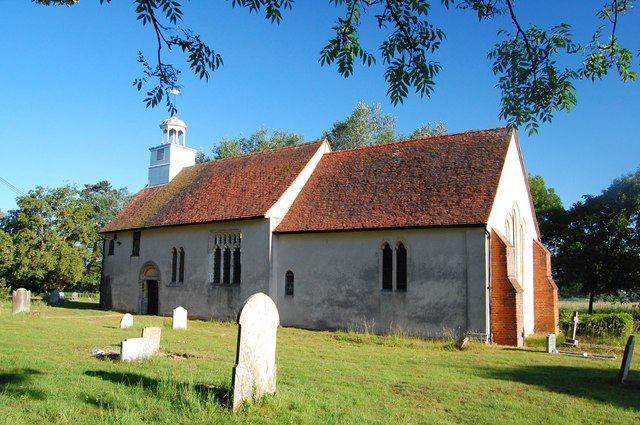
The church and churchyard of St. Andrews in Barnston, Essex

Thomas Watson’s books and sermons have remained among the favorites of both pastors and laymen who have read and studied the best of the Puritan fathers of the 17th Century, especially his works on The Lord’s Prayer, The Ten Commandments, and The Beatitudes, as well as particular individual sermons. Watson will likely be read as long as there are faithful Reformed pastors.


Resources for Further Study

President Without Receiving a Single Vote, 1974

2022-08-10T10:10:24-05:00August 10, 2022|HH 2022|

“…let us set a king over us like all the nations around us…”
—Deuteronomy 17:14

President Without Receiving a Single Vote,
August 8, 1974

In listing the American Presidents in order, the one left out most often in the 20th Century is Gerald Ford. Part of the reason may be that he conducted no campaign to become either President or Vice President, nor did he receive a single vote to obtain that office. His achievement could only have occurred the way it did. Some people today think the United States may experience a similar outcome though for different reasons with the current holder of the highest office in the land.
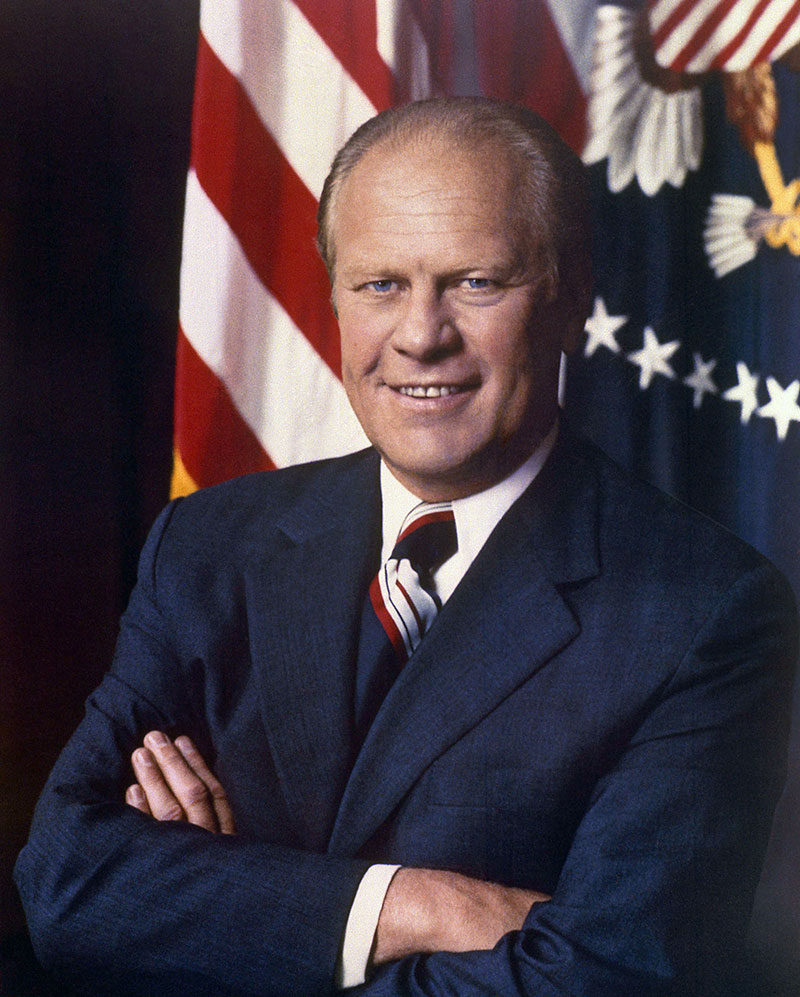
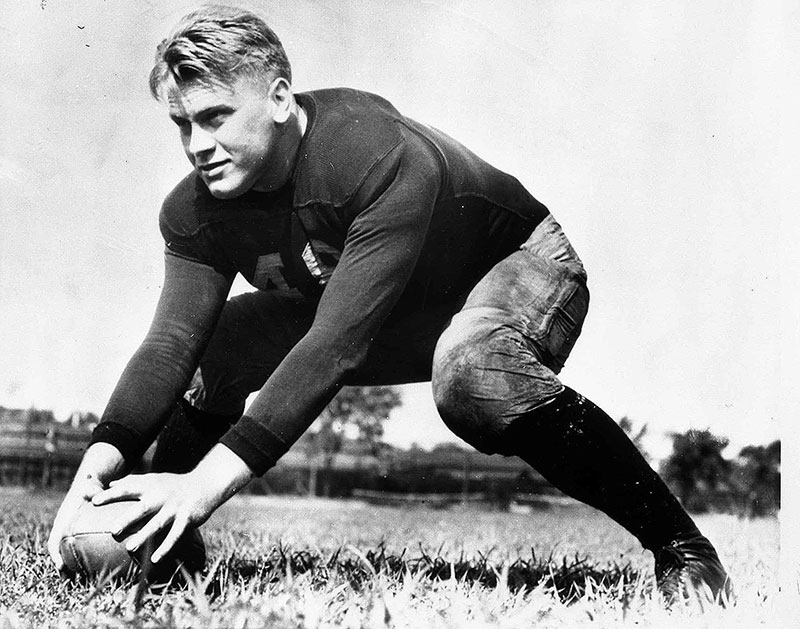
Gerald Rudolph Ford, Jr. (born Leslie Lynch King, Jr., 1913-2006)

Leslie Lynch King, Jr. became Gerald R. Ford, formally, at the age of 22 in 1935. His mother had left Mr. King years earlier for spousal abuse, and moved from Omaha, Nebraska to Illinois, to Grand Rapids, Michigan, where she married Gerald Rudolff Ford, a salesman for a paint and varnish company. Her son Leslie from then on took his step-father’s name. He grew up with three step-brothers: Tom, Dick, and Jim. Gerald Ford achieved Eagle Scout, the only American President to do so. His outstanding athletic prowess and leadership achieved him captaincy of the football team, election to all-star teams, and a stellar career at the University of Michigan. He helped lead his team to two national championship and his team members voted him as MVP. Upon graduation with a degree in economics, Ford rejected pro football contracts in favor of attending law school at Yale, and coaching there.


Ford (then Leslie King) and his mother, Dorothy Ayer King, on his baptism day


Ford on the field for the University of Michigan football team, 1933

Immediately after the attack on Pearl Harbor, Ford enlisted in the Navy, commissioned as an ensign, and coached all nine sports offered at Navy Pre-flight School, as well as teaching navigation, ordnance, gunnery, and first aid. By the time he went to sea, Gerald Ford was a lieutenant. Among his service accomplishments was saving his aircraft carrier—the USS Monterey—during the typhoon that sank three destroyers with the loss of 800 men. His ship caught fire when planes broke loose and started fires amidships. As Officer of the Day, Ford fought his way to the hangar deck and took charge of the situation, saving the ship and the crew.


The aircraft carrier USS Montere

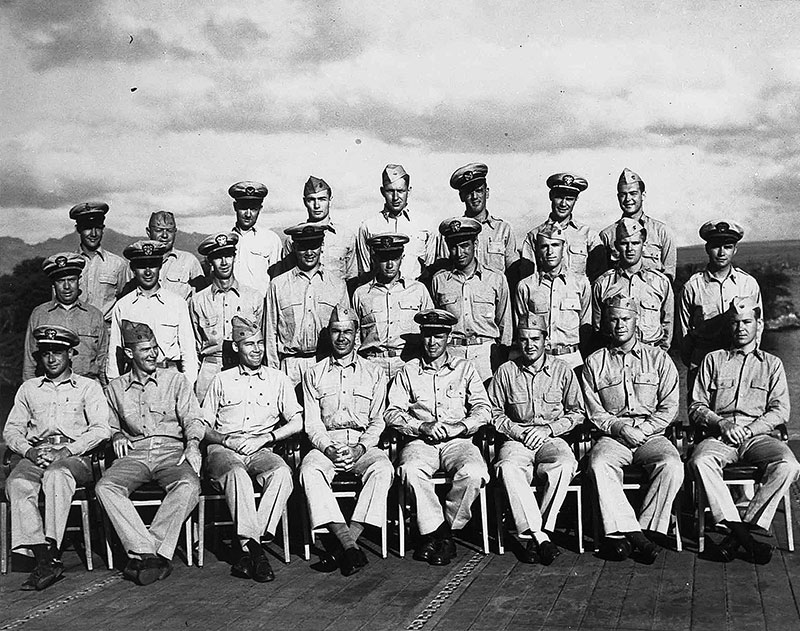
The gunnery officers of the USS Monterey; Ford is second from the right, in the front row
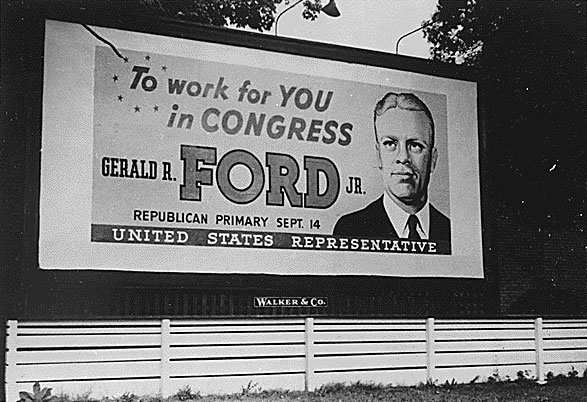
Ford was elected to the United States House of Representatives in 1946 as a Republican and served there for twenty-five years, turning down offers to run for the Senate and for Governor of Michigan. His negotiation skills and work to conciliate conflicting opinions won the respect of all his colleagues in the House. Ford was a “moderate” in domestic policy and an internationalist in foreign policy, fighting against states’ rights, but also helping blunt Lyndon Johnson”s big government “Great Society” programs. He voted for all of the Democratic Party’s “civil rights” programs. He angered Johnson with his opposition to the Vietnam War—the President said Ford had played too many football games “without his helmet.”


A 1948 Michigan billboard for Ford’s campaign for US Representative

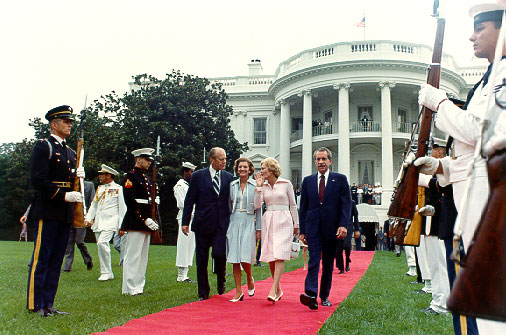
Ford had a pleasant personality, was non-confrontational and known for fairness, winning plaudits and developing friendships on both sides of the aisle. His greatest political power came with fellow Republican Richard Nixon in the White House. In 1973, the conservative Vice President, Spiro Agnew, resigned over criminal charges of tax evasion and money laundering, and the party leaders insisted that Nixon choose Ford as the new Vice President, a position the Michigan Congressman accepted and appreciated. The following year, President Nixon was hounded out of office by the mass media and the Democratic Party leadership, impeached and vilified with unprecedented hatred unleashed by his adversaries. The man who had won the office in a landslide resigned the Presidency (the first in history to do so), and Vice President Ford became President of the United States on August 8, 1974 without ever running for either office—an utterly remarkable turn of events.

Gerald and Betty Ford escort Richard and Pat Nixon from the White House to a waiting helicopter on August 9, 1974, following Nixon’s resignation from the presidency

The swearing in of President Gerald Ford by Supreme Court Chief Justice Warren Burger, with Mrs. Ford looking on

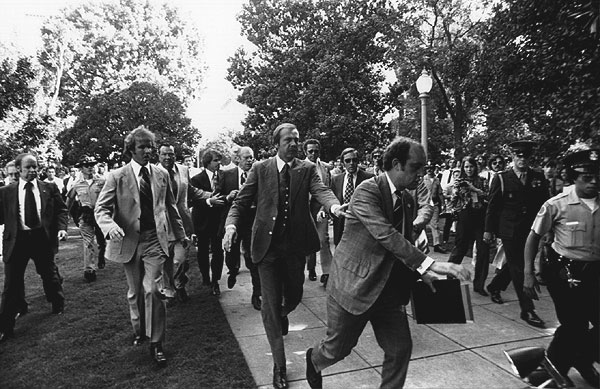
Ford chose the liberal Governor of New York, Nelson Rockefeller, as Vice President, angering the conservative Republicans, and not for the first time. His time in office included issuing amnesty for draft dodgers, support for abortion rights and outspoken support of the “equal rights amendment” which failed to pass. With the advent of the “swine flu epidemic”, Ford urged every American to be vaccinated. He resisted billions in aid to Israel and faced powerful resistance from men of both parties. The media portrayed him as a clumsy oaf and klutz, the exact opposite of his actual life. He was the target of two failed assassination attempts. A number of his fiscal policies reflected his more conservative instincts in economics.


Following the September 5, 1975 assassination attempt, Secret Service agents rush President Ford towards the California State Capitol in Sacramento

Most historians consider Ford’s Presidency a failure, but his pardoning of Nixon would have gotten him that rating all by itself. He lost the 1976 election to Jimmie Carter of Georgia, in a close electoral vote. The athletic Michigan Congressman turned President lived to be more than 93 years old, surpassed by the man who defeated him, Jimmie Carter, who is currently 97. Citing the Ford Presidency, there are some pundits who foresee the current Vice President Kamala Harris getting bought off to resign, President Biden choosing someone like the Governor of California, Newsome to be Vice President, then Biden resigning due to health problems. Voilá! An unelected president devoted to the Californiazation of the United States! Where is Gerald Ford, or Jimmie Carter for that matter, when you need him?


President George W. Bush and Laura Bush pose with former President Gerald R. Ford and wife Betty Ford during a dinner in honor of President Ford’s 90th birthday at the White House, July 16, 2003


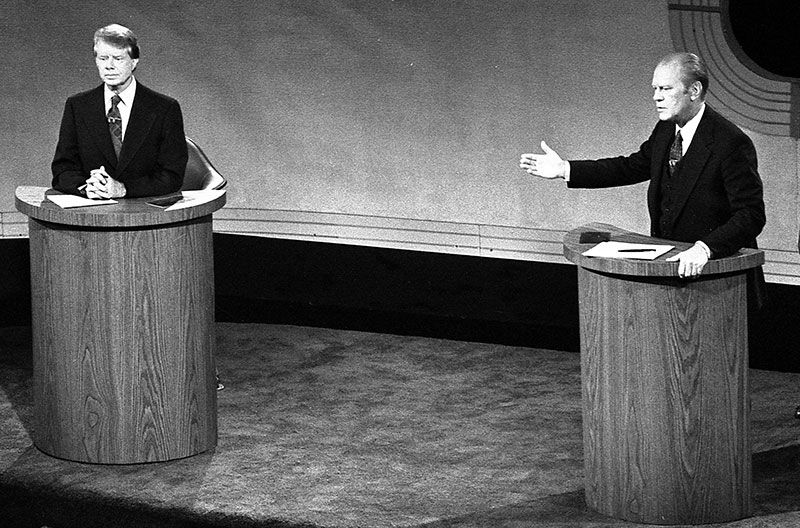
Jimmie Carter (left) and Gerald Ford (right) during the 1976 Presidential Debates

Decree Expelling Jews from Spain Goes into Effect, 1492

2022-08-01T19:49:09-05:00August 1, 2022|HH 2022|

“For I know the plans I have for you,” declares the LORD, “plans to prosper you and not to harm you, plans to give you hope and a future.” —Jeremiah 29:11

Decree Expelling Jews from Spain Goes into Effect, August 2, 1492

“In 1492 Columbus sailed the ocean blue,” we learned in our earliest days in school. Leaving aside that the little rhyme to get children to remember the year Columbus “discovered America,” the doggerel now triggers the sensitive but ignorant imbeciles that consider “Admiral of the Ocean Sea,” Christopher Columbus, as the white supremacist perpetrator of a holocaust in the New World. It just so happens that another event, perhaps more important than the exploration of C. Columbus, took place the same year in the same country: the expulsion of the substantial Jewish population of Spain. The action created another Jewish diaspora that changed history.
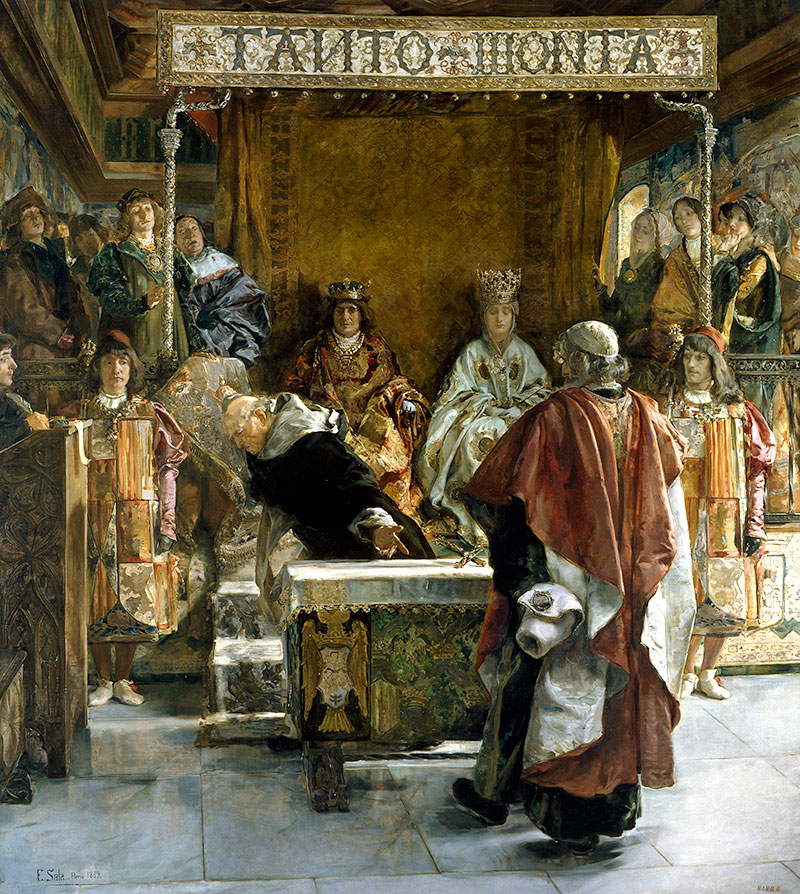
The Grand Inquisitor Tomás de Torquemada offers to the Catholic Monarchs, Ferdinand and Isabella, the Edict of Expulsion of the Jews from Spain for their signatures, 1492

After the fall of the Roman Empire, Hispania (the Iberian Peninsula) was conquered by the Teutonic tribe known as the Visigoths, around A.D. 476. They adopted a form of Christianity and held political sway until they were in turn overrun by the Islamic Empire in North Africa in 711, who took advantage of the political unrest and divisions of the Spanish kingdom. The Muslims failed to conquer the Basques and held Galicia, the extreme northwest, for only twenty-eight years. The City of Granada, however, became an Islamic stronghold for 781 years. Throughout the Islamic Caliphate, Jews and Christians paid tributes and taxes to their Muslim overlords, and were, in turn, allowed to practice their faith.


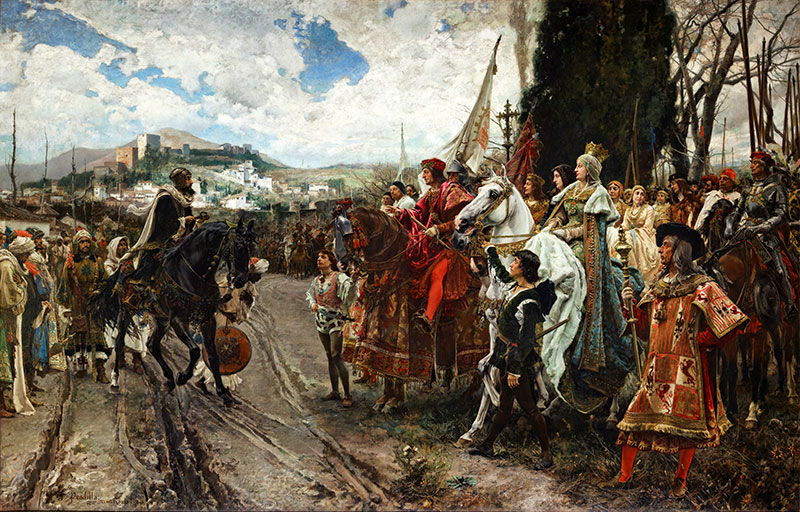
The last Muslim king of Granada, Abu Abdullah Muhammad XII, hands over Granada, the last stronghold of Muslims in Andalusia, to the Catholic Monarchs Ferdinand II of Aragon and Isabella I of Castile

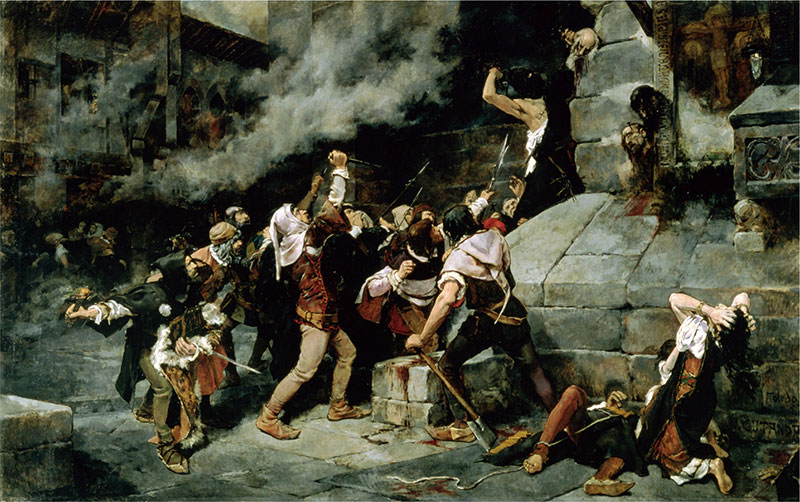
In the 12th and 13th Centuries the Roman Church countenanced within its pale certain anti-Jewish movements, passing laws restricting rights and looking the other way when persecutions arose. The 14th Century brought wars and the bubonic plague, spelling the end of relative tolerance of Jews by the Catholic Church. In the Kingdom of Navarre in 1321, Jews were massacred in two towns when the “Shepherd’s Crusade” crossed the Alps into Spain. In the 1340s, Jews were blamed for the Black Death, and were massacred in Barcelona and Catalonia. On several other occasions in the century, synagogues were burned and Jews cut down in other cities in Spain, sometimes as a result of “political and economic unrest” sometimes as scapegoats for diseases or other social disruptions. The Talmud was outlawed, Jews were forced to attend Mass. Required conversions and baptisms characterized persecution in Castile and Aragon in the early 1400s. Throughout the century, “conversos” were looked upon with suspicion, since their conversions were coerced.


‘At the Feet of the Savior’ depicts a massacre of Jews in Toledo, Spain—one of many similar massacres during the Middle Ages

The Kingdoms of Aragon and Castile combined their political dominance with the marriage of teenage cousins Ferdinand and Isabella in 1469. Some Jews who were baptized as Christians, the conversos, continued to worship God in their old way secretly, others moved to the countryside to avoid the crack-downs in the cities. In the Court of Castile, Jews held prominent administrative and financial positions. The Queen protected her Hebrew subjects and their worship was permitted, but such was the not the case in most Spanish states. In 1478 the Pope assigned members of the “Holy Inquisition” to Spain to investigate and prosecute converts who reverted to Judaism or attempted to worship in secret. In twelve years, the Inquisition condemned 13,000 for the secret practice of Judaism. One historian claims the Inquisition burned 32,000 heretics to death in Spain. Ferdinand and Isabella still continued to try and protect the Jews of their kingdoms, until 1492. They tried to isolate the Jews in ghettos to better avoid persecution, but enforcement of both protective measures and restrictions were ineffective.


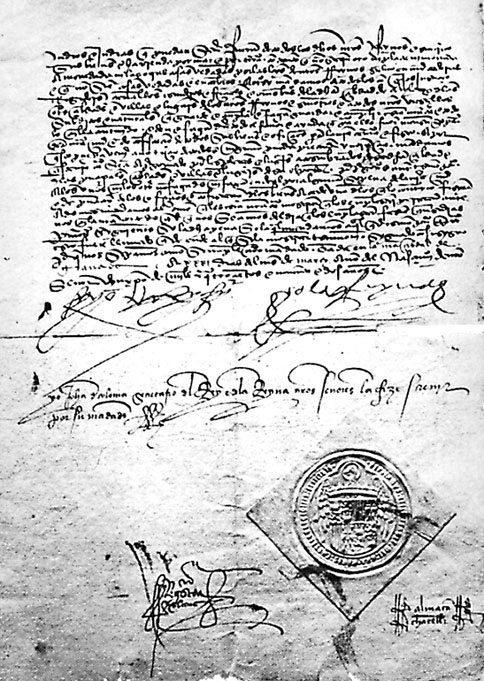
A sealed copy of the Edict of Granada (also known as the Alhambra Decree, or Edict of Expulsion), was issued in 1492

After the final expulsion of the Muslims in the War against Grenada in 1492, Ferdinand and Isabella signed the decree of expulsion of the Jews of Grenada, to go into effect on August 2, 1492. The Inquisitor General Thomas de Torquemada played a key role in the royal decree. The Jews were not allowed to take gold or silver, horses or arms with them, or ever return to Spain. Christians who helped Jews hide or violate other rules would be subject to the loss of all their property also. The opportunity to abandon their faith and become Catholics was still offered as an option, and the preaching of “the holy Gospel and the doctrines of holy Mother Church” went forth across Spain. Perhaps half the Jews chose to convert, including many rabbis.


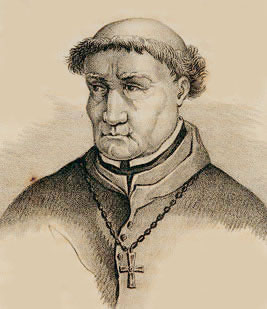
Tomás de Torquemada (1420-1498), Grand Inquisitor of the Spanish Inquisition


Expulsion of the Jews from Portugal, 1497

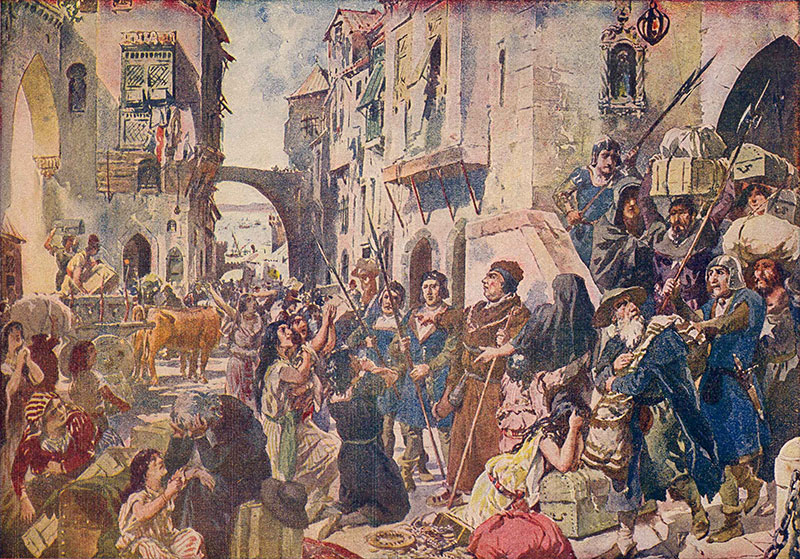
No one actually knows how many Jews left Spain. Estimates range from 40,000 to 800,000. They would ever be known as Sephardic Jews. Technically, there were none left in Spain, but it is well known that many went underground with their religion there and the search for them continued for another century. Many of the diaspora of Spain settled in Portugal, from where they were expelled four years later into Italy, North Africa, Navarre, the Balkans, Holland, and the Middle East. Historians have noted that the expulsion of the Jews of Spain took place in the same month as the destruction of the Temple and exile to Babylon and the destruction of the Temple in Jerusalem in 70 A.D.


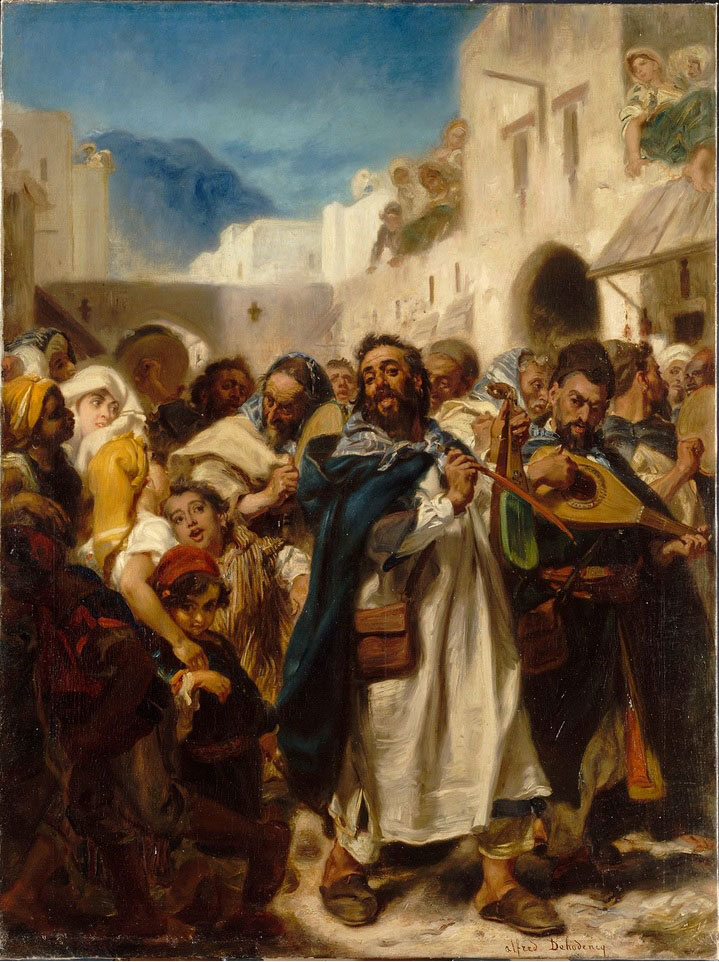
A Jewish festival in Tetouan, Morocco

Over time, the Sephardic Jews assimilated in the countries they arrived in. Among them were successful traders, authors, economists, philosophers, businesspeople, famous architects, and wise and resourceful rabbis. Among the descendants of the Sephardic diaspora of Spain and Portugal are the philosophers Spinoza and Karl Marx, British Prime Minister Benjamin Disraeli, French writer Montaigne, American super-lawyer Alan Dershowitz, humorist Jerry Seinfeld, and many others of note. Like the exiled Huguenots of France, what persecutors intended for evil, God had other unknown powerful providential plans.

Go to Top